






Starter
JAXA Statistics: The Japan Aerospace Exploration Agency (JAXA) has made significant strides in space exploration during 2025 and 2026. In 2025, JAXA recorded four major spacecraft launches, including the final H‑IIA Flight No.50 carrying the GOSAT‑GW satellite on June 29, 2025, and the H3 Flight 7 (H3 F7) launching the new HTV‑X1 cargo vehicle to the International Space Station from Tanegashima Space Center on October 26, 2025.
Additionally, while the Marshall Green Award was presented to JAXA and NASA in 2024, in 2025 the Japan‑America Society of Washington, DC honored a different recipient (Charles D. Lake II), and JAXA and NASA continued their cooperation through joint missions such as QZSS satellites and HTV‑X1 resupply flights rather than a new joint award.
Furthermore, JAXA organized and participated in multiple aerospace events in 2025, including the 35th Workshop on JAXA Astrodynamics and Flight Mechanics (July 28–29, 2025) and aircraft/aviation symposia under JSASS, complementing Japan’s presence at Expo 2025 Osaka and ongoing international aerospace exhibitions.
The Ultimate Picks
- The Japan Aerospace Exploration Agency (JAXA) was founded on October 1, 2003, and celebrated 21 years of establishment at the end of 2024.
- In 2015, JAXA became a National Research and Development Agency.
- JAXA was established through the merger of three organizations: the National Space Development Agency of Japan (NASDA), the Institute of Space and Astronautical Science (ISAS), and the National Aerospace Laboratory of Japan (NAL).
- JAXA is supervised by the Ministry of Education, Culture, Sports, Science and Technology and the Ministry of Internal Affairs and Communications (MIC).
- In fiscal year 2025, JAXA’s initial budget amounted to about 154.5 billion Japanese yen roughly USD 1.0 billion.
- In the same fiscal year, JAXA continued to report strong results from its space project segment, with operating income supported by major missions such as GOSAT‑GW on the final H‑IIA flight and the inaugural HTV‑X1 cargo flight on H3 F7.
- This segment includes activities such as satellite operations, space transportation systems, space science and exploration, and human space activities.
- As of June 28, 2025, the H‑IIA launch vehicle had flown 50 times with 49 successful launches, corresponding to a 98% success rate and completing a streak of 44 consecutive successful missions from 2003 to 2025.
- JAXA has planned to reach 50 H-IIA Flights by the end of 2025.
- On January 20, 2024, JAXA successfully landed the Smart Lander for Investigating Moon (SLIM) at 0:20 a.m. JST.
- In 2025, lunar exploration preparations continued toward the Lunar Polar Exploration Mission (LUPEX) launch scheduled for December 11, 2025, extending Japan’s planetary exploration portfolio.
- JAXA developed the Kibo module, which is the largest experiment module on the International Space Station (ISS).
- On its 10th anniversary in 2013, JAXA introduced the corporate slogan “Explore to Realize”.
- Following its establishment in 2003, the first launch of H-IIA No. 6 failed; however, subsequent H-IIA launches were successful.
General Japan Aerospace Exploration Agency Facts
- The JAXA is headquartered in Chōfu, Tokyo, Japan.
- JAXA uses the H‑IIA rocket as its former medium‑lift launch vehicle. By 2025, the H3 rocket has effectively taken over as Japan’s new mainstay launcher, succeeding both H‑IIA and H‑IIB, with multiple successful flights completed since its debut in 2023.
- Moreover, for smaller launches, JAXA uses the Epsilon rocket and the SS-520, S-520, and S-310 sounding rockets for experiments in the upper atmosphere.
- Active Fleet: JAXA boasts an impressive fleet of over 20 operational satellites, constantly gathering data and performing various missions.
- Earth Observation Satellites: JAXA is a leader in Earth observation. Their “GCOM” series of satellites, for instance, monitors weather patterns, climate change, and natural disasters.
- Scientific Spacecraft: JAXA ventures beyond Earth. Their “Hayabusa2” mission, for example, successfully collected samples from an asteroid and returned them to Earth for analysis, opening doors to studying the origins of our solar system.
- Global Partnerships: JAXA actively collaborates with international space agencies like NASA, ESA, and others. This teamwork allows for the sharing of resources and expertise, pushing the boundaries of space exploration further.
- International Space Station (ISS): JAXA is a key partner in the ISS program. The Kibo module, a Japanese contribution, serves as a vital research and experimentation facility onboard the station.
JAXA Organization
Japan Aerospace Exploration Agency is segmented into 7 different bodies and their specialization:
- Space Technology Directorate I: (Allows for developing launch vehicles)
- Space Technology Directorate II: (Earth-observing satellites in charge)
- Human Spaceflight Technology Directorate: (Maintaining and helping in running all crewed spaceflight programs)
- Research and Development Directorate: (performs technological innovations and improvements that are required for aviation and spaceflight)
- Institute of Space and Astronautical Science (ISAS): (Head of all scientific satellites)
- The Aviation Program Group: (is focused on new technologies for further aviation)
- Space Exploration Innovation Hub Center (TansaX): (enable exploration of the solar system)
JAXA by Regular Staff
(Reference: statista.com)
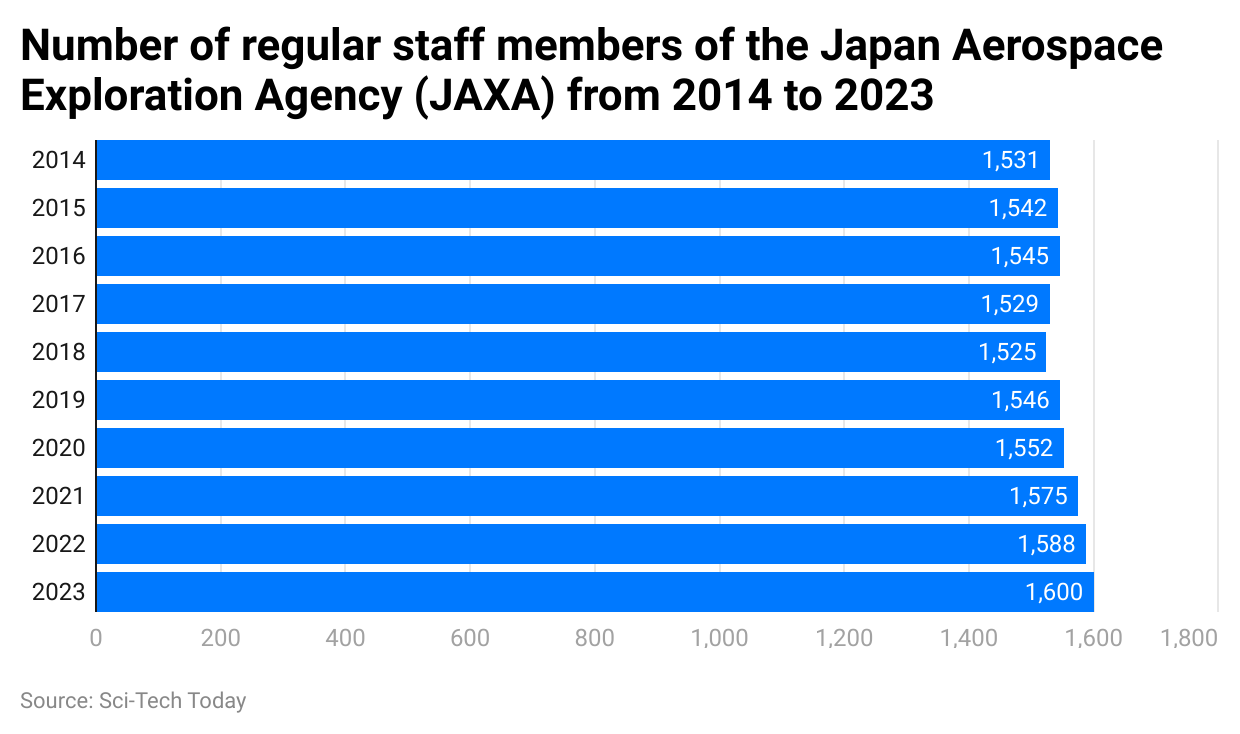
- A report published by Statista on JAXA Statistics mentioned that, as of April 2025, the Japan Aerospace Exploration Agency (JAXA) had around 1,660 regular staff members.
- The number of regular staff in JAXA was slightly lower in previous years, such as 2024 (around 1,640 estimated) and 2023 (1,600), continuing the gradual upward trend seen since 2014.
JAXA by Budget
(Reference: statista.com)
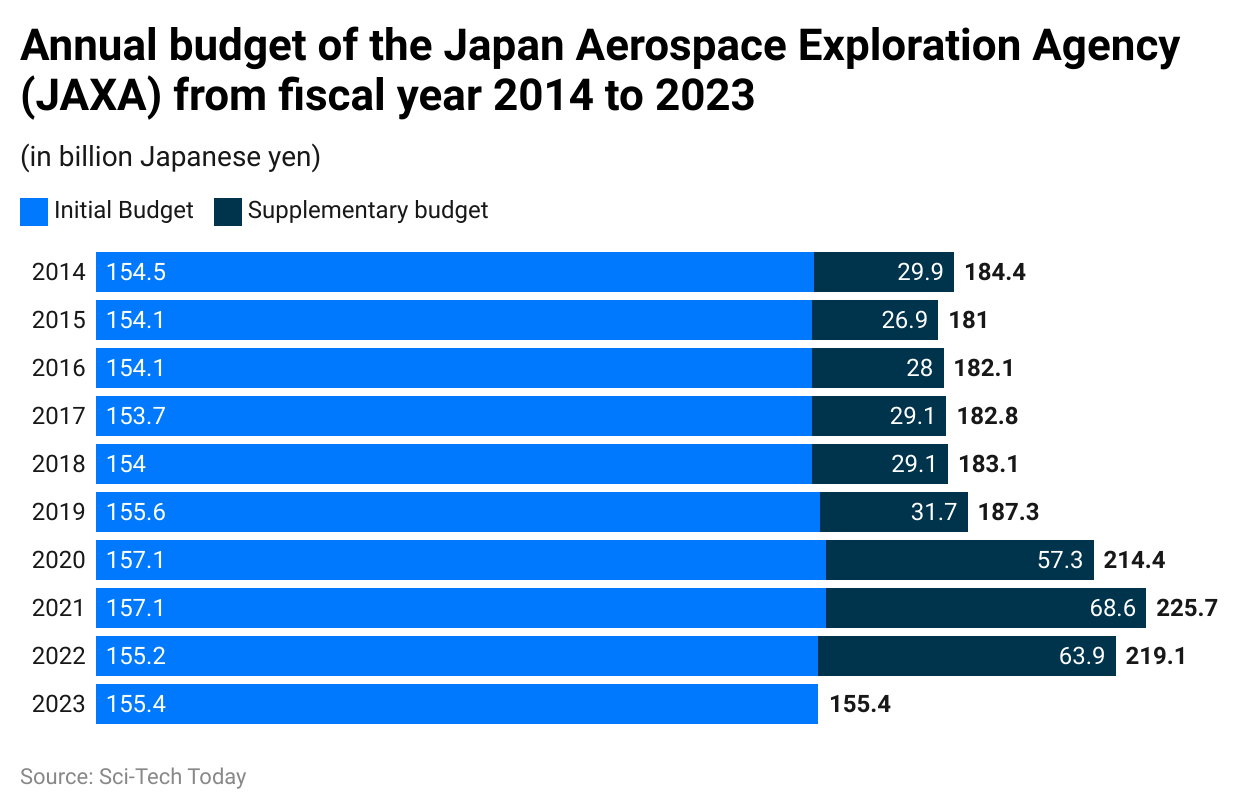
- Based on JAXA Statistics, the Japan Aerospace Exploration Agency’s initial budget was about 154.5 billion Japanese yen roughly USD 1.0 billion in fiscal year 2025, reflecting a slightly adjusted but still robust allocation for space and aeronautics.
- Meanwhile, the total space‑related budget in FY2025 under MEXT amounted to 151.6 billion yen, and a separate Space Strategy Fund phase and supplementary budgets added around 200 billion yen more for strategic space projects, mirroring the way the 2022 budget combined initial and supplementary allocations.
Total Number of Spacecraft Launches by JAXA
(Reference: statista.com)
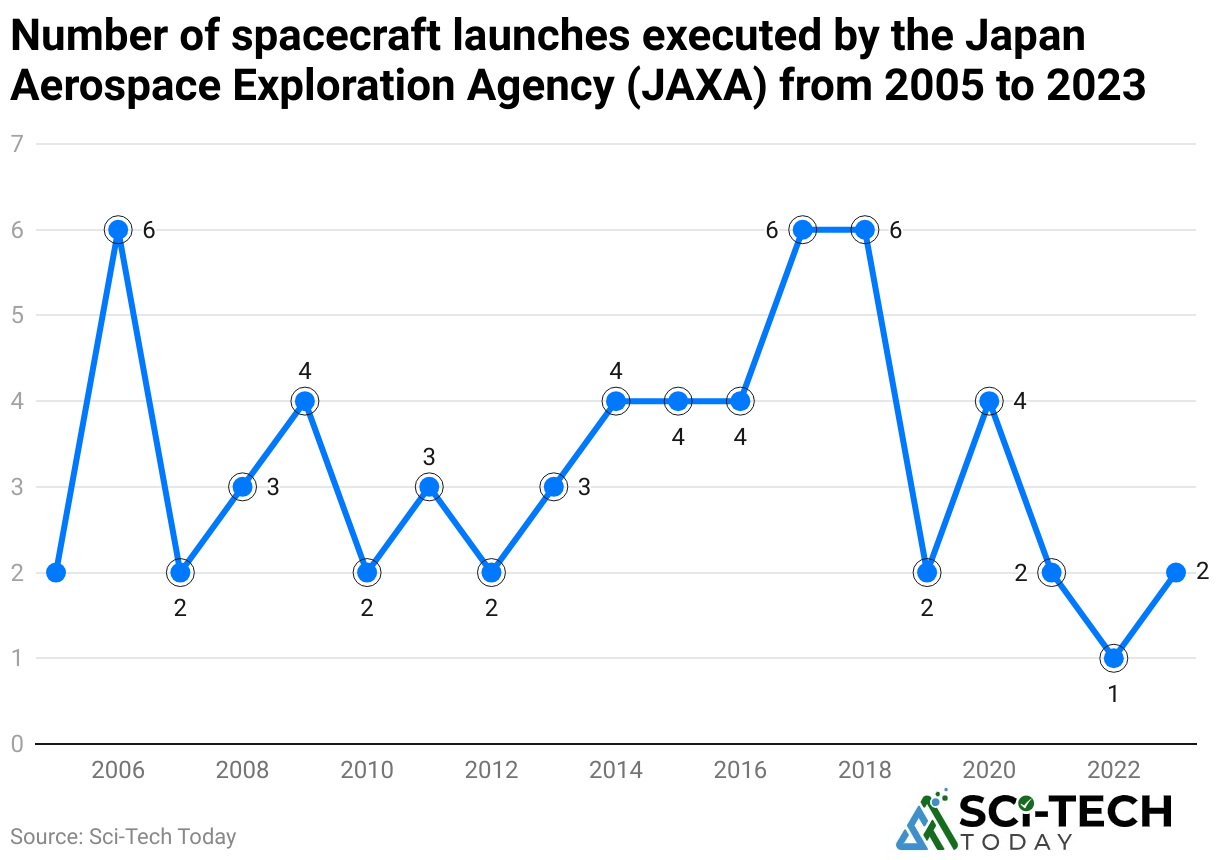
- By 2025, JAXA’s launch activity had stepped up to four notable spacecraft missions, including QZS‑6 on H3 F5, GOSAT‑GW on the final H‑IIA F50, the new HTV‑X1 cargo vehicle on H3 F7, and the RAISE‑4 technology demonstration satellite on an Electron rocket, reflecting a clear rise in annual mission count.
- Furthermore, from 2005 to 2021, the total number of spacecraft launches were 2005 (2), 2006 (6), 2007 (2), 2008 (3), 2009 (4), 2010 (2), 2011 (3), 2012 (2), 2013 (3), 2014 (4), 2015 (4), 2016 (4), 2017 (6), 2018 (6), 2019 (2), 2020 (4), and 2021 (2); continuing this history, 2022 saw 1 launch, 2023 saw 2 launches, 2024 added 3 launches, and 2025 reached 4 spacecraft launches.
JAXA’s Recent Milestones
- On February 2, 2025, JAXA launched the Michibiki 6 satellite aboard the H3 rocket from Tanegashima Space Center. This satellite is part of Japan’s Quasi-Zenith Satellite System (QZSS), enhancing regional navigation capabilities.
- February 2, 2025: H3-22S rocket launched the QZS-6 satellite into Geostationary Transfer Orbit (GTO).
- November 4, 2024: H3-22S rocket launched the DSN-3 payload into GTO.
- July 1, 2024: H3-22S rocket launched the ALOS-4 satellite into Sun-Synchronous Orbit (SSO).
- On March 17, 2025, JAXA announced the public availability of Level 2 cloud and aerosol observation data from the EarthCARE satellite, contributing to climate research and weather prediction.
- For the fiscal year 2024, JAXA received a budget of 155.8 billion Japanese yen, excluding supplementary budgets.
- In February 2025, JAXA President Dr. Hiroshi Yamakawa attended the World Economic Forum Annual Meeting in Davos, emphasizing the importance of international cooperation in space exploration.
- In January 2025, JAXA introduced the world’s first large-scale riblet coating on a Boeing 787-9 aircraft operated by Japan Airlines.
- This technology aims to reduce skin friction resistance, improve fuel efficiency, and reduce CO₂ emissions.
- This mission, planned for 2025, will use the H3-24L rocket to deliver supplies to the International Space Station (ISS).
- Scheduled for 2025, aiming to advance communication technologies.
- Development continues on CALLISTO, a collaborative project between JAXA, CNES (France), and DLR (Germany), aiming to demonstrate reusable rocket technologies with test flights anticipated in the 2025–2026 timeframe.
By Missions Launched
- On February 2, 2025, JAXA conducted a major mission from the Tanegashima Space Center (TNSC), launching the Quasi‑Zenith Satellite “MICHIBIKI No. 6 (QZS‑6)” aboard H3 Flight 5 (H3 F5), one of several H3 missions that year following the 2024 H3 TF2 flight carrying VEP‑4, CE‑SAT‑IE, TIRSAT, and XRISM.
Other launch records of the mission are described in the table below (from 2003 to 2023):
| Mission | Launch Date (JST) | Launch Vehicle | Launch Site |
| Information Gathering Satellites (IGS) | November 29, 2003 | H-IIA F6 | TNSC |
| Multi-Functional Transport Satellite-1 Replacement “Himawari-6” (MTSAT-1R) | February 26, 2005 | H-IIA F7 | TNSC |
| X-ray Astronomy Satellite “Suzaku” (ASTRO-EII) | October 7, 2005 | M-V-6 | USC |
| Advanced Land Observing Satellite “DAICHI” (ALOS) | January 24, 2006 | H-IIA F8 | TNSC |
| Multi-functional Transport Satellite-2 “Himawari-7” (MTSAT-2) | February 18, 2006 | H-IIA F9 | TNSC |
| Infrared Imaging Satellite “AKARI” (ASTRO-F) | February 22, 2006 | M-V-8 | USC |
| IGS | September 11, 2006 | H-IIA F10 | TNSC |
| Solar Physics Satellite “HINODE” (SOLAR-B) | September 23, 2006 | M-V-7 | USC |
| Engineering Test Satellite VIII “KIKU No.8” (ETS-VIII) | December 18, 2006 | H-IIA F11 | TNSC |
| IGS | February 24, 2007 | H-IIA F12 | TNSC |
| SELenological and ENgineering Explorer “KAGUYA” (SELENE) | September 14, 2007 | H-IIA F13 | TNSC |
| Wideband Inter Networking Engineering Test and Demonstration Satellite “KIZUNA” (WINDS) | 32 February 2008 | H-IIA F14 | TNSC |
| Japanese Experiment Module “Kibo” Experiment Logistics Module | March 11, 2008 | Space Shuttle | KSC |
| Japanese Experiment Module “Kibo” Pressurized Module | June 1, 2008 | Space Shuttle | KSC |
| Small Demonstration Satellite-1 (SDS-1) and Greenhouse Gases Observing Satellite “IBUKI” (GOSAT) | January 23, 2009 | H-IIA F15 | TNSC |
| Japanese Experiment Module “Kibo” Exposed Facility | July 16, 2009 | Space Shuttle | KSC |
| H-II Transfer Vehicle “KOUNOTORI” (HTV Demonstration Flight) | September 11, 2009 | H-IIB TF1 | TNSC |
| IGS | November 29, 2009 | H-IIA F16 | TNSC |
| Small Solar Power Sail Demonstrator “IKAROS” and Venus Climate Orbiter “AKATSUKI” (PLANET-C) | May 21, 2010 | H-IIA F17 | TNSC |
| Quasi-Zenith Satellite-1 “MICHIBIKI” | September 11, 2010 | H-IIA F18 | TNSC |
| H-II Transfer Vehicle “KOUNOTORI”2 (HTV2) | January 22, 2011 | H-IIB F2 | TNSC |
| IGS | September 23, 2011 | H-IIA F19 | TNSC |
| IGS | December 12, 2011 | H-IIA F20 | TNSC |
| Small Demonstration Satellite-4 (SDS-4) and Global Change Observation Mission – Water “SHIZUKU” (GCOM-W) | May 18, 2012 | H-IIA F21 | TNSC |
| H-II Transfer Vehicle “KOUNOTORI”3 (HTV3) | July 21, 2012 | H-IIB F3 | TNSC |
| IGS | January 27, 2013 | H-IIA F22 | TNSC |
| H-II Transfer Vehicle “KOUNOTORI”4 (HTV4) | August 4, 2013 | H-IIB F4 | TNSC |
| Spectroscopic Planet Observatory for Recognition of Interaction of Atmosphere “HISAKI” (SPRINT-A) | September 14, 2013 | Epsilon-1 | USC |
| Global Precipitation Measurement / Dual-frequency Precipitation Radar (GPM/DPR) | February 28, 2014 | H-IIA F23 | TNSC |
| Advanced Land Observing Satellite-2 “DAICHI-2” (ALOS-2) | May 24, 2015 | H-IIA F24 | TNSC |
| Geostationary Meteorological Satellite “Himawari-8” | October 7, 2014 | H-IIA F25 | TNSC |
| Asteroid Explorer “Hayabusa2” | December 3, 2014 | H-IIA F26 | TNSC |
| IGS | February 1, 2015 | H-IIA F27 | TNSC |
| IGS | March 22, 2015 | H-IIA F28 | TNSC |
| H-II Transfer Vehicle “KOUNOTORI”5 (HTV5) | August 19, 2015 | H-IIB F5 | TNSC |
| H-IIA UPGRADE / Telstar 12 VANTAGE | November 24, 2015 | H-IIA F29 | TNSC |
| X-ray Astronomy Satellite “Hitomi” (ASTRO-H) | February 17, 2016 | H-IIA F30 | TNSC |
| Geostationary Meteorological Satellite “Himawari-9” | November 2, 2016 | H-IIA F31 | TNSC |
| H-II Transfer Vehicle “KOUNOTORI”6 (HTV6) | December 9, 2016 | H-IIB F6 | TNSC |
| Exploration of energization and Radiation in Geospace (ERG) | December 20, 2016 | Epsilon-2 | USC |
| X-band defense communication satellite-2 | January 24, 2017 | H-IIA F32 | TNSC |
| IGS | March 17, 2017 | H-IIA F33 | TNSC |
| Quasi-Zenith Satellite-2 “MICHIBIKI No. 2” | July 1, 2017 | H-IIA F34 | TNSC |
| Quasi-Zenith Satellite-3 “MICHIBIKI No. 3” | August 19, 2017 | H-IIA F35 | TNSC |
| Quasi-Zenith Satellite-4 “MICHIBIKI No. 4” | October 10, 2017 | H-IIA F36 | TNSC |
| Global Change Observation Mission – Climate “SHIKISAI” (GCOM-C) and
Super Low Altitude Test Satellite “TSUBAME” (SLATS) | December 23, 2017 | H-IIA F37 | TNSC |
| NEC Small radar satellite “ASNARO-2.” | January 18, 2018 | Epsilon-3 | USC |
| IGS | February 27, 2018 | H-IIA F38 | TNSC |
| IGS | June 12, 2018 | H-IIA F39 | TNSC |
| H-II Transfer Vehicle “KOUNOTORI”7 (HTV7) | September 23, 2018 | H-IIB F7 | TNSC |
| Mercury Exploration Mission “BepiColombo” | October 20, 2018 | Ariane 5 | Guiana |
| Greenhouse gases Observing SATellite-2 “IBUKI-2” (GOSAT-2) | October 29, 2018 | H-IIA F40 | TNSC |
| The Innovative Satellite Technology Demonstration-1 | January 18, 2019 | Epsilon-4 | USC |
| H-II Transfer Vehicle “KOUNOTORI”8 (HTV8) | September 25, 2019 | H-IIB F8 | TNSC |
| IGS | February 9, 2020 | H-IIA F41 | TNSC |
| H-II Transfer Vehicle “KOUNOTORI”9 (HTV9) | May 21, 2020 | H-IIB F9 | TNSC |
| The Emirates Mars Mission(EMM) | July 20, 2020 | H-IIA F42 | TNSC |
| Japanese Data Relay System “JDRS” | November 29, 2020 | H-IIA F43 | TNSC |
| The Innovative Satellite Technology Demonstration-2 | November 9, 2021 | Epsilon Launch Vehicle No. 5 | USC |
| The Innovative Satellite Technology Demonstration-3 | October 7, 2022 | Epsilon Launch Vehicle No. 6 | USC |
| Advanced Land Observing Satellite-3 “DAICHI-3” (ALOS-3) | March 7, 2023 | The first H3 Launch Vehicle (H3 TF1) | TNSC |
| X-Ray Imaging and Spectroscopy Mission (XRISM) and Smart Lander for Investigating Moon (SLIM) | September 7, 2023 | H-IIA F47 | TNSC |
(Source: global.jaxa.jp)
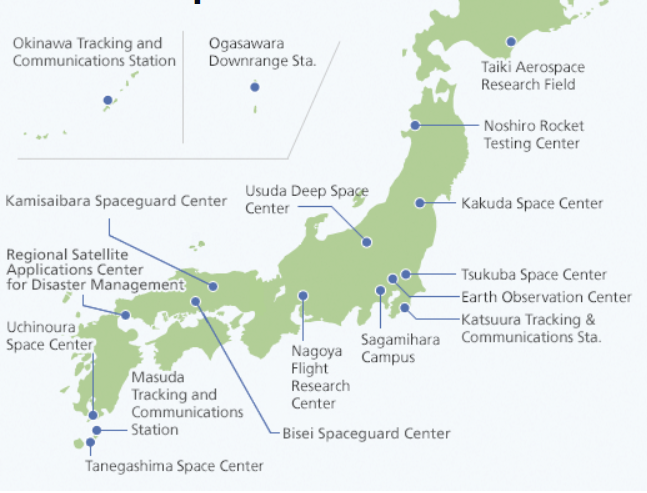
JAXA Research Centers by Location
(Source: global.jaxa.jp)
| JAXA’s Research Centers | Establishment Date | Location (Japan) |
| Tsukuba Space Center (TKSC) | 1972 | Tsukuba Science City |
| Chofu Aerospace Center (CAC) | 1962 | Chōfu, Tokyo, |
| Sagamihara Campus (SC) | 1989 | Sagamihara, Kanagawa |
| Tanegashima Space Center (TNSC) | 1969 | Southeast coast of Tanegashima |
| Uchinoura Space Center (USC) | 1962 | On the Pacific coast of Kagoshima |
| Kakuda Space Center (KSC) | 1965 | 1 Koganesawa, Kimigaya, Kakuda-shi, Miyagi |
| Earth Observation Center (EOC) | 1978 | Hatoyama, Saitama |
| Noshiro Rocket Testing Center (NRTC) | 1962 | Asanai, Noshiro-city, Akita |
| Taiki Aerospace Research Field (TARF) | 1997 | Taiki Multi-Purpose Aerospace Park. |
| Usuda Deep Space Center (UDSC) | 1984 | Usuda Town, Minami-saku |
| Katsuura Tracking and Communications Station (KTCS) | 1968 | Katsuura, Chiba |
| Masuda Tracking and Communications Station (MTCS) | 1974 | On Tanegashima Island in Kagoshima |
| Okinawa Tracking and Communications Station (OTCS) | 1968 | 1712 Afuso Kinrabaru, Onna-son, Kunigami-gun |
| Ogasawara Downrange Station (ODS) | 1975 | Ogasawara, Tokyo |
| Nagoya Flight Research Center (NFRC) | – |
4520-4 Norifusa, Aoyama, Toyoyama-cho, Nishikasugai-gun, Aichi |
| Regional Satellite Applications Center for Disaster Management (RSACDM) | – | Yamaguchi Prefectural Industrial Technology Institute |
| Kamisaibara Space Guard Center (KSGC) | – | Kagamino-cho, Tomada-gun, Okayama |
| Bisei Space Guard Center (BSGC) | 1999-2000 | Ookura, Bisei-cho, Ibara-shi, Okayama |
JAXA Statistics by Astronauts
(Source: global.jaxa.jp)
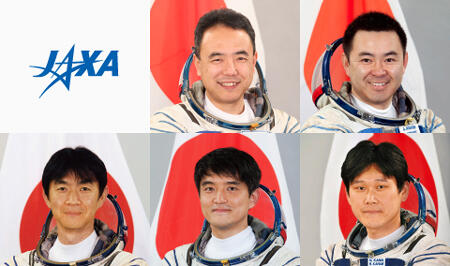
- Currently, only 5 active astronauts are present at JAXA with experience of long-term stays at the International Space Station (ISS) over 100 days: Furukawa Satoshi, Hoshide Akihiko, Yui Kimiya, Onishi Takuya, and Kanai Norishige.
- In recent years, six JAXA astronauts have retired and are working in different fields: Wakata Koichi, Noguchi Soichi, Mohri Mamoru, Makai Chiaki, Doi Takao, and Yamazaki Naoko.
- In 2025, Astronauts Onishi and Yui are each scheduled to join an expedition crew.
- Meanwhile, in Expedition 69 and 70, the Astronaut Furukawa (Crew 7 mission) was launched on August 26, 2023, and returned on March 12, 2024.
Other JAXA Astronaut Boarding Plan
| Astronaut | Mission | Launched and Returned Date |
| Wakata (Expedition 68) | Crew 5 | October 26, 2023 to March 12, 2023 |
| Hoshide (Expedition 65 & 66) | Crew 2 | April 23, 2021, to November 9, 2021 |
| Noguchi (Expedition 64 & 65) | Crew 1 | November 16, 2020, to May 2, 2021 |
JAXA Statistics by Planned Launches
| Date and time | Launch site (Tanegashima) | Rocket | Mission |
| June 30, 2024 | LA-Y2 | H3 | Advanced Land Observing Satellite (ALOS) |
| Q3 2024 | LA-Y1 | H-IIA 202 | Information Gathering Satellite (IGS-Rader 8) |
| 2024 | LA-Y2 | H3 | DSN Corporation (DSN-3) |
| 2024 | LA-Y1 | H-IIA 202 | The Greenhouse Gases Observing Satellite-2 (GOSAT-2) |
| 2024 | LA-Y2 | H3 | The Quasi-Zenith Satellite System (QZSS-5) |
| 2025 | LA-Y2 | H3-24L | New Space-Station Resupply Vehicle (HTV-X1) |
| 2025 | LA-Y2 | H3 | (QZSS-6) |
| 2025 | LA-Y2 | H3 | (QZSS-7) |
| 2025 | LA-Y2 | H3 | ETS-9 (Kiku-9) |
| 2026 | LA-Y2 | H3-24L | (HTV-X2) |
| 2026 | LA-Y2 | H3-24L | (HTV-X3) |
| 2026 | LA-Y2 | H3-24L | Martian Moons eXploration (MMX) |
| 2026 | LA-Y2 | H3 | IGS-Optical 9 |
| 2027 | LA-Y2 | H3 | IGS-Optical Diversification 2 |
| 2027 | LA-Y2 | H3 | JDRS-2 |
| 2028 | LA-Y2 | H3 | Himawari 10 |
| 2029 | LA-Y2 | H3 | IGS-Radar Diversification 1 |
| 2029 | LA-Y2 | H3 | IGS-Optical 10 |
| 2030 | LA-Y2 | H3 | IGS-Radar Diversification 2 |
| 2031 | LA-Y2 | H3 | IGS-Radar 9 |
| 2032 | LA-Y2 | H3 | IGS-Optical Diversification Successor |
| 2032 | LA-Y2 | H3 | LiteBIRD |
| 2033 | LA-Y2 | H3 | IGS-Radar 10 |
| 2033 | LA-Y2 | H3 | IGS-Optical 11 |
(Source: wikipedia.org)
JAXA Statistics: Budget and Workforce
- Budget: JAXA’s annual budget in fiscal year 2025 is around 154 billion Japanese yen, which corresponds to roughly USD 1.1 billion. This still accounts for about 2% of global civil space agency budgets, keeping JAXA behind NASA and the European Space Agency (ESA) in absolute funding, but supported by Japan’s separate ¥1 trillion Strategic Space Fund.
- Workforce: JAXA employs around 1,660 regular staff members as of April 2025, and in total between 1,000 and 5,000 employees.
Launch Vehicles
- H-IIA Rocket: JAXA’s H‑IIA rocket has continued to be a reliable workhorse through its retirement, flying a total of 50 times with 49 successful launches by June 28, 2025, which corresponds to a 98% success rate. This versatile rocket has launched numerous satellites and spacecraft for JAXA and international partners, including the final GOSAT‑GW (IBUKI‑GW) mission in 2025.
- H3 Launch Vehicle: The next‑generation H3 rocket is designed to be more cost‑effective and powerful, and by 2025 it has flown five successful missions and two failures since its debut in 2023.
Human Spaceflight
- Astronaut Corps: JAXA maintains a highly trained astronaut corps. These astronauts have participated in missions aboard the Space Shuttle and the ISS, conducting valuable research and contributing to the advancement of human spaceflight.
Looking to the Future
- Lunar Gateway: JAXA is looking towards the Moon. They are collaborating on the construction of the Lunar Gateway, a mini-space station that will serve as a critical hub for future lunar exploration missions.
- Martian Dreams: Mars exploration is also on the horizon. JAXA is involved in missions to study the Red Planet and pave the way for future human exploration.
Beyond Numbers: The Impact of JAXA
JAXA’s work extends beyond impressive statistics. Here are some key areas where their impact is felt:
- Disaster Management: JAXA’s Earth observation satellites provide vital data for disaster preparedness and response. Real-time information on weather patterns, floods, and earthquakes allows for better decision-making and saving lives.
- Climate Change Monitoring: JAXA’s satellites play a crucial role in monitoring the effects of climate change, providing data on global warming, deforestation, and rising sea levels.
- Scientific Advancement: JAXA’s space missions contribute significantly to scientific research. Their missions to asteroids and the Moon provide valuable insights into the formation of our solar system and the possibility of life beyond Earth.
- Technological Innovation: JAXA’s space endeavors drive technological advancements. The development of rockets, satellites, and spacecraft requires cutting-edge technologies that benefit other sectors, such as communication, navigation, and material science.
Ending
The history of JAXA is all about innovations, international cooperation, and a never-ending quest for expanding the frontiers of space. Although the statistics provide enough information about their accomplishments, their real value is measured by their role in science, disaster response, and mankind’s aspirations to reach for the stars in the future.
FAQ
JAXA is the Japan Aerospace Exploration Agency, the national organization responsible for Japan’s space and aviation research, satellite development, and space exploration. Formed on October 1, 2003, it combined three previous agencies to handle everything from basic aerospace science to rocket launches.
YAMAKAWA currently resides and takes leadership role as the President of Japan Aerospace Exploration Agency (JAXA) since April 2018.
JAXA was formed as an Independent Administrative Institution administered by the Ministry of Education, Culture, Sports, Science and Technology (MEXT) and the Ministry of Internal Affairs and Communications (MIC).

Sources