









Overview
Mars Exploration Statistics: Mars exploration is one of the most exciting areas in modern space science. Mars has fascinated people for centuries, and now, technology lets us explore it in more detail. Space agencies like NASA, ESA, CNSA (China), and ISRO (India) lead missions to understand Mars better.
These missions look for clues about whether Mars once had life and prepare for future human visits. Robotic missions have found evidence of water, complex landforms, and a thin atmosphere. Today, scientists focus on returning samples, using Mars’ resources, and developing technologies for human missions. These expensive missions provide important information about Mars.
The Editor’s Prime Picks
- NASA’s budget for Mars exploration in 2024 is around USD 3 billion, approximately 8% of its total budget.
- By the 2030s, companies like SpaceX will have spent billions aiming for human missions to Mars.
- More than 60% of Mars missions have been successful, with NASA’s Perseverance rover playing a key role.
- Mars Exploration Statistics show that, due to advancing technology, the Mars exploration market could exceed USD 20 billion by 2030.
- Based on research and innovation, investments focus on developing new space technologies, with 30% going to robotics and AI for planetary exploration.
- Meanwhile, countries like the U.S., China, and the UAE are leading, with China investing USD 1.5 billion in Mars missions.
- The sector is projected to create thousands of jobs globally, from engineering to research.
- Mars Exploration Statistics further states that some experts estimate that by the end of 2040, around 1% of global space budgets will focus on preparing for human settlement on Mars.
- At the same time, the potential Mars tourism market will generate USD 2-3 billion annually.
- International partnerships, such as those between NASA and ESA, are crucial for pooling resources and sharing costs, aiming for greater Mars exploration success.
General Mars Exploration Statistics
- Mars is a rocky planet like Earth, but it is half the size of Earth. It has a thin atmosphere and a cold, desert-like surface.
- Some scientists used their telescopes to find out about two moons called Phobos and Deimos, polar ice, and Olympus Mons, which is considered the largest mountain in our Solar System.
- The exploration of the red planet by spacecraft launched from Earth began in the latter part of the 20th century.
- These expeditions have made us know more about Mars and helped in learning about its geology and the possibilities of the existence of life.
- At the beginning of April 2024, NASA selected some companies to assess how they could assist in conducting robotic science on Mars.
- According to the statistics of Mars exploration, NASA has sent five robots, referred to as rovers, to explore the Martian landscape, take pictures, and collect data on Mars.
- The European Space Agency is delaying the launch of the Rosalind Franklin rover to the planet until the latter part of the decade.
- India plans to launch the Mars Orbiter Mission 2 in 2031 for further exploration of Mars’ atmosphere and surface.
(Source: datainnovation.org)
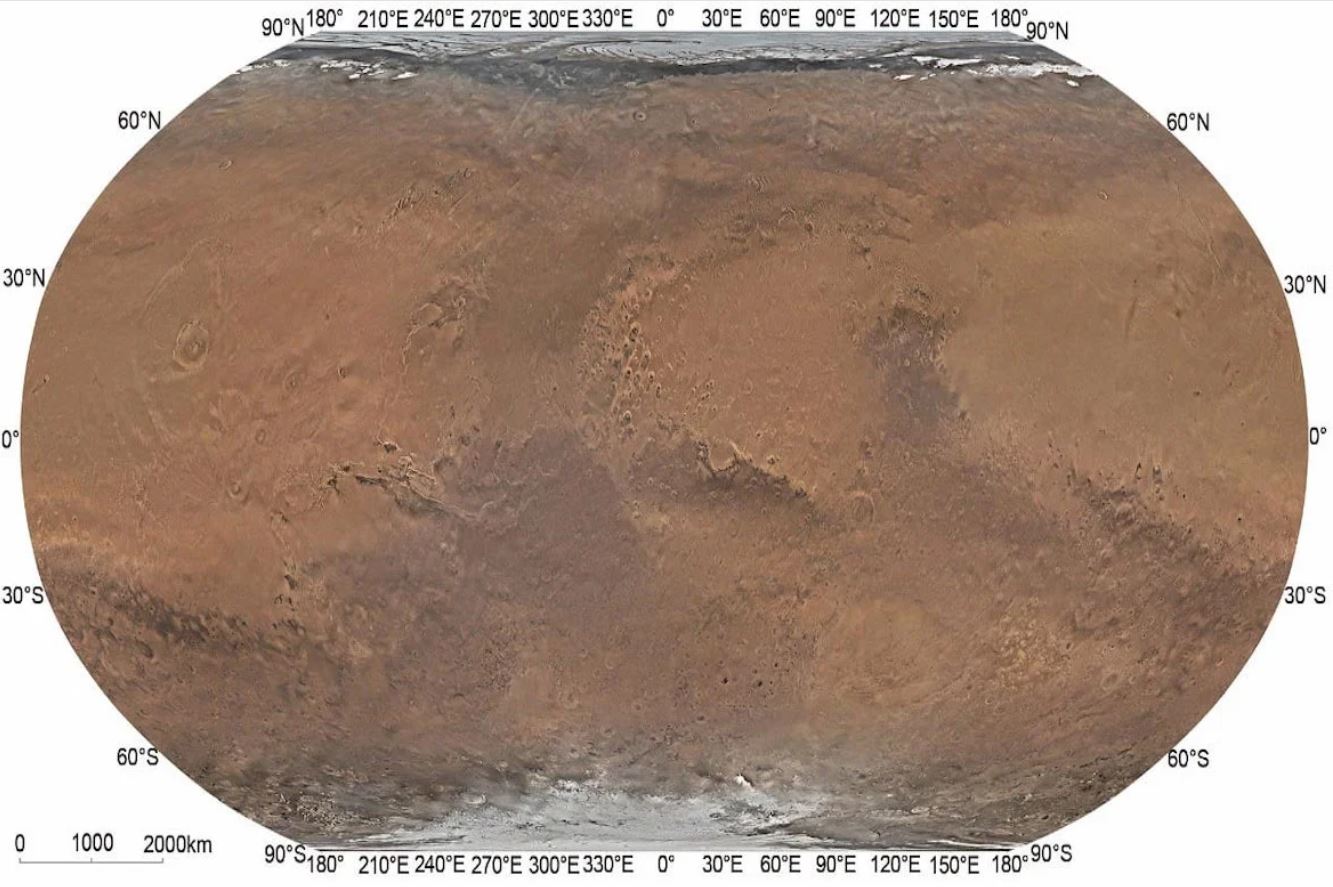
- China’s Tianwen-1 mission, the country’s first Mars exploration project, has achieved significant milestones since its launch in July 2020.
- A key achievement is the release of a global colour image map of Mars, which is considered the most detailed map of the planet to date.
Mars Exploration by Launch Windows
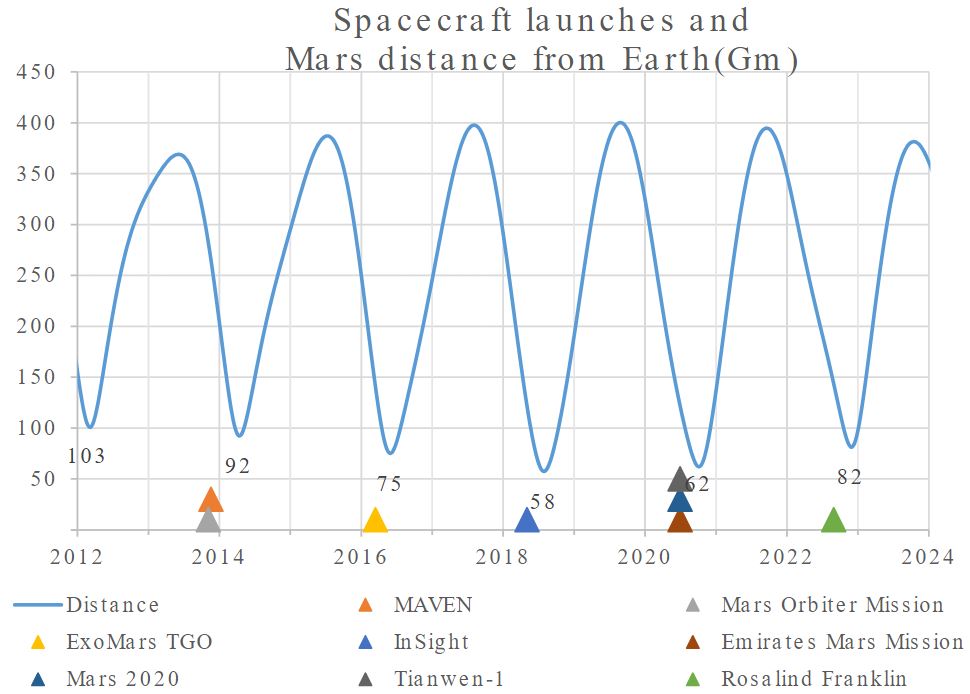
- The best times to launch missions to Mars happen every 780 days, or about every two years and two months.
- There was a low in 1969 and 1971, a peak in the late 1970s, and another low in 1986 and 1988.
(Source: upload.wikimedia.org)
- Escape and Plasma Acceleration and Dynamics Explorers (ESCAPADE) is expected to launch in November 2024 and is part of NASA’s SIMPLEx program.
- This mission to Mars will use two spacecraft, named Blue and Gold, to study the planet’s atmosphere.
The table below elaborates on the launch opportunities from 2013 to 2024:
| Launch Date | Spacecraft (launched or planned) |
| 2024 (October to November) | EscaPADE |
| 2020 (July to September) | Mars Hope orbiter Tianwen-1 orbiter, deployable and remote camera, lander, and Zhurong rover Mars 2020 Perseverance rover and Ingenuity helicopter |
| 2018 (May) | InSight |
| 2016 (March) | ExoMars TGO |
| 2013 (November) | MAVEN, Mars Orbiter Mission |
Similarly, expected launch opportunities in the coming years are stated as:
| 2026 (November to December) | Martian Moons eXploration (MMX) Impulse/Relativity Mars lander |
| 2028 / 2029 (December to January) | Rosalind Franklin Mars Orbiter Mission 2 |
NASA’s Mars Exploration Program Plan (from 2024 to 2044)
- As mentioned in Mars Exploration Statistics, from 2024 to 2030, ongoing missions like Perseverance, Curiosity, and orbiters will continue while new small landers develop.
- Meanwhile, missions between 2031 and 2035 will bring Martian samples back to Earth for detailed study.
- Advanced satellites and landers will explore Mars’ air, ground, and underground environment from 2036 to 2040.
- Between 2041 and 2044, robots will begin missions to prepare for humans, showing resource use and building infrastructure.
List of Mars Missions
| Launch Date | Spacecraft | Operator | Mission | Mission Type | Result |
| 13 October 2023 | Psyche | United States (NASA) | Psyche | Flyby (Gravity assist) | Enroute |
|
30 July 2020
| Ingenuity |
United States (NASA)
|
Mars 2020
| Helicopter | Successful |
| Perseverance | Rover | Operational | |||
|
23 July 2020
| Tianwen-1 orbiter |
China (CNSA)
|
Tianwen-1
| Orbiter | Operational |
| Tianwen-1 lander | Lander |
Successful
| |||
| Zhurong rover | Rover | ||||
| Tianwen-1 Remote Camera | Lander | ||||
| Tianwen-1 Deployable Camera 2 | Orbiter | ||||
| 19 July 2020 | Hope | United Arab Emirates (MBRSC) | Emirates Mars Mission | Orbiter | Operational |
|
5 May 2018
| InSight |
United States
(NASA) |
InSight
| Lander |
Successful
|
| Marco A | Flyby | ||||
| Marco B | Flyby | ||||
|
March, 2016
| ExoMars Trace Gas Orbiter |
Roscosmos
(ESA) |
ExoMars 2016
| Orbiter | Operational |
| Schiaparelli EDM lander | Lander | Spacecraft failure | |||
| 18 November 2013 | MAVEN | United States (NASA) | MAVEN | Orbiter | Operational |
| 5 November 2013 | Mars Orbiter Mission | India (ISRO) | Mars Orbiter Mission | Orbiter | Successful |
| 26 November 2011 | Curiosity | NASA (U.S.) | Mars Science Laboratory | Rover | Operational |
|
8 November 2011
| Phobos-Grunt | Roscosmos (Russia) |
Fobos-Grunt / Yinghuo-1
| Orbiter Phobos sample return | Launch failure |
| Yinghuo-1 | CNSA (China) | Orbiter | Precluded Lost with Phobos-Grunt | ||
| 27 September 2007 | Dawn | NASA (U.S.) | Dawn | Flyby (Gravity assist) | Successful |
| 4 August 2007 | Phoenix | NASA (U.S.) | Phoenix | Lander | Successful |
| 12 August 2005 | Mars Reconnaissance Orbiter | NASA (U.S.) | Mars Reconnaissance Orbiter | Orbiter | Operational |
|
2 March 2004
| Rosetta |
ESA
|
Rosetta
|
Flyby (Gravity assist)
|
Successful
|
| Philae | |||||
| 8 July 2003 | Opportunity (MER-B) | NASA (U.S.) | Opportunity | Rover | Successful |
| 10 June 2003 | Spirit (MER-A) | NASA (U.S.) | Spirit | Rover | Successful |
|
2 June 2003
| Beagle 2 |
ESA
|
Mars Express
| Lander | Lander failure |
| Mars Express | Orbiter | Operational | |||
| 7 April 2001 | Mars Odyssey | NASA (U.S.) | Mars Odyssey | Orbiter | Operational |
|
3 January 1999
| Mars Polar Lander |
NASA (U.S.)
|
Mars Polar Lander / Deep Space 2
| Lander |
Spacecraft failure
|
| Deep Space 2 |
Penetrator
| ||||
| Deep Space 2 | |||||
| 11 December 1998 | Mars Climate Orbiter | NASA (U.S.) | Mars Climate Orbiter | Orbiter | Spacecraft failure |
| 3 July 1998 | Nozomi (PLANET-B) | Japan (ISAS) | Nozomi | Orbiter | Spacecraft failure |
|
4 December 1996
| Mars Pathfinder |
NASA (U.S.)
|
Mars Pathfinder
| Lander |
Successful
|
| Sojourner | Rover | ||||
|
16 November 1996
| Mars 96 (M1 No.520) (Mars-8) |
Rosaviakosmos (Russia)
|
Mars 96
| Orbiter Penetrators | Launch failure |
| Mars 96 lander | Lander |
Launch failure
Lost with Mars 96 | |||
| Mars 96 lander | Lander | ||||
| Mars 96 penetrator | Penetrator | ||||
| Mars 96 penetrator | Penetrator | ||||
| 7 November 1996 | Mars Global Surveyor | NASA (U.S.) | Mars Global Surveyor | Orbiter | Successful |
| 25 September 1992 | Mars Observer | NASA (U.S.) | Mars Observer | Orbiter | Spacecraft failure |
|
7 July 1988
| Phobos 1 (1F No.101) |
Soviet Union
|
Phobos 1
| Orbiter | Spacecraft failure |
| DAS | Phobos lander | Failure Lost with Phobos 1 | |||
|
12 July 1988
| Phobos 2 (1F No.102) |
Soviet Union
|
Phobos 2
| Orbiter | Mostly successful |
| Prop-F | Phobos rover |
Failure
Lost with Phobos 2 | |||
| DAS | Phobos lander | ||||
|
20 August 1975
| Viking 1 orbiter |
NASA (U.S.)
|
Viking 1
| Orbiter |
Successful
|
| Viking 1 lander | Lander | ||||
|
9 September 1975
| Viking 2 orbiter |
NASA (U.S.)
|
Viking 2
| Orbiter |
Successful
|
| Viking 2 lander | Lander | ||||
|
5 August 1973
| Mars 6 (3MP No.50P) |
Soviet Union
|
Mars 6
| Flyby | Successful |
| Mars 6 lander | Lander | Spacecraft failure | |||
|
9 August 1973
| Mars 7 (3MP No.51P) |
Soviet Union
|
Mars 7
| Flyby | Successful |
| Mars 7 lander | Lander | Spacecraft failure | |||
| 21 July 1973 | Mars 4 (3MS No.52S) | Soviet Union | Mars 4 | Orbiter | Partial success |
| 25 July 1973 | Mars 5 (3MS No.53S) | Soviet Union | Mars 5 | Orbiter | Successful |
|
5 August 1973
| Mars 6 |
Soviet Union
|
Mars 6
| Flyby | Successful |
| Mars 6 lander | Lander | Spacecraft failure | |||
|
9 August 1973
| Mars 7 |
Soviet Union
|
Mars 7
| Flyby | Successful |
| Mars 7 lander | Lander | Spacecraft failure | |||
| 30 May 1971 | Mariner 9 | NASA (U.S.) | Mariner 9 | Orbiter | Successful |
|
28 May 1971
| Mars 3 |
Soviet Union
|
Mars 3
| Orbiter | Successful |
| Mars 3 lander | Lander | Partial success | |||
| PrOP-M | Rover | The carrier vehicle failed before the rover was deployed | |||
|
19 May 1971
| Mars 2 lander |
Soviet Union
|
Mars 2
| Lander | Spacecraft failure |
| Mars 2 | Orbiter | Successful | |||
| PrOP-M | Rover | Failure | |||
| 10 May 1971 | Kosmos 419 | Soviet Union | Kosmos 419 | Orbiter | Launch failure |
| 9 May 1971 | Mariner 8 | NASA (U.S.) | Mariner 8 | Orbiter | Launch failure |
| 2 April 1969 | 2M No.522 | Soviet Union | 2M No.522 | Orbiter | Launch failure |
|
27 March 1969
| Mariner 7 | NASA (U.S.) | Mariner 7 | Flyby | Successful |
| 2M No.521 | Soviet Union | 2M No.521 | Orbiter | Launch failure | |
| 25 February 1969 | Mariner 6 | NASA (U.S.) | Mariner 6 | Flyby | Successful |
| 30 November 1964 | Zond 2 | Soviet Union | Zond 2 | Flyby | Spacecraft failure |
| 28 November 1964 | Mariner 4 | NASA (U.S.) | Mariner 4 | Flyby | Successful |
| 5 November 1964 | Mariner 3 | NASA (U.S.) | Mariner 3 | Flyby | Launch failure |
| 4 November 1962 | 2MV-3 No.1 | Soviet Union | 2MV-3 No.1 | Lander | Launch failure |
| 1 November 1962 | Mars 1 | Soviet Union | Mars 1 | Flyby | Spacecraft failure |
| 24 October 1962 | 2MV-4 No.1 | Soviet Union | 2MV-4 No.1 |
Flyby
|
Launch failure
|
| 14 October 1960 | 1M No.2 |
Soviet Union (OKB-1)
| 1M No.2 | ||
| 10 October 1960 | 1M No.1 | 1M No.1 |
(Source: wikipedia.org)
Is Exploring Mars Costly?
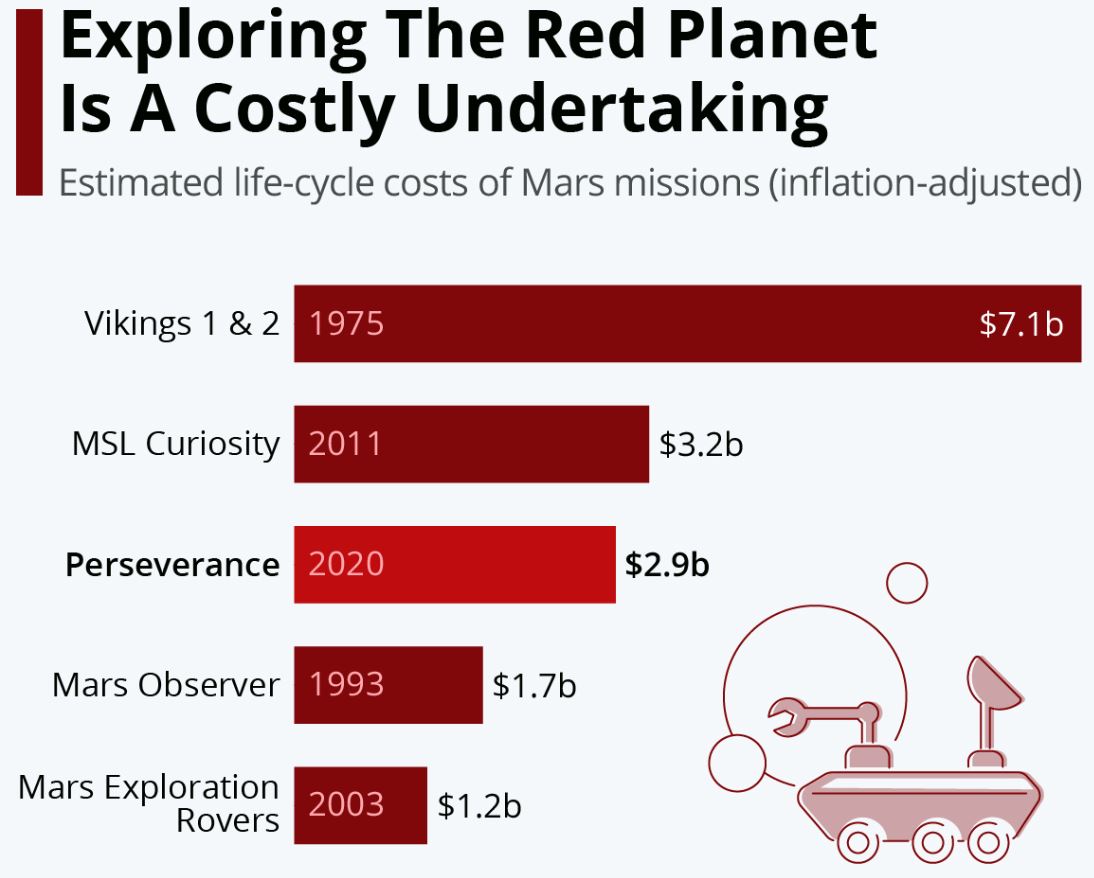
Indeed, Mars exploration is very expensive, and NASA’s Perseverance rover mission is expected to cost around USD 2.7 billion.
(Source: statista.com)
- In 2020, the estimated life-cycle costs of the Perseverance Mars mission were around USD 2.9 billion.
- Mars Exploration Statistics also show that other Mars mission costs are followed by Vikings 1 & 2 (USD 7.1 billion), MSL Curiosity (USD 3.2 billion), Mars Observer (USD 1.7 billion), and Mars Exploration Rovers (USD 1.2 billion).
Mars Exploration Missions by Organizations
| Names of Organisations | Total Missions | Successful Missions |
| NASA (United States) | Over 20 | As of 2024, around 16 missions have successfully reached Mars. |
| European Space Agency (ESA) | 3 | 2 |
| Roscosmos (Russia) | 18 | Two missions were partially successful. |
| China National Space Administration (CNSA) | 1 | Tianwen-1 (2020). |
| Indian Space Research Organisation (ISRO) | 1 | Mars Orbiter Mission or Mangalyaan, 2013 |
Proposed Mars Missions Statistics
| Proposed Date | Mission | Type | Organisation |
| 2024 | Mars-Grunt | Orbiter, lander, ascent vehicle, sample-return | Roscosmos |
| 2024 | MELOS rover | Rover and aircraft | JAXA |
| 2024 | SatRevolution | Orbiter | Poland |
| 2026 | Icebreaker Life | Lander | NASA |
| 2030 | Deimos and Phobos Interior Explorer (DePhine) | Orbiter and Martian moon flybys | ESA |
| NET 2030 | NASA-ESA Mars Sample-return | Orbiter/Lander/Return vehicle | NASA & ESA |
Future Mars Exploration Mission Statistics
| Proposed Date | Mission | Type | Organisation |
| NET October 2024 | Hera | Flyby to the Didymos asteroid system | ESA |
| NET Spring 2025 | EscaPADE | 2 Orbiters | NASA |
|
2026
| SpaceX Uncrewed Landing | Uncrewed lander | SpaceX |
| Martian Moons eXploration (MMX) Phobos Sample Return Mission | Orbiter/Lander | JAXA | |
| First Commercial Mission to Mars | Lander | Relativity Space, Impulse Space | |
| 2028 | Tianwen-3 Mars sample-return mission | There are two spacecraft: one consists of an orbiter and return module, the other of a lander, ascent module, mobile sampling robot, and helicopter. | CNSA |
Mars Exploration Rovers Statistics
| Mars exploration rovers | Mission | Size | Weight | Duration | Distance Traveled |
| Zhurong Rover (CNSA, 2021-present) | Tianwen-1 | 2.6 meters long, 3 meters wide (with solar panels) | 240 kg | Still active | 1.92 km (as of 2024) |
| Perseverance Rover (NASA, 2021-present) | Mars 2020 | 3 meters long, 2.7 meters wide, 2.2 meters high | 1,025 kg | Still active | 17 km, to date |
| Curiosity Rover (NASA, 2012-present) | Mars Science Laboratory | 2.9 meters long, 2.7 meters wide, 2.2 meters high | 899 kg | Active (planned for two years) | Over 30 km |
| Opportunity Rover (NASA, 2004-2018) | Mars Exploration Rover (MER-B) | 1.6 meters long, 1.5 meters wide, 1.5 meters high | 185 kg | Active for nearly 15 years (planned for 90 days) | 45.16 km |
| Spirit Rover (NASA, 2004-2010) | Mars Exploration Rover (MER-A) | 1.6 meters long, 1.5 meters wide, 1.5 meters high | 185 kg | Active for six years (planned for 90 days) | 7.73 km |
| Sojourner Rover (NASA, 1997) | Mars Pathfinder | 65 cm long, 48 cm wide, 30 cm high | 10.6 kg | Active for 83 days (planned for seven days) | 100 meters |
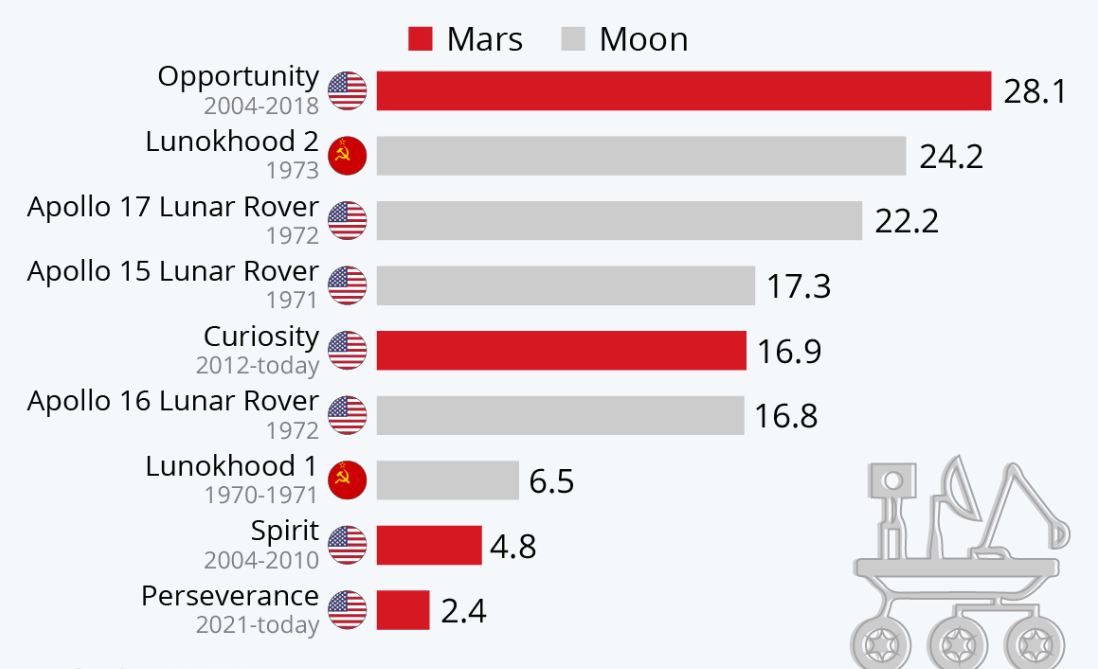
Longest Distance Travelled by Mars Rovers
(Source: statista.com)
- NASA’s Perseverance rover has been exploring Mars for a year. It landed on the planet on February 18, 2021, and covered a distance of around 28.1 miles.
- Mars Exploration Statistics further reports that the total distance covered by Curiosity Mars rovers has been 16.9 miles to date, followed by Spirit (4.8 miles) and Perseverance (2.4 miles).
Mars Exploration by Radiation Exposure
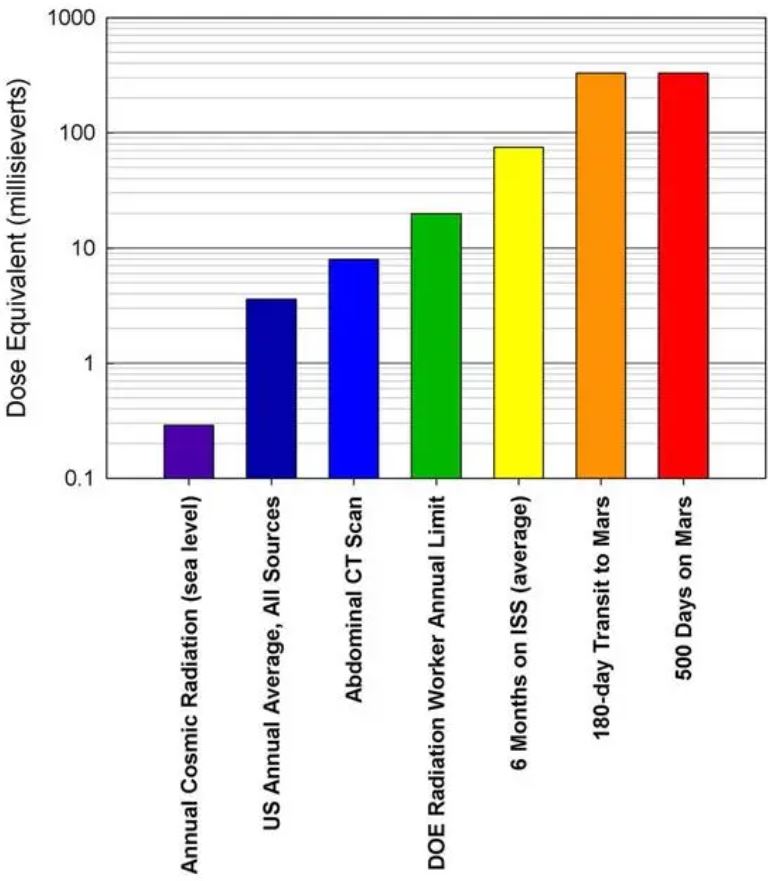
(Source: science.nasa.gov)
- Radiation Exposure on Mars: Mars gets exposed to 0.2 to 0.7 millisieverts (mSv) of radiation on an everyday basis. The radiation exposure experienced by Mars is 100 times more than that of Earth.
- Radiation Exposure during Traveling to and from Mars: The overall exposure to radiation during traveling to and from Mars would be approximately 600-1,000 mSv, which is equal to 50 CT scans.
- NASA has set a career radiation limit for astronauts of 1,000 millisieverts. A single Mars mission could expose astronauts to up to 60% of this lifetime limit.
Driving Distance Analyses on Mars and the Moon
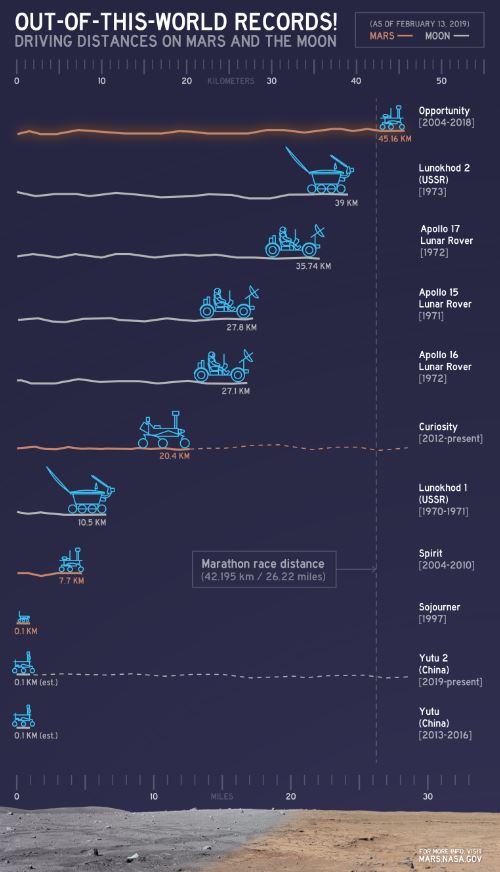
(Source: science.nasa.gov)
- By the end of the Mars Exploration Rovers, Spirit travelled 4.8 miles (7.7 kilometres) on Mars.
- Meanwhile, Opportunity drove 28.06 miles (45.16 kilometres), the longest distance a rover has covered on another planet.
Mars Exploration by Budgetary Contributions
- NASA’s Mars exploration budget continues to be substantial. The Mars Sample Return (MSR) mission is one of the most expensive upcoming projects, resulting in USD 5-7 billion.
- The Mars 2020 mission, which includes the Perseverance rover, had a total development and launch cost of around USD 2.7 billion, with an additional USD 300 million allocated annually for operations.
- ESA has committed significant resources to the ExoMars program, which consists of the Trace Gas Orbiter (TGO) and the Rosalind Franklin rover. The ExoMars mission has an overall estimated cost of €1.3 billion (approximately USD 1.4 billion), shared across ESA member states.
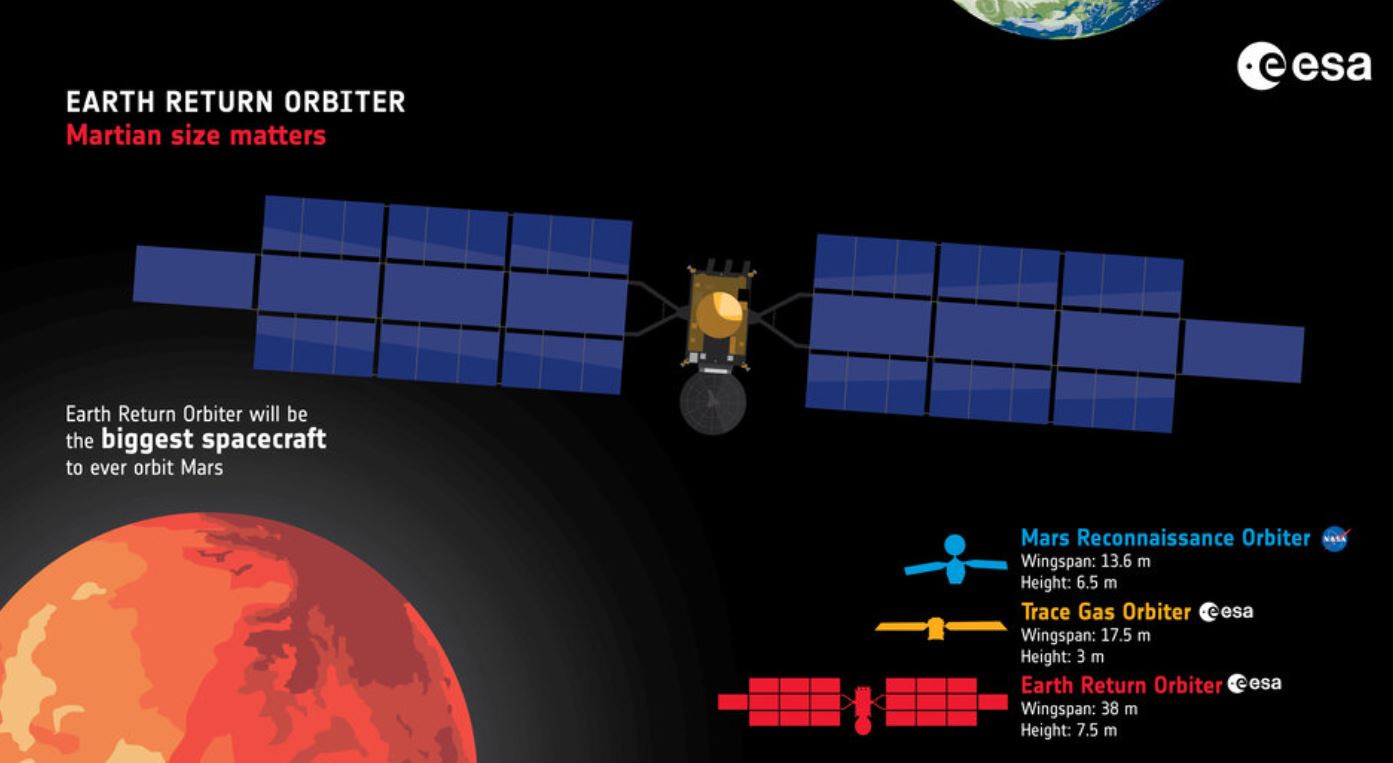
- ESA will contribute the Sample Fetch Rover and the Earth Return Orbiter for the Mars Sample Return mission, which is estimated to cost around €300-400 million (about USD 340-450 million).
NASA’s Mars Exploration Program Statistics
(Source: science.nasa.gov)
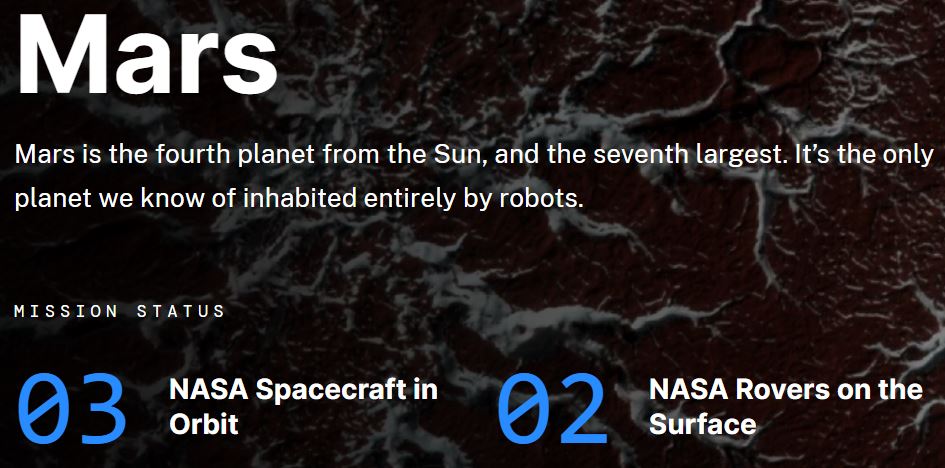
- NASA’s Mars Exploration Program has two rovers and three orbiters currently working on Mars.
- Since the 1960s, NASA has undertaken over 20 missions to Mars, 16 of which have been classified as successful.
- The first successful flyby of Mars by NASA is stated as Mariner 4 (1964).
- Similarly, the first successful landers were Viking 1 and 2 (1976).
- Mars Science Laboratory (Curiosity Rover, 2012): Still operational, exploring the Gale Crater.
- Perseverance Rover (2021): Collecting samples for the future Mars Sample Return mission.
- According to Mars Exploration Statistics, NASA has already accomplished around 80% of all its missions on Mars through the use of orbiters, landers, and rovers, which contribute to our knowledge about Mars.
- The budget of NASA concerning the Mars Exploration Program represents a 7.1% increase from the budget of the previous year and constitutes a total of USD 27.2 billion.
By Scientific Observations
- The Perseverance Rover has detected features in Jezero Crater that may suggest the presence of ancient microbial life, though further analysis is needed to confirm these findings.
- NASA is actively preparing to return soil and rock samples from Mars to Earth by the early 2030s.
- Perseverance discovered carbonate-bearing rocks in Jezero Crater, a significant finding as these minerals typically form in the presence of water.
- The MAVEN Mission Studies have demonstrated how the solar winds have stripped the atmosphere of Mars to explain why Mars evolved into a desert planet.
- Scientific research carried out by NASA missions has proven that there used to be liquid water on the surface of Mars, with the Curiosity Rover identifying the presence of lakes in Gale Crater.
- Scientists have discovered huge volcanic formations like Olympus Mons on Mars and volcanic activity on Mars during its early years.
- The atmosphere on Mars is 100 times less dense than that on Earth, which makes entering and landing on the planet very difficult.
Europe’s Mars Exploration Statistics
(Source: esa.int)
- The ExoMars Trace Gas Orbiter (TGO), launched in 2016, is examining Mars’ air, especially focusing on gases like methane.
- Europe’s first Mars rover, Rosalind Franklin, will launch in 2028 and drill 2 meters deep to find signs of life.
- Mars Express reached its 25,000th Mars orbit on 19 October 2023 and continues operating on an extended mission through at least the end of 2026, so its cumulative orbit count now exceeds 25,000.
- The orbiter’s camera captures images with 10-meter resolution, continuing its study of Mars’ surface, atmosphere, and moons.
China’s Mars Exploration Mission Statistics
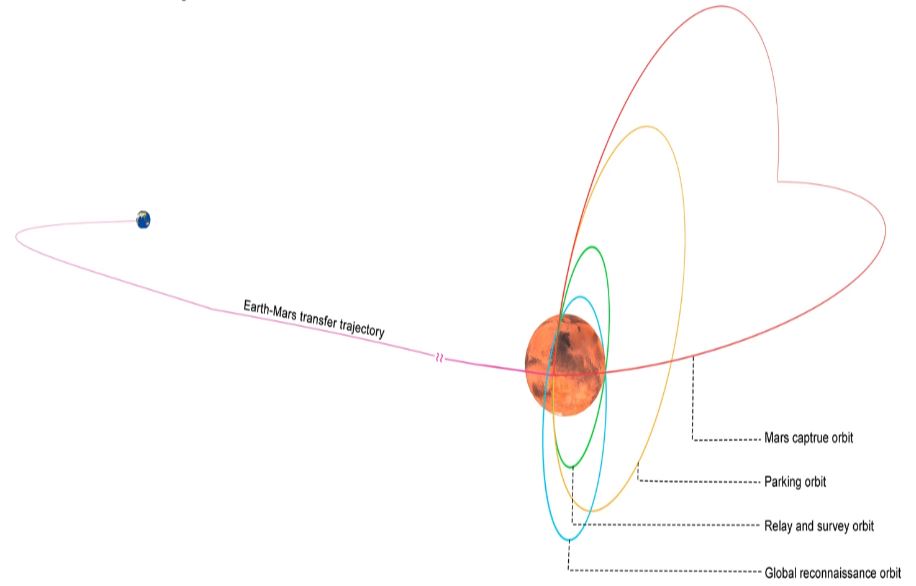
(Source: link.springer.com)
| Launch Date | Mission | Spacecraft | Launch site | Launch vehicle | Orbital insertion date | Landing date | Result |
|
July 23, 2020
04:41:15 |
Tianwen-1
| Tianwen-1 orbiter |
Wenchang Space Launch Site
|
Long March 5, or Changzheng 5 (CZ-5)
|
February 10, 2021
| – | Operational |
| Tianwen-1 lander |
May 14, 2021
|
Success
| |||||
| Zhurong rover |
Indian Mars Exploration Missions Statistics
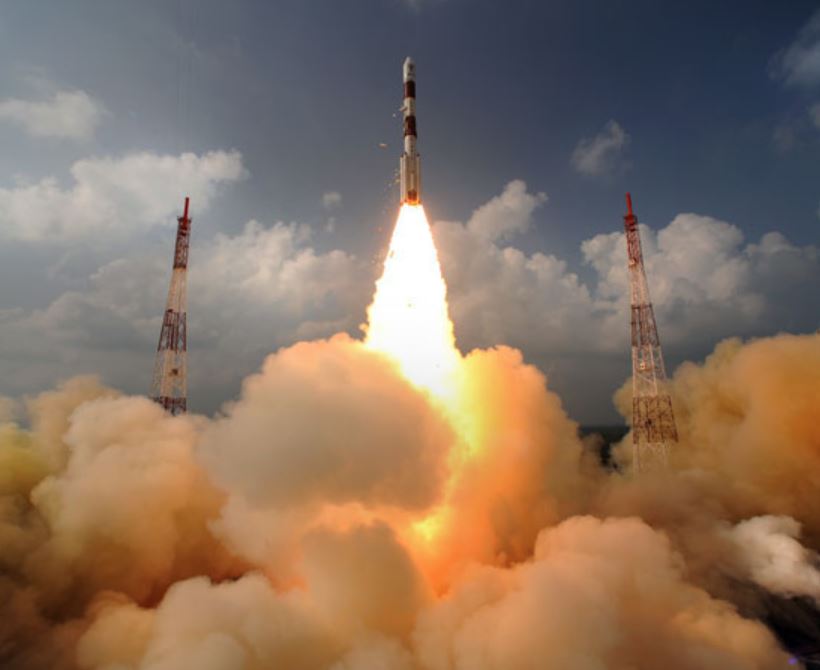
The image below illustrates the PSLV-XL C25 launched by the Mars Orbiter Mission on November 5, 2013.
(Source: upload.wikimedia.org)
| Launch Date | Mission | Launch Vehicle | Orbital Insertion Date | Expected Mission Duration | Final Mission Duration |
| 5 November 2013 | Mars Orbiter Mission (Mangalyaan) | The Polar Satellite Launch Vehicle (PSLV) | 24 September 2014 | Six months | Seven years, six months, eight days |
| TBD | Mars Orbiter Mission 2 (Mangalyaan-2) | The Launch Vehicle Mark-3 (LVM3) | TBD | One year | TBD |
(Source: wikipedia.org)
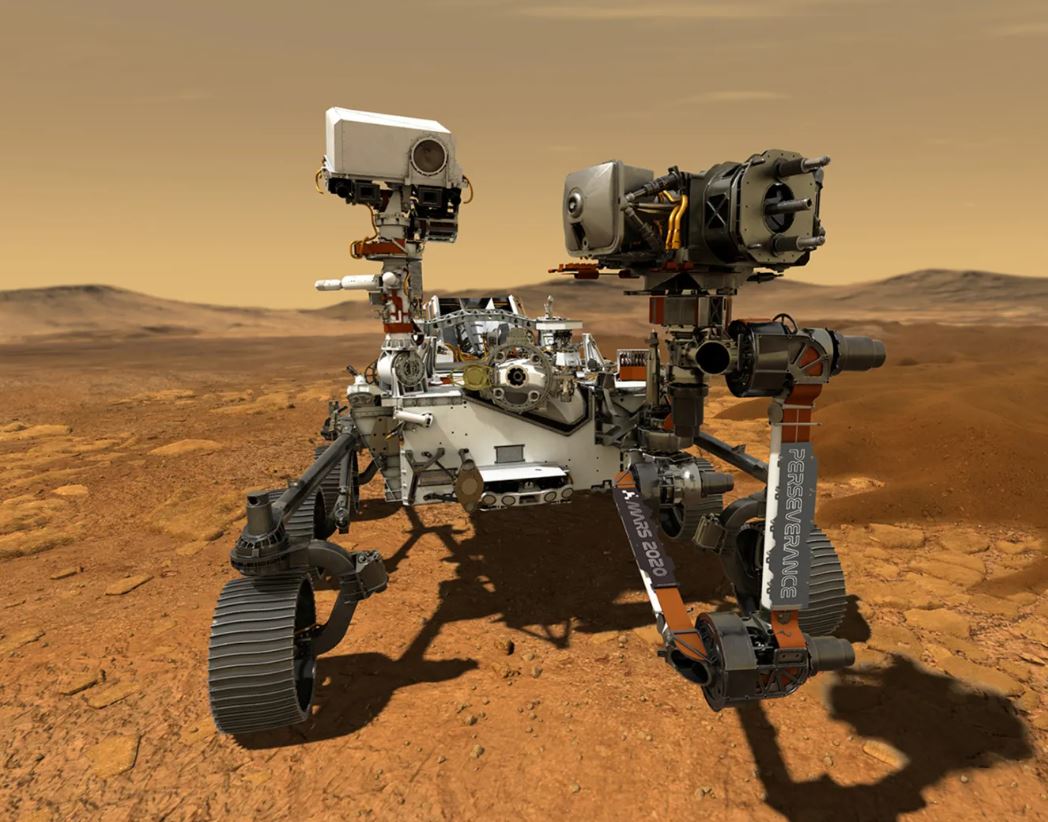
Top Five Reasons for Mars Exploration
(Source: brookings.edu)
- The first important reason for studying Mars is finding out whether life was ever there because it can help scientists understand life outside of Earth.
- Studying Mars can help us understand more about its volcanic activity, past water, and climate, helping us know how our planet evolved.
- Mars missions help us prepare for humans to visit Mars by testing ways to make water, oxygen, and fuel there.
- These explorations also improve space technology, such as robots and new engines, which can be useful for future space travel and Earth.
- Mars exploration inspires young scientists and engineers and encourages cooperation between space agencies like NASA, ESA, and others globally.
Final Thoughts
Various space agencies like NASA, ESA, CNSA, and ISRO lead Mars exploration. Mars Exploration Statistics: Different missions aimed at making scientific discoveries and preparing for human exploration. These missions focus on collecting Mars samples, testing technologies to use Martian resources, and planning for future human landings. These Mars Exploration Statistics include all global past and current analyses, along with many projects costing several Mars missions by different organisations.
Despite the high costs, these missions are helping scientists learn more about Mars and paving the way for humans to explore the Red Planet in the future. The next two decades will see even more exciting missions and developments in Mars exploration.
FAQ
While nearly 100% of the Martian surface has been mapped and photographed from orbit by satellites, less than 1% has been explored up close by rovers and landers.
A standard “Martian solar minute” is equal to exactly 61.65 seconds in Earth time.
In terms of Einstein’s physics, yes, you would age faster on Mars due to its weaker gravity, but the difference is incredibly microscopic, amounting to only a few extra seconds over an entire lifetime. However, biologically, the harsh environment could accelerate physical wear-and-tear.