








Overview
Nursing Burnout Statistics: Nurses are the backbone of every healthcare system, but many are reaching their breaking point. Long shifts, heavy workloads, staff shortages, and the emotional stress of caring for patients every day are causing more nurses to experience burnout than ever before. Burnout can affect both their physical and mental health, leading to stress, fatigue, lower job satisfaction, and even decisions to leave the profession.
It also impacts patient care and increases pressure on hospitals. Understanding the latest nursing burnout statistics helps reveal the size of this growing problem and why healthcare organizations must take action to support nurses, improve working conditions, and build a stronger healthcare workforce.
Top Insights
- 53% of nurses reported experiencing burnout in 2026, down from 59% in 2024.
- 62% of nurses said they felt overwhelmed by their work.
- 53% experienced prolonged workplace stress, making it one of the most common mental health challenges.
- 49% identified dissatisfaction with salary and wage policies as the leading cause of burnout.
- 48% blamed unmanageable nurse-to-patient ratios for increasing workplace stress.
- 51% encountered ethical dilemmas or moral injury while working.
- 83% experienced verbal abuse from patients or their family members.
- 46% reported compassion fatigue, matching the share affected by alarm fatigue.
- 41% stayed in bedside nursing primarily because of financial necessity.
- 62% of U.S. nurses felt overwhelmed, while 53% reported burnout in 2026.
Top Workplace Factors Behind Nurse Burnout In 2026
- 49% of nurses said dissatisfaction with salary and wage increase policies was the biggest factor affecting their mental health, according to a report published by nurse.com.
- 48% pointed to a lack of responsive leadership.
- Another 48% reported that unmanageable nurse-to-patient ratios increased workplace stress.
- 43% said excessive documentation added to burnout.
- 41% felt their concerns were not heard, negatively affecting their well-being.
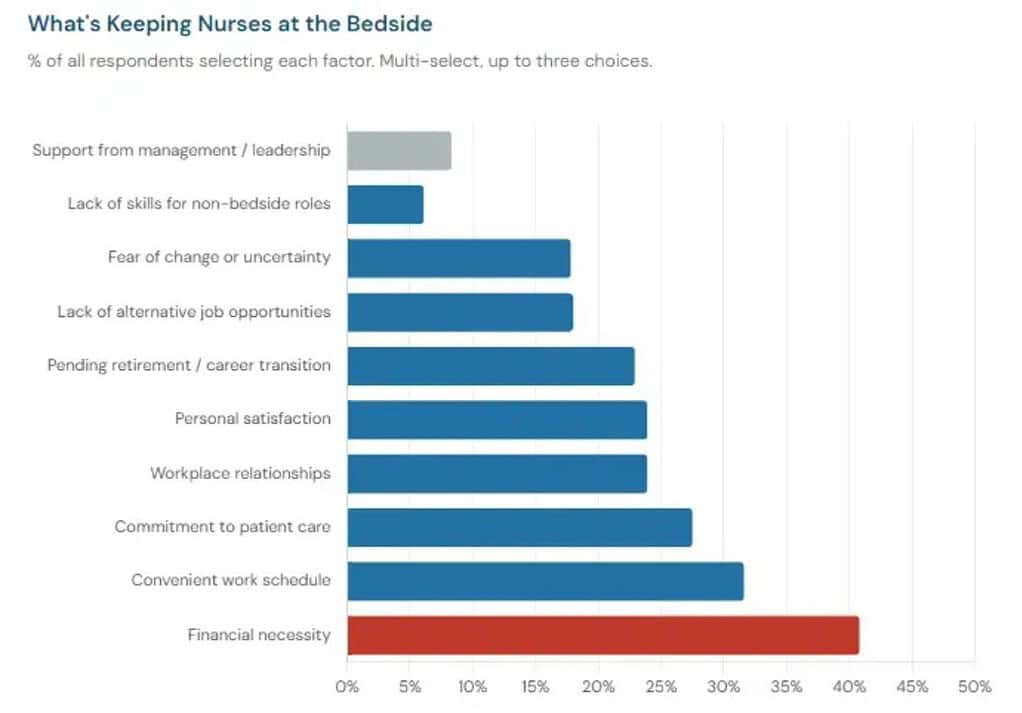
Factors Keeping Nurses At The Bedside
(Source: nurse.org)
- Financial necessity is the main reason nurses remain at the bedside, selected by 41% of respondents.
- A convenient work schedule is the second-largest factor at 32%, followed by commitment to patient care at 28%.
- Personal satisfaction and workplace relationships each influence 24% of nurses, while pending retirement or a career transition affects 23%.
- Fear of change or uncertainty and limited alternative job opportunities are each reported by 18% of respondents.
- Support from management or leadership accounts for 8%, while a lack of skills for non-bedside roles accounts for 6%.
- The 2026 Nurse.org State of Nursing Survey included 2,090 respondents, who could select up to three factors.
Other Workplace Stress Factors Affecting Nurses
- In 2026, 53% of nurses said they experienced prolonged stress at work.
- 51% reported facing ethical dilemmas or moral injury during their jobs.
- 46% experienced compassion fatigue, while another 46% struggled with alarm fatigue.
- 31% said they dealt with depression related to work.
- 25% reported feeling isolated from their coworkers.
Nurse-Reported Burnout And Well-Being Trends, 2024 Vs. 2026
| Reported experience | 2024 | 2026 |
| Feeling overwhelmed | 68% | 62% |
| Burnout | 59% | 53% |
| Prolonged stress | 54% | 51% |
| Compassion fatigue | 47% | 46% |
| Mental-health concerns | 48% | 46% |
| Physical-health concerns | 49% | 40% |
Burnout Trends By Nursing License Type
- According to the survey done by Nurse, in 2026, registered nurses made up 80% of survey respondents. Among them, 62% felt overwhelmed, 54% experienced burnout, and 52% reported prolonged stress over the previous two years.
- Licensed practical nurses/licensed vocational nurses (LPNs/LVNs) represented 15% of respondents and most often reported dissatisfaction with pay and feeling unheard.
- Advanced practice registered nurses reported the highest salaries and greater job satisfaction overall.
- 49% of RNs planned to pursue additional certifications, indicating that many may be seeking new career opportunities because of burnout.
By Gender
- Female nurses accounted for 91% of respondents in the 2026 survey.
- Male nurses represented 7% of respondents.
- Around 30% of male nurses considered leaving the profession, compared with 23% of female nurses.
By age and generation
- Generation Z nurses (under 28) represented 4% of respondents and reported the lowest salary satisfaction.
- Millennials (29-44) were the most likely to say higher pay would encourage them to remain in the profession.
- Generation X and Baby Boomers (45-79) generally reported higher job and salary satisfaction than younger nurses.
- More than 60% of Generation X and Baby Boomers believed AI could make patient care feel less personal, creating additional workplace stress.
By Race and Ethnicity
| Racial/Ethnic Group | Key Finding |
| American Indian & Alaska Native | Nearly 40% of nurses wanted workplace bonuses. |
| Asian | 59% reported burnout, the highest rate among surveyed groups. |
| Black or African American | Nurses were more likely than White nurses to receive a salary increase after certification. |
| Hispanic, Latinx, or Spanish | 67% felt overwhelmed, representing the highest reported rate. |
| Native Hawaiian or Other Pacific Islander | Nurses reported the highest median annual salary. |
| White | 25% considered leaving the nursing profession. |
Country-wise Nurse Burnout And Workplace Stress Statistics
- 2026 Nurse Salary and Work-Life Report further stated that in 2026, in the United States, 62% of nurses felt overwhelmed, 53% reported burnout, while 51% experienced prolonged stress and 46% reported compassion fatigue.
- The same U.S. report found that 46% of nurses faced job-related mental health concerns, while 40% experienced physical health concerns.
- According to the Journal of Nursing Management, around 56% experienced burnout, 42% had an intention to leave, and only 40% of nurses felt valued.
- Royal College of Nursing’s 2026 Last Shift Survey further stated that in the United Kingdom, 76% of nurses experienced emotional exhaustion, while 64% said staffing levels were below need and 44% believed patient care was compromised.
- Australian Health Workforce Taskforce report 2026 mentioned that in Australia, 13.5% of hospital-based nurses and midwives planned to resign from their jobs.
- Almost 50% of emergency nurses intended to leave the profession within the next 5 years.
United States Registered Nurse Workforce Growth Statistics
- Data released on May 15, 2026, showed that 4.91 million registered nurses held active licenses in May 2025, while 3.76 million were employed, leaving about 1.15 million licensed RNs not working as RNs, according to the U.S. Bureau of Labor Statistics.
- The number of licensed RNs not working in RN roles increased by 17,661, from 1.13 million in May 2024 to 1.15 million in May 2025.
- In 2025, 192,915 first-time U.S.-educated candidates passed the NCLEX-RN exam, compared with 157,206 in 2016.
- A February 2024 workforce analysis used data from 455,000 RNs and U.S. Census records to evaluate future workforce trends, as per the peer-reviewed Journal of the American Medical Association.
- The study projected the U.S. RN workforce will grow by about 1.2 million by 2035, exceeding expected Baby Boomer retirements.
States Facing The Largest Nursing Shortages In 2026
- According to nightingale.edu, Idaho is projected to face the highest nursing shortage at -35%, with a deficit of -6,300 registered nurses.
- Virginia follows at -30% (-25,670), ahead of Oklahoma at -28% (-11,530) and New Mexico at -26% (-4,990).
- Louisiana is expected to record -25% (-12,340), while Maryland is expected to reach -23% (-13,800).
- South Carolina (-21%, -11,690), Iowa (-20%, -6,290), Colorado (-20%, -9,970), and West Virginia (-19%, -3,860) also face significant registered nurse workforce shortages in 2026.
States Expected To Need The Most Registered Nurses In 2026
- Based on the total number of nurses needed, California ranks first with a deficit of -42,590 registered nurses despite a -13% shortage rate.
- Virginia follows with -25,670 (-30%), while Pennsylvania records -22,760 (-16%).
- North Carolina (-17,490, -16%) and Michigan (-17,120, -16%) also report large shortages.
- Florida (-14,940, -7%), Texas (-14,580, -6%), Maryland (-13,800, -23%), and Georgia (-12,370, -12%) complete the list.
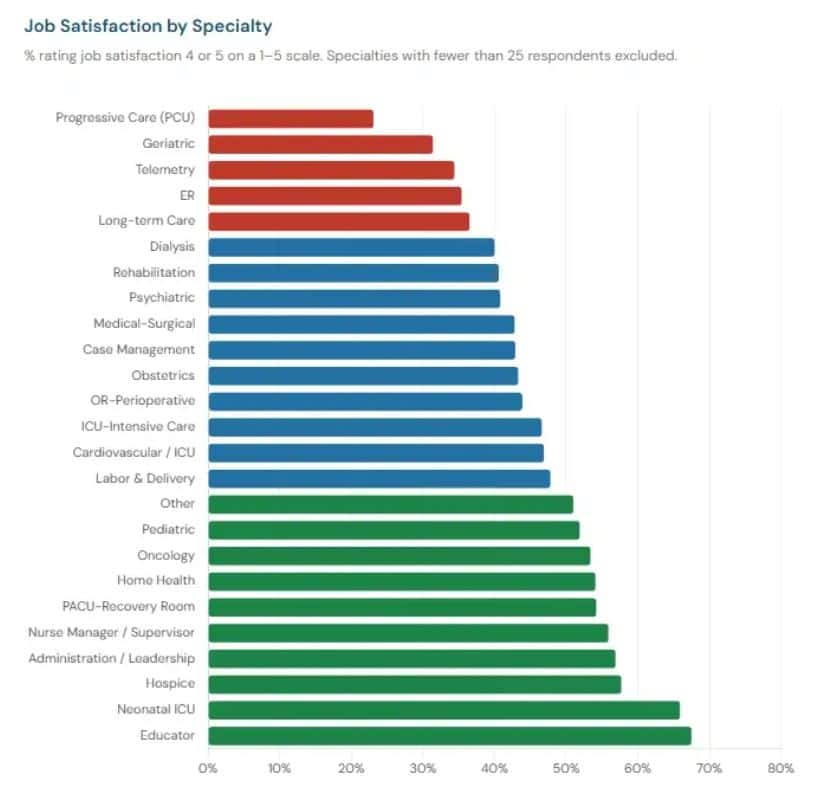
Job Satisfaction By Nursing Specialty
(Source: nurse.org)
- The chart shows the share of nurses who rated job satisfaction as 4 or 5 on a 1-5 scale in the 2026 State of Nursing Survey, based on 2,090 respondents.
- Specialties with fewer than 25 respondents were excluded.
- Educators reported the highest satisfaction at about 68%, followed by Neonatal ICU at 66%, Hospice at 58%, and Administration/Leadership at 57%.
- Nurse Managers/Supervisors reached 56%, while Oncology, Home Health, and PACU-Recovery Room were each near 54%. Pediatric was 52%, and Other was 51%.
- Lower satisfaction was reported in Progressive Care Unit at about 23%, Geriatric at 31%, Telemetry at 34%, ER at 35%, and Long-term Care at 36%.
- Mid-range specialties included Dialysis at 40%, Rehabilitation and Psychiatric at 41%, Medical-Surgical and Case Management at 43%, and Labor & Delivery at 47%.
Current Nursing Shortage Statistics, 2026
| Occupation | Share | Positions |
| Registered Nurses | -8% | 263,870 unoccupied positions |
| Licensed Practical Nurses | -14% | 94,320 unoccupied positions |
| Nurse Practitioners (overall) | +15% | 56,990 staff in excess |
| Primary Care Nurse Practitioners | +15% | 12,340 staff in excess |
| Psychiatric Nurse Practitioners | +2% | 380 staff in excess |
| Nurse Anesthetists | +1% | 900 staff in excess |
| Women’s Health Nurse Practitioners | +19% | 1,680 staff in excess |
| Nurse Midwives | +1% | 90 staff in excess |
Medical Department Burnout Statistics
- Nursing burnout statistics reveal the burnout percentages among the various doctors, including plastic surgery, which has the lowest percentage of burnout at 23%, followed by dermatology and pathology at 32%.
- These two rates are closely followed by the percentages for ophthalmology and orthopedics, which are 33% and 34%, respectively, with the health professionals dealing with diabetes and endocrinology having a burnout value of 35%.
- Public health and psychiatry also have a value of 36%, showing a very high mental and emotional toll on healthcare professionals.
- Those in rheumatology, anaesthesiology, and gastroenterology have the same percentage of burnout, which is 38%, while oncology and nephrology have rates of 39% and 40%, respectively.
- Infectious diseases and pediatrics also show the same 40%, and then pulmonary medicine and otolaryngology at 41% and 42%, respectively.
- Cardiology and general surgery are common, with 43% burnout, as well as allergy, immunology, and urology.
- Some specialties, like physical medicine and rehabilitation, also have 44% burnout, while radiology and emergency medicine professionals experience 45% burnout. Internal medicine and obstetrics/gynecology have the same value of 46%, although family medicine is slightly above this average at 47%.
- Neurology and critical care are at the top, with 48% of those most affected by burnout. This shows how much pressure and demand these specialties have from their patients or work.
- From these categories, therefore, the symptoms of burnout differ among the types, with some more seriously burned than others.
Workplace Violence and Abuse Experienced By Nurses
- Around 83% of nurses experienced verbal abuse from patients or their family members.
- 51% reported intimidation from colleagues, creating additional workplace stress.
- 35% experienced physical assault or abuse from patients or family members.
- Only 15% faced workplace violence every week.
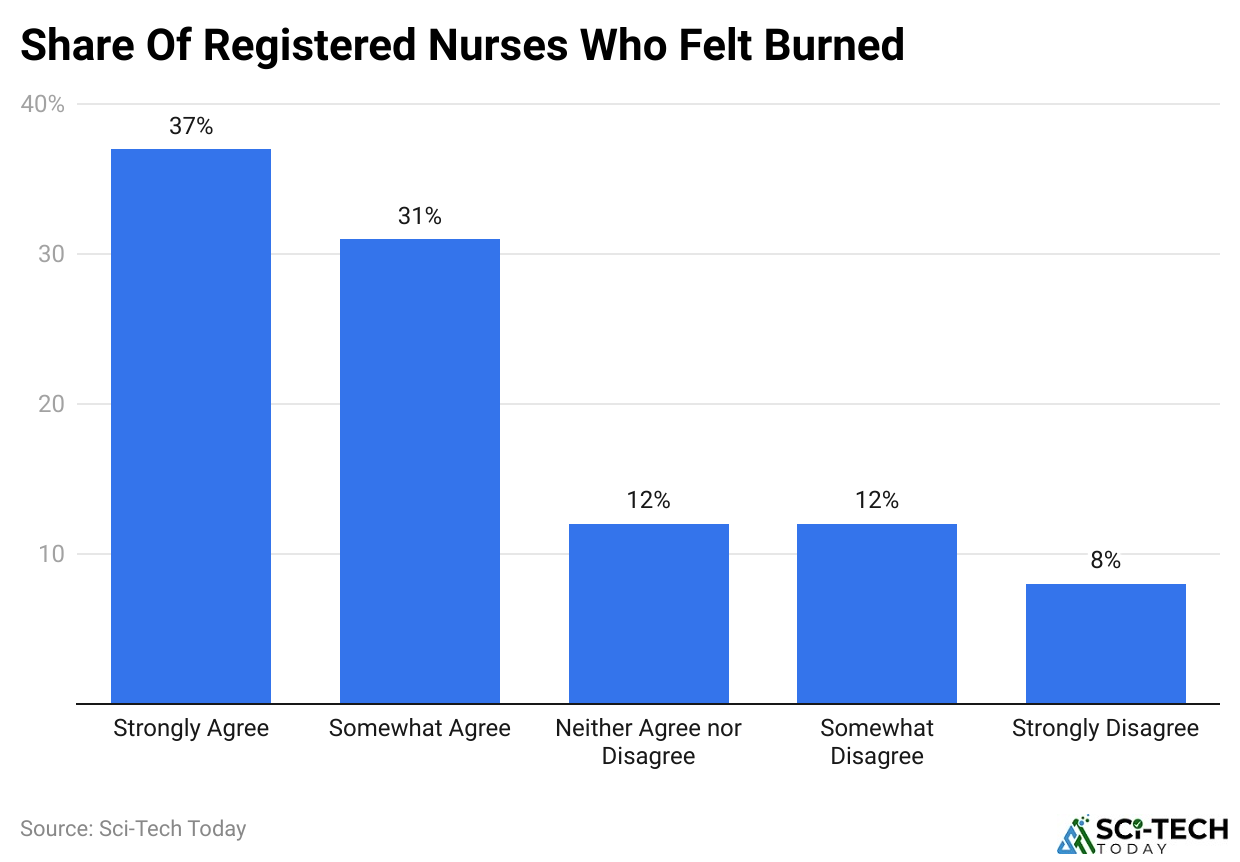
Share Of Registered Nurses Who Felt Burned
(Reference: statista.com)
- More than two-thirds reported having experienced burnout regularly most days of the week, with 37% strongly agreeing and 31% somewhat agreeing, whereas only 8% disagreed.
- Workloads, Canberra-caused issues, and lower nurse staffing levels have all added to these increasing feelings. This problem is compounded by an aging nursing workforce.
- According to nursing burnout statistics, the mean age of the registered nurse (RN) is 52, meaning that many are nearing retirement age.
- As more nurses retire, the need for new nurses to fill the shortage will increase.
- The 2020 HRSA Nurse Workforce Projections report estimates a shortage of 78,610 full-time RNs by 2025 and 63,720 by 2030, with an expected fulfillment of 98% for the needs expressed.
- Meanwhile, the Bureau of Labor Statistics projects a 6% growth of the nursing workforce over the next few years, slightly higher than the actual average growth of 5% among all jobs.
- However, it is said that Nursing Burnout Statistics paints a more severe picture of the shortage in that, unlike the projections above, they estimate that the number of nurses would be lower, from 200,000 to 450,000, which constitutes 10% to 20% of the needed workforce by 2025.
- Burnout has led to a significant proportion of nurses looking forward to leaving their positions.
- Globally, around 40% of nurses are looking to change jobs within this profession, of which close to 27% are considering changing jobs to those of travel nurses.
- In addition to that, 23% are contemplating alternative careers, and 10% are weighing the option of retiring from nursing completely.
- These data point to the necessity of establishing immediate strategies to combat these forces of burnout and retain key nursing personnel.
Summary
Nursing burnout is a growing problem that affects nurses, patients, and healthcare systems. Heavy workloads, long shifts, stress, and staff shortages make it harder for nurses to stay healthy and provide the best care.
Hospitals and healthcare leaders should focus on better staffing, mental health support, and a healthy work environment. Supporting nurses improves patient safety, reduces staff turnover, and helps build a stronger, more reliable healthcare workforce.
FAQ
Common causes of nursing burnout include long working hours and mandatory overtime, high patient-to-nurse ratios, staffing shortages, emotional stress from patient care, administrative workload and documentation, workplace violence or harassment, and lack of organizational support.
Common symptoms are chronic fatigue, emotional exhaustion, reduced job satisfaction, increased irritability, difficulty concentrating, sleep disturbances, frequent absenteeism, and feeling detached from patients or coworkers.
Approximately 30%-60% of nurses experience moderate to high burnout, varying by specialty, workplace, and country.

Sources