









Starter
Targeted Advertising Statistics: Targeted advertising is a marketing strategy where ads are tailored to specific groups of people based on their interests, behaviors, demographics, or online activity. Instead of showing the same message to everyone, targeted ads aim to reach the right audience with relevant content. This makes the ads more likely to engage people and lead to sales.
However, there are challenges like privacy issues, changing regulations, and the need to keep up with shifting consumer preferences. To stay effective, companies must keep improving their targeting strategies. This article will guide you accordingly, as it includes several current trends and analyses from different insights of recent years.
Top Selections by the Editor
- The global targeted advertising market does not have a consistently reported standalone 2025 value comparable to the earlier USD 213 billion estimate.
- The broader global digital advertising market was estimated at approximately USD 777 billion in 2025, representing 75.2% of total global advertising expenditure.
- Google, Meta, and Amazon remained the three leading digital-ad platforms. Together, Google and Meta accounted for more than 50% of global digital advertising, while Amazon remained the third-largest platform; estimates put Amazon’s worldwide advertising revenue at approximately USD 68.64 billion in 2025.
- Targeted Advertising Statistics do not provide a verified, cross-platform 2025 average CTR directly comparable with the 3.12% figure.
- Performance varies significantly by channel: average Facebook traffic-campaign CTR was around 1.57%, while lead-generation campaigns averaged 2.53%.
- Likewise, no standardized 2025 global conversion-rate comparison for personalized ads (9.8%) versus non-targeted ads (5.4%) was found, so these figures should not be replaced with unsupported numbers.
- Digital ad spending was estimated at approximately USD 777 billion in 2025, up from more than USD 790 billion reported for 2024 under a different market-estimation methodology.
- Meta generated about USD 164.5 billion in advertising revenue in Advertising continued to account for roughly 98% of Meta’s total revenue, so targeted and personalized advertising remained central to its business model.
- Google generated approximately USD 402.84 billion in advertising revenue in 2025, remaining the largest advertising business globally. Advertising continued to represent the majority of Alphabet’s revenue, although the exact targeted-ad share of total revenue was not separately disclosed.
- Global companies’ precise annual expenditure on targeted ads was not separately reported for 2025. However, digital advertising expenditure reached about USD 777 billion, and almost 90% of digital ads use some form of targeting or personalization.
- A directly comparable 2025 figure for the share of social-media users who purchased a product because of targeted advertising was not found. The closest cited evidence is that targeted social advertising can strongly affect purchase intent: 80% of consumers report being more likely to purchase from brands offering personalized experiences.
- By the end of 2026, the social media advertising budget will increase by 11.76%.
General Targeted Advertising Statistics
- As of 2025, programmatic advertising accounted for approximately 82.4% of global digital advertising spend, with businesses spending more than USD 650 billion on programmatic placements. This is the closest standardized measure available; it is not limited solely to “targeted” digital ads.
- Mobile apps continued to play a significant role in capturing user data.
- In the United States, in-app advertising represented 41.5% of total digital ad spending in 2025, while mobile advertising overall accounted for more than 70% of worldwide digital-ad spending.
- The United States remained the largest social-media advertising market, with social-media ad spending estimated at approximately USD 84.6 billion in 2025.
- Targeted video ads continued to expand in 2025, led by platforms such as YouTube and TikTok. A single verified global year-over-year growth figure directly comparable with the earlier 14.3% estimate was not available; however, programmatic video grew about 24% year over year, and connected-TV programmatic ad buying increased by roughly 38%.
- A universal average CPC for targeted ads was not reported for 2025 because prices vary sharply by channel and industry. For comparison, Google Search ads averaged USD 5.26 per click, Facebook lead-generation ads averaged USD 1.92, and Microsoft Ads averaged USD 1.54.
- Targeted advertising campaigns likewise do not have a reliable single cross-platform 2025 CTR. Google Search ads averaged a 6.66% CTR, Facebook lead-generation campaigns averaged 2.59%, and TikTok ads averaged 0.84%.
- Moreover, an equivalent 2025 worldwide percentage of internet users using ad blockers was not consistently reported. The closest current evidence indicates 25% of U.S. consumers use ad blockers when browsing, while adoption is about 25% on mobile versus 42% on desktop globally.
What is Targeted Advertising?
Targeted advertising means showing ads to specific groups of people. It works both online and offline in many industries. The main idea is to find your potential customers and group them based on certain characteristics.
Global Internet Advertising by Revenue
(Reference: statista.com)
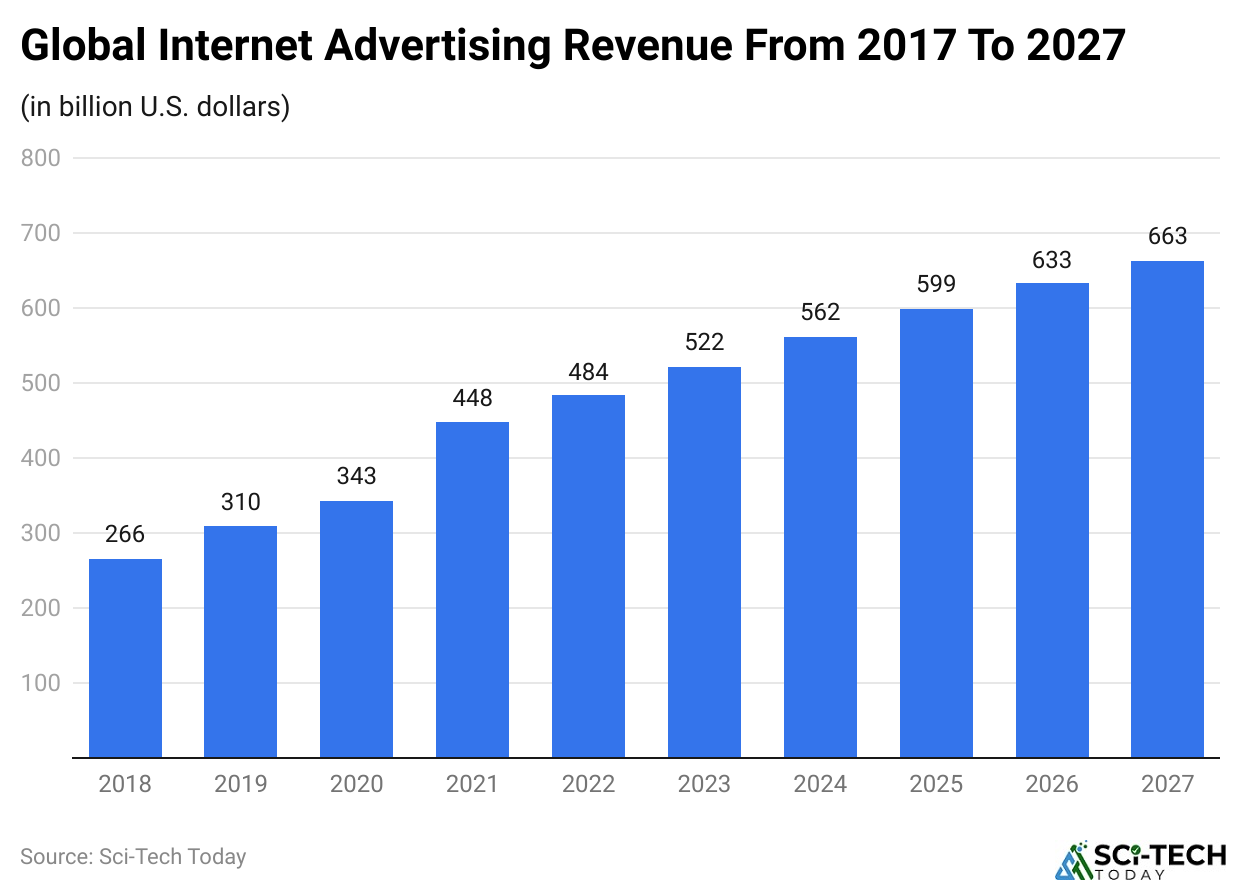
- In the fiscal year 2024, the global internet advertising revenue is expected to be USD 562 billion.
- In the coming years, the revenue rates are projected to be around 2025 (USD 599 billion), 2026 (USD 633 billion), and 2027 (USD 663 billion).
Targeted Ad Spending by Countries
- Targeted Advertising Statistics elaborate that the United States led in targeted ad spending, with USD 171.33 billion in 2025, digital ad spending specifically, with a growth rate of 6.7% from 2024.
- Emerging markets like India are experiencing significant growth, with a 20% year-on-year increase in digital advertising spending in FY2025, reaching Rs 49,000 crore and now commanding 44% of India’s total ad market.
The table below shows the targeted ad spending by major countries in 2024:
| Country | Targeted Ad Spending (USD) | Growth Rate (YoY) |
| China | 100 billion | 15% |
| United Kingdom | 30 billion | 8% |
| Germany | 25 billion | 7% |
| Japan | 22 billion | 10% |
| India | 15 billion | 20% |
| Brazil | 10 billion | 12% |
| Canada | 9 billion | 9% |
| Australia | 7 billion | 6% |
| France | 6 billion | 5% |
Total Spending by In-App Advertising
(Reference: statista.com)
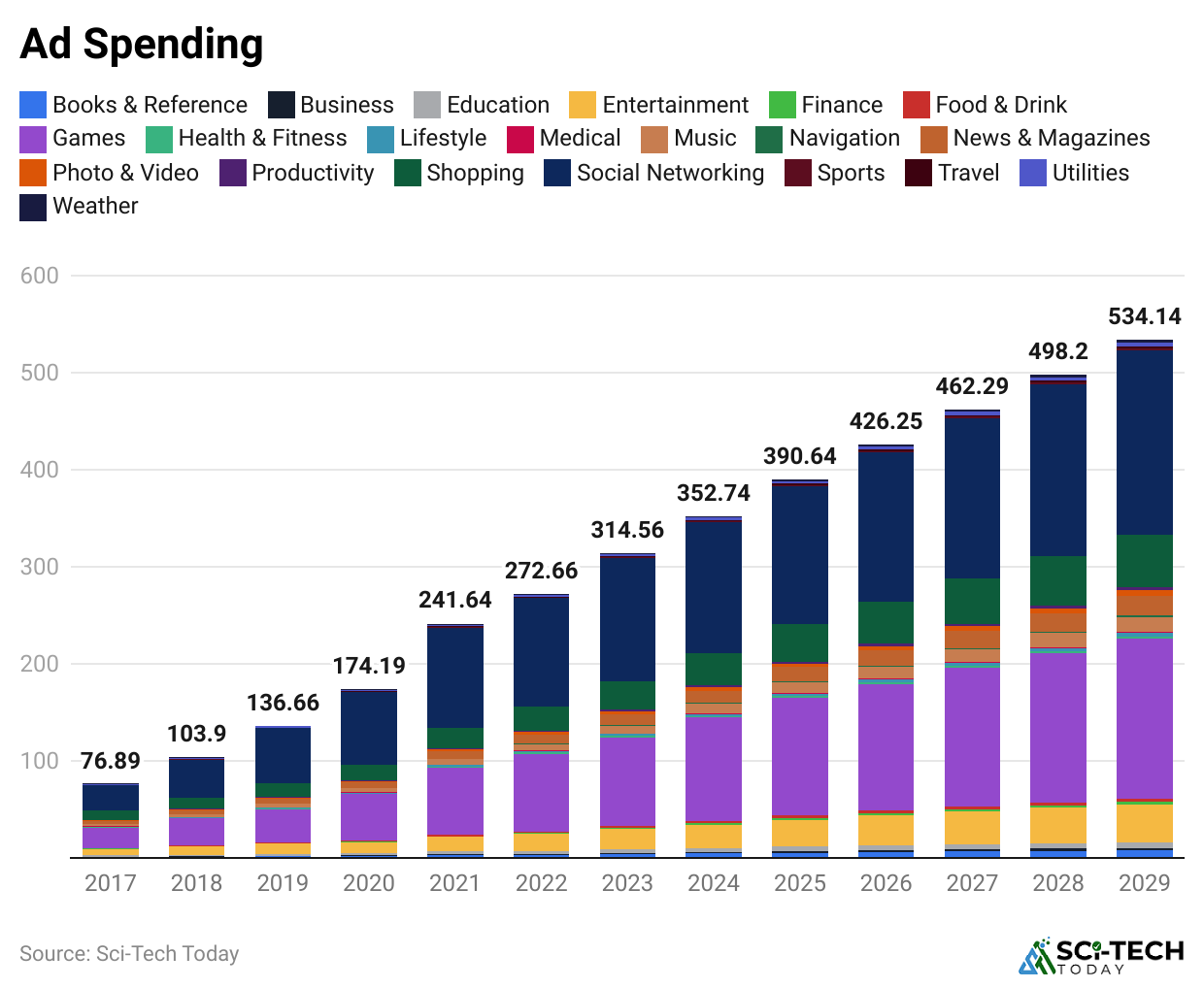
- Based on Statista’s 2024-2029 category forecasts, the social networking segment was projected to spend approximately USD 144.08 billion on in-app advertising in 2025, followed by games (USD 116.19 billion), shopping (USD 37.15 billion), entertainment (USD 26.89 billion), and news and magazines (USD 14.10 billion).
- These estimates apply the implied compound annual growth rate from Statista’s published 2024 and 2029 figures for each category.
Furthermore, other apps’ Ad Spending in 2024 is stated in the table below:
| In-Apps Names | Ad Spendings (USD billion) |
| Books & References | 5.02 |
| Business | 1.60 |
| Education | 3.76 |
| Finance | 1.36 |
| Food & Drink | 2.32 |
| Health & Fitness | 1.55 |
| Lifestyle | 2.04 |
| Medical | 0.83 |
| Music | 9.44 |
| Navigation | 1.00 |
| Photos & Video | 3.43 |
| Productivity | 1.79 |
| Sports | 1.28 |
| Travel | 1.21 |
| Utilities | 2.35 |
| Weather | 1.72 |
By Search Advertising
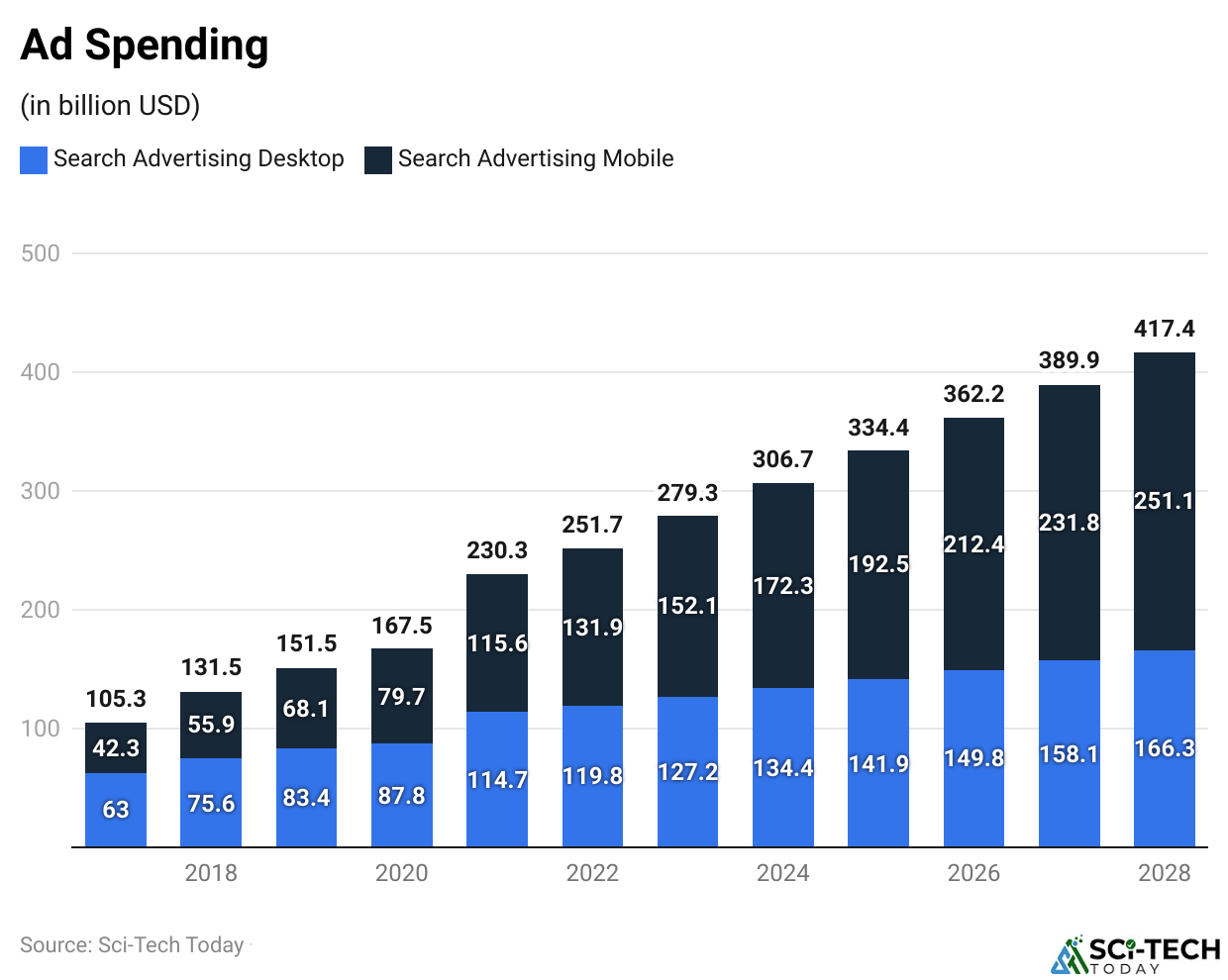
- Ad spending in the search advertising market was projected to reach around USD 334.4 billion in 2025, calculated from the 2024 base of USD 306.7 billion using the stated 8.01% annual growth rate.
- It was projected to continue growing at an annual rate of 8.01% through 2028, leading to a total market size of USD 417.4 billion by 2028.
- Applying the same growth rate to the United States’ 2024 forecast of USD 132.70 billion gives an estimated USD 143.33 billion in U.S. search-ad spending for 2025. This is an extrapolation; a directly published, like-for-like Statista U.S. 2025 figure was not available in the sources reviewed.
- The below graph shows that the total advertisement spending in 2025 is segmented into Search Advertising Desktop and Search Advertising Mobile, resulting in USD 141.9 billion and USD 192.5 billion, respectively.
(Reference: statista.com)
By Social Media Advertising
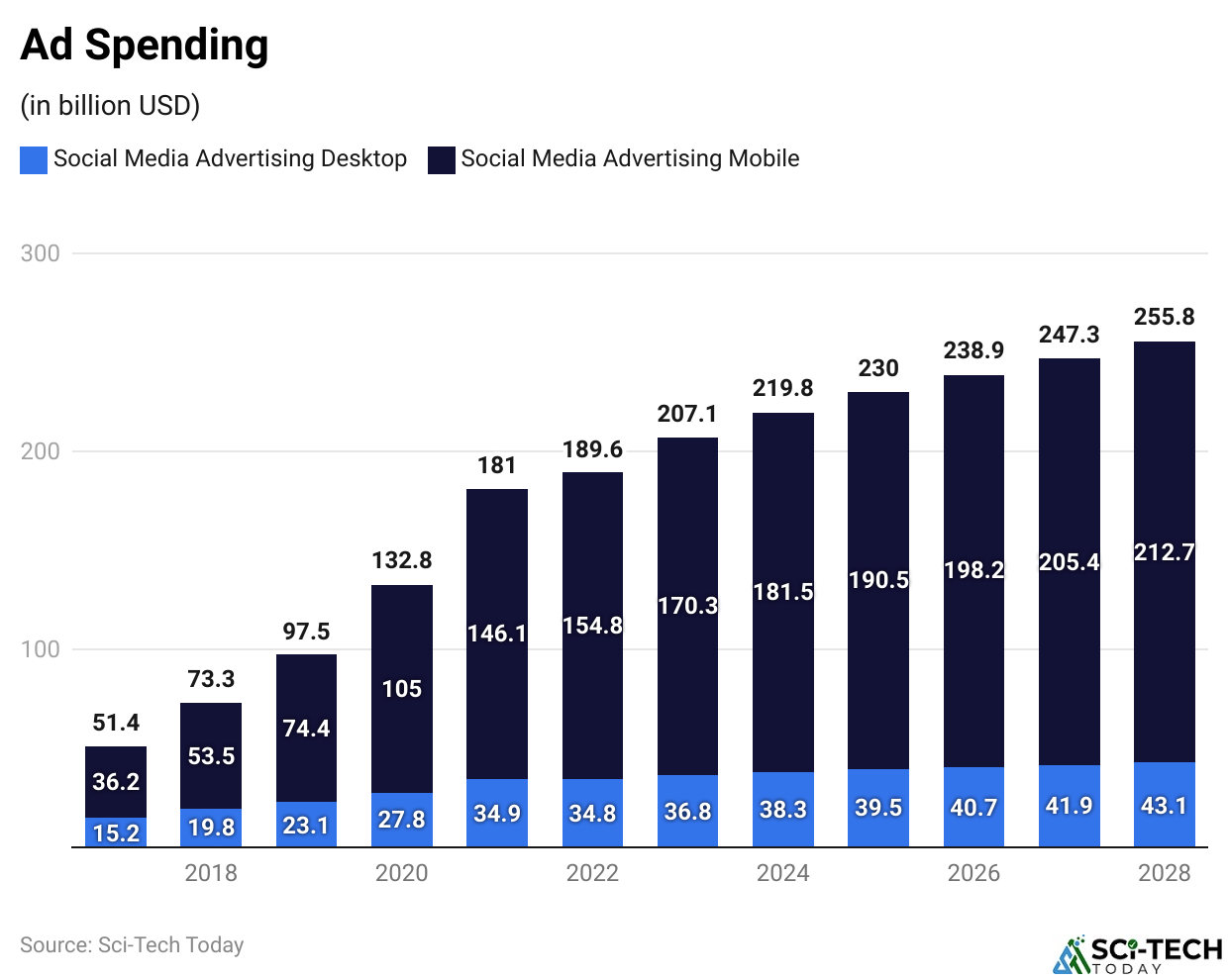
- Targeted Advertising Statistics further reports that total spending on social media ads reached approximately USD 230 billion in 2025, up about 11% year over year.
- China remained one of the largest social-media advertising markets in 2025, although a directly comparable Statista figure matching the earlier USD 81.36 billion estimate was not available in current sources. China’s total digital ad-spend market was estimated at USD 140.97 billion for 2025.
- A directly comparable 2025 split between social-media advertising on desktop and mobile was not published in the reviewed sources.
- However, mobile continued to dominate: in 2024 it represented nearly two-thirds of digital ad investment globally, and forecasts indicate mobile would account for more than 70% of total digital ad spending in 2025.
(Reference: statista.com)
By Digital Banner Advertising
 (Reference: statista.com)
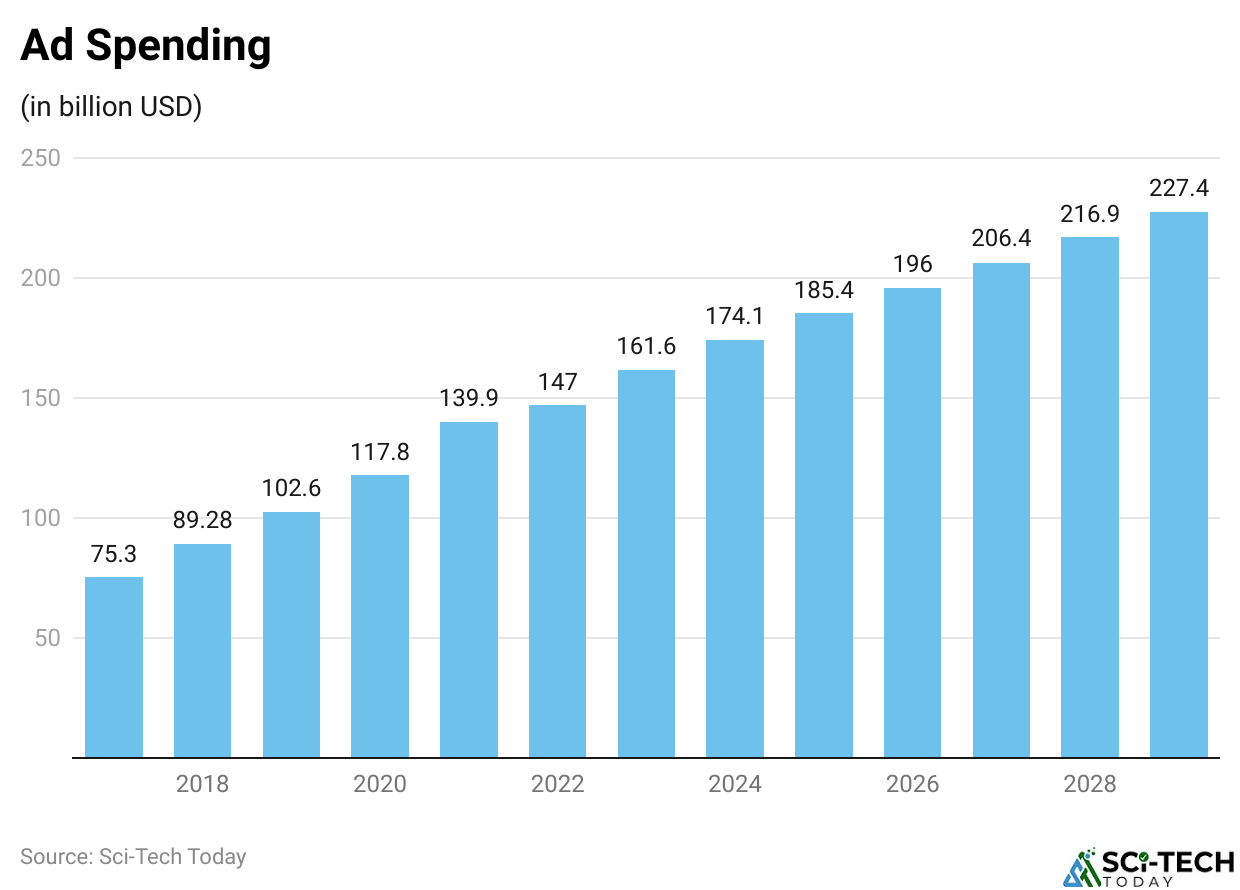
- Worldwide spending on digital banner ads was projected to reach approximately USD 185.4 billion in 2025, based on the stated 5.49% annual growth rate from the 2024 figure of USD 174.10 billion.
- The market was estimated to continue growing at an annual rate of 5.49% through 2029, resulting in USD 227.40 billion by 2029.
- Applying the same annual growth rate, the United States, the largest market was projected to spend around USD 70.80 billion on digital banner advertising in 2025, up from USD 67.12 billion in 2024. This is a calculated estimate, as a directly comparable published U.S. 2025 figure was not available.
By Influencer Advertising
(Reference: statista.com)
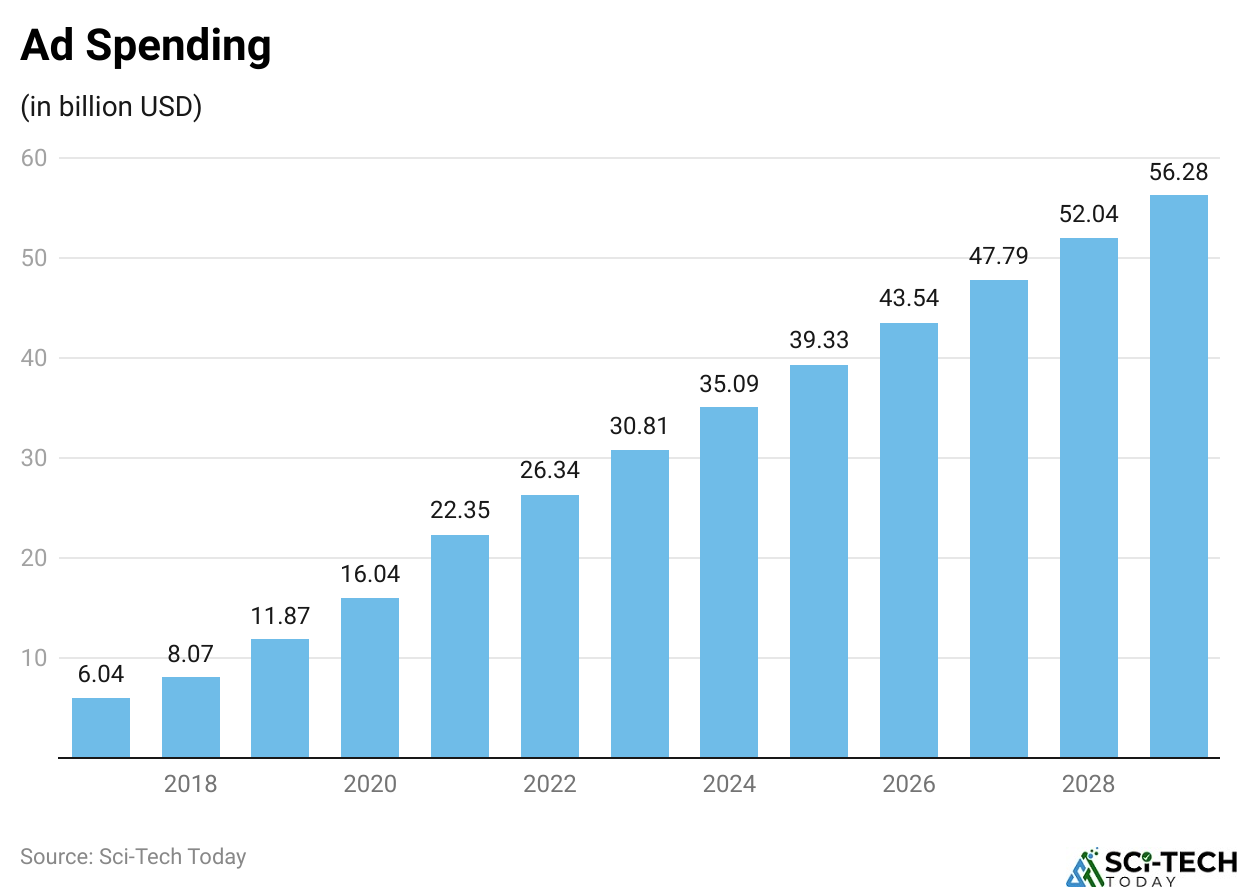
- The influencer advertising market was projected to reach approximately USD 39.33 billion in 2025, based on the implied annual growth rate of 9.91% between the USD 35.09 billion 2024 estimate and the USD 56.28 billion forecast for 2029.
- By 2025, the average amount spent on influencer ads for each internet user was projected to be approximately USD 6.77. This is a calculated estimate using the same implied growth rate.
- China was projected to remain the largest market, with influencer-ad spending of approximately USD 21.06 billion in 2025. This is also calculated by applying the same implied annual growth rate to the USD 19.16 billion 2024 estimate, as a directly published like-for-like 2025 China figure was not available.
By Digital Classifieds
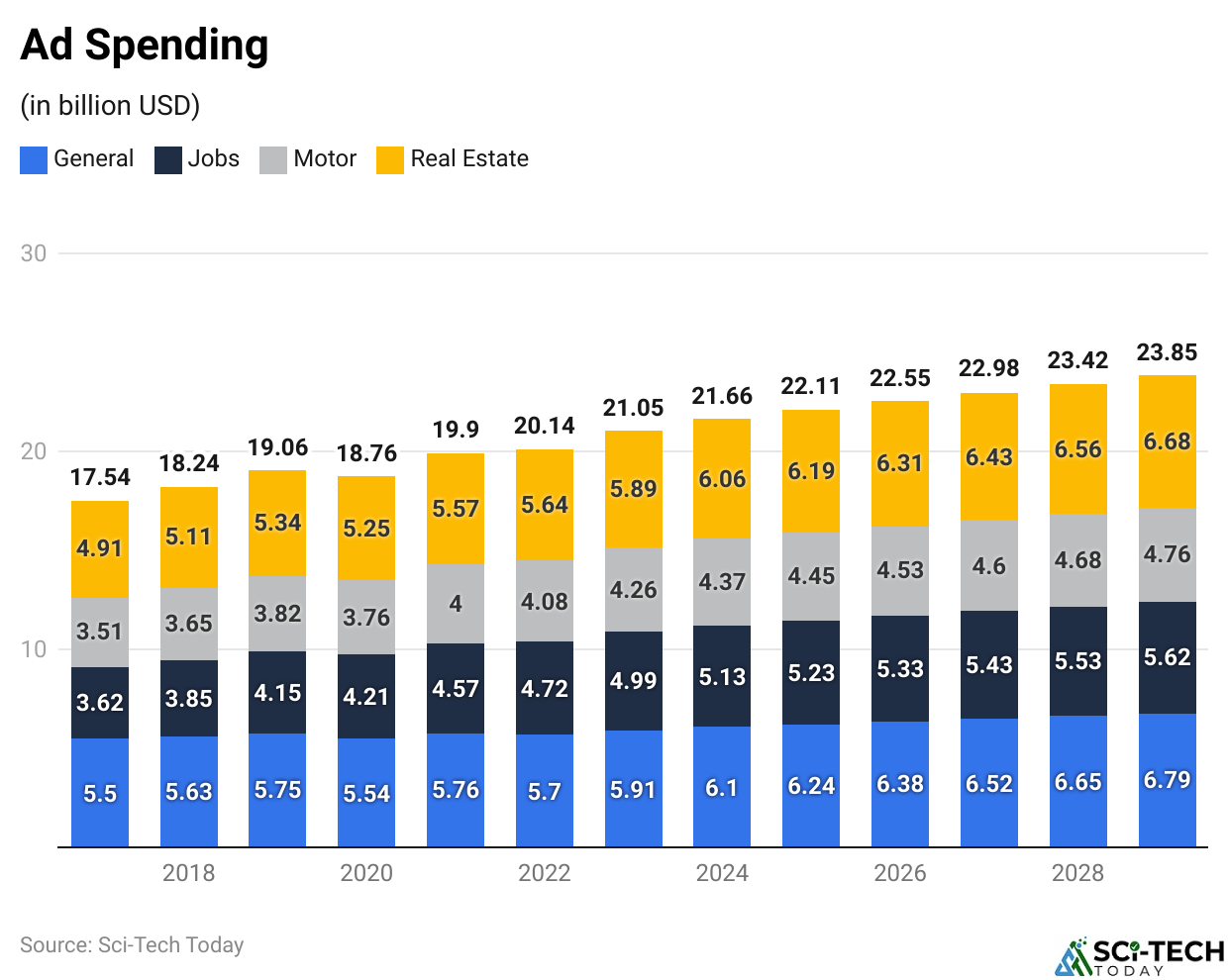
- In 2025, the digital classifieds’ global ad spending will reach USD 22.11 billion, and the market volume is projected to account for USD 23.85 billion by the end of 2029.
- The annual growth rate of the market will grow at a 1.95% CAGR from 2024 to 2029.
(Reference: statista.com)
- The above graph shows that in 2025, the average ad spending of the general classified will reach USD 6.24 billion, followed by real estate (USD 6.19 billion), jobs (USD 5.23 billion), and motor (USD 4.45 million).
- Similarly, the mobile and desktop Ad spending on digital classifieds will be USD 10.20 billion and USD 11.45 billion, respectively.
By Cinema Advertising
(Reference: statista.com)
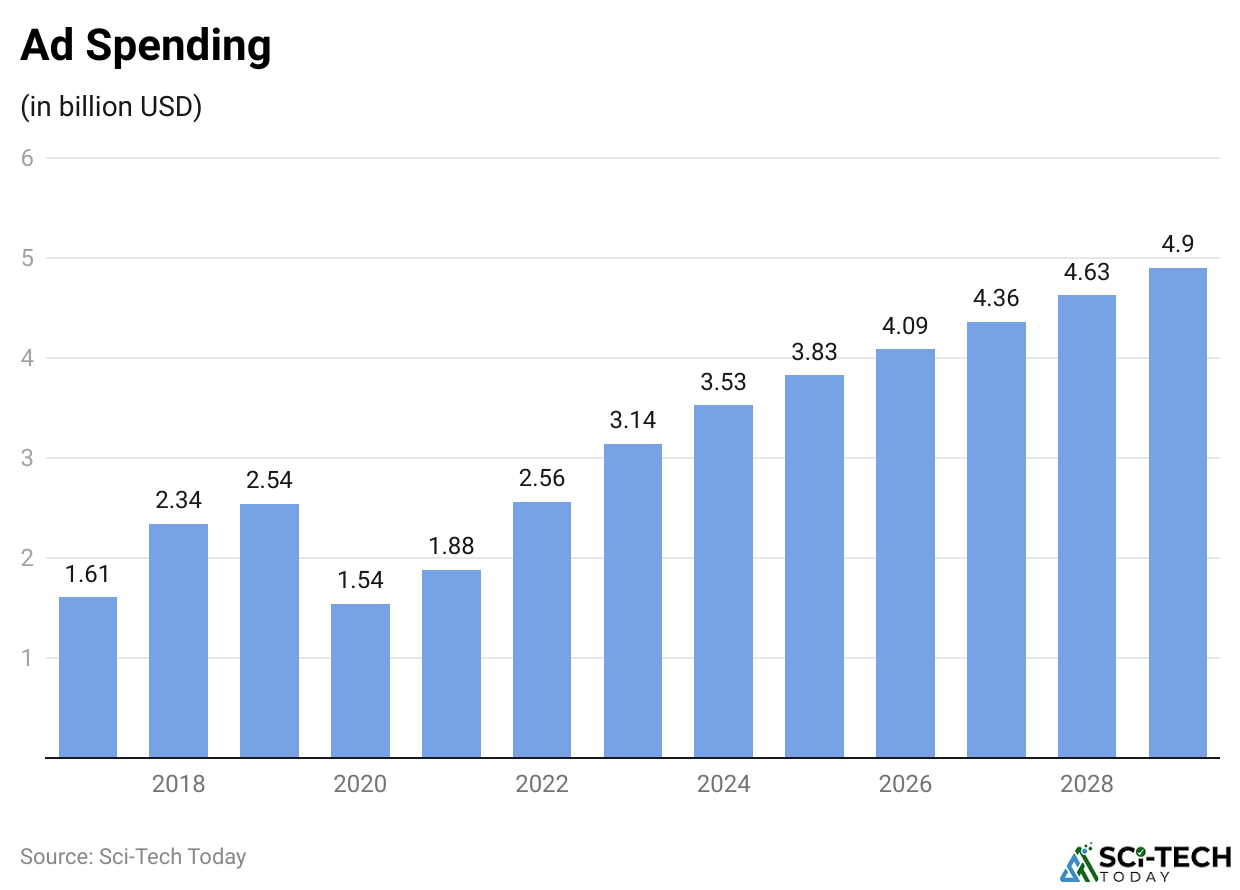
- Cinema advertising spending will reach around USD 3.83 billion in 2025 and USD 4.90 billion by the end of 2029.
- Ad spending will grow by an average of 6.78% each year from 2024 to 2029.
- In 2025, the average ad spending per viewer in cinema advertising will be turned to USD 3.59.
By Retail Platform Advertising
(Reference: statista.com)
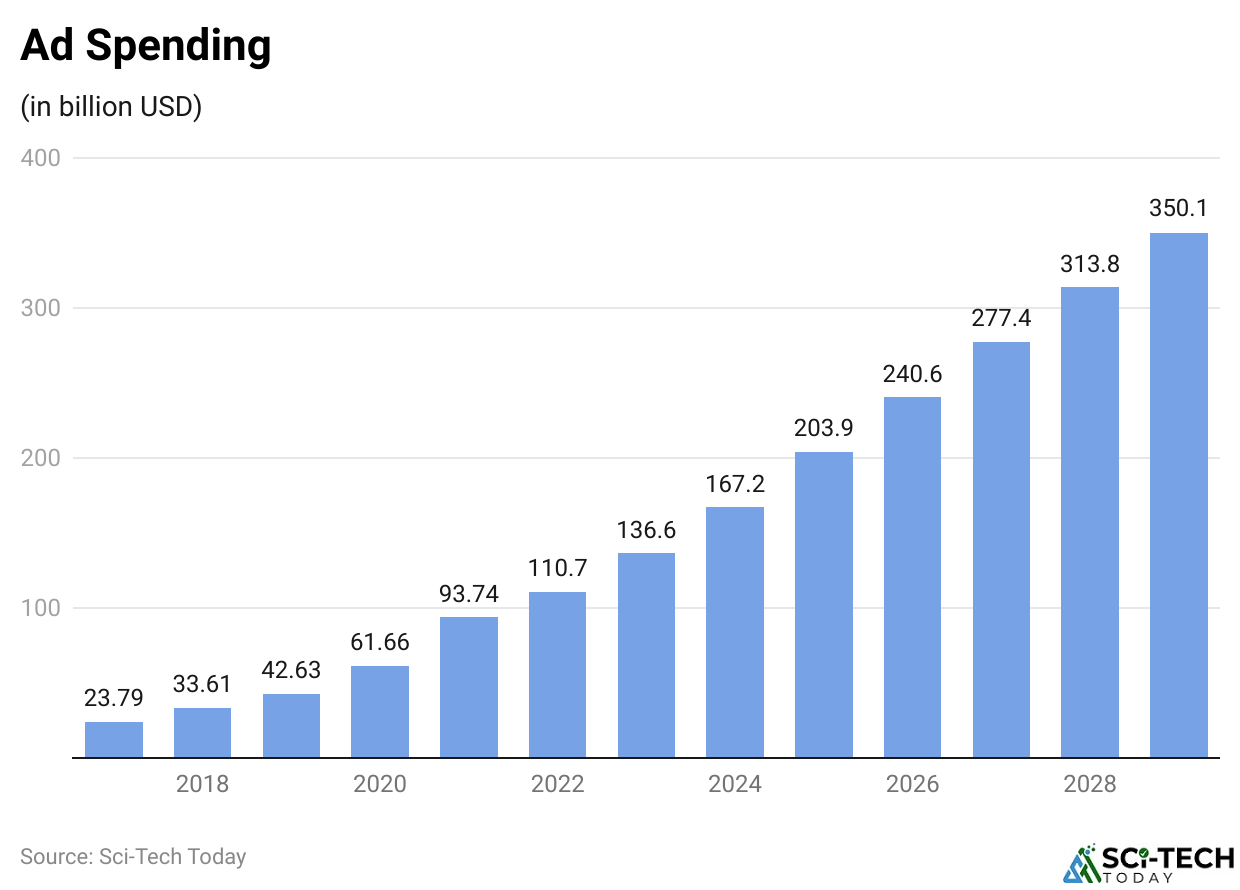
- Targeted Advertising Statistics show that by 2025, ad spending in the retail platform advertising market is estimated to be USD 203.9 billion.
- In contrast, by the end of 2029, ad spending will reach USD 350.10 billion, with a CAGR of 15.93%.
- The United States will lead global ad spending with USD 60.10 billion in 2025.
- In retail platform advertising, desktop and mobile ad spending will account for USD 78.66 billion and USD 88.51 billion, respectively.
By Marketer’s Post Vs Consumer’s Needs
- Targeted Advertising Statistics explained that 18% of marketers post content on social media, and almost 72% of consumers want effective discounts on several products and services.
Furthermore, the table below analyzes all other social media content based on targeted advertising, followed by marketer posts, and consumer needs share in 2025:
| Social Media Content Type | Consumer’s Need | Marketer’s Post |
| Showcase new products or services | 60% | 46% |
| Teach something | 59% | 61% |
| Posts that entertain | 56% | 47% |
| Posts that inspire | 49% | 53% |
| Announce what is happening at the company | 41% | 51% |
| tell a story | 37% | 58% |
| Reports a company’s personality | 23% | 44% |
| About the company’s employee | 13% | 24% |
| Partnership with influencers | 12% | 16% |
Consumer Perception on Targeted Advertising
(Reference: prnewswire.com)
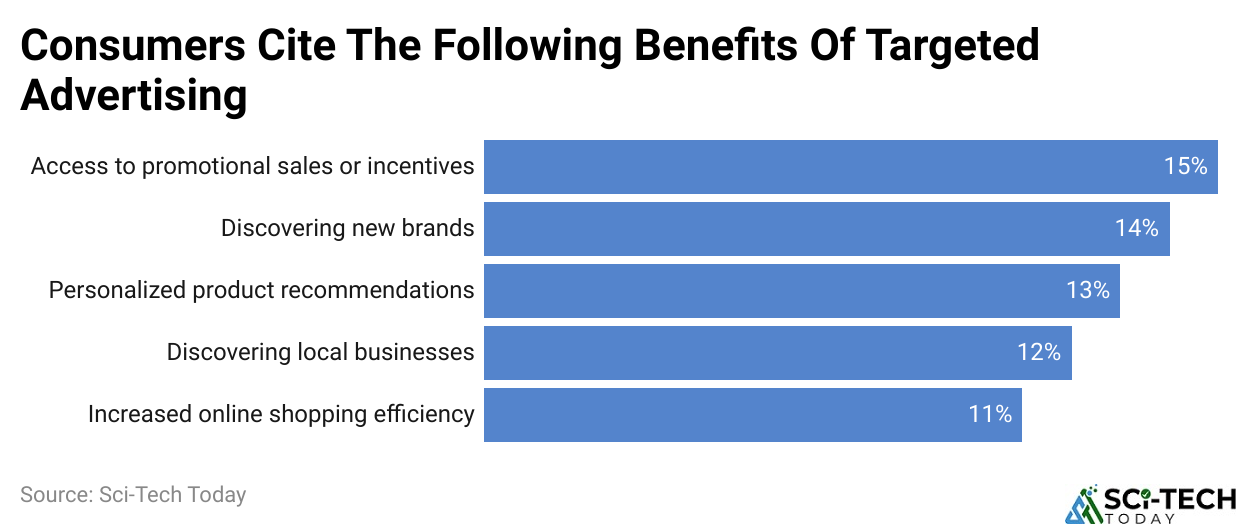
- Promotional Sales and Incentives (15%): Many people look for special deals and discounts online to save money.
- Discovering New Brands (14%): Online shopping helps users find new brands that they might like.
- Personalized Recommendations (13%): People enjoy getting product or service suggestions tailored to their preferences.
- Finding Local Businesses (12%): Users often search online to locate nearby shops and services.
- Efficient Online Shopping (11%): Online platforms offer a quicker and easier way to shop compared to traditional methods.
Digital Ad Spending Statistics
(Source: eMarketer.com)
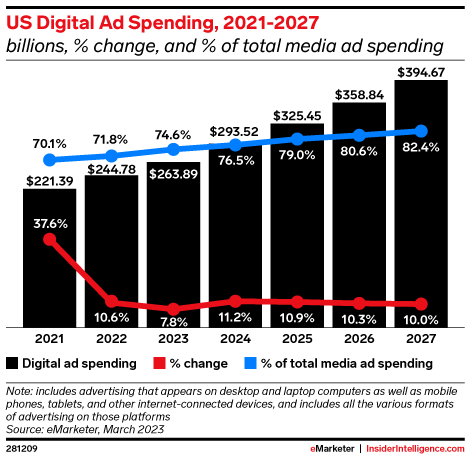
- In the United States of America, digital ad spending will account for around USD 325.45 billion in 2025, decreasing by 10.9% from 2024.
- This represents 79.0% of total media ad spending.
Total Media Ad Spending Statistics
(Source: eMarketer.com)
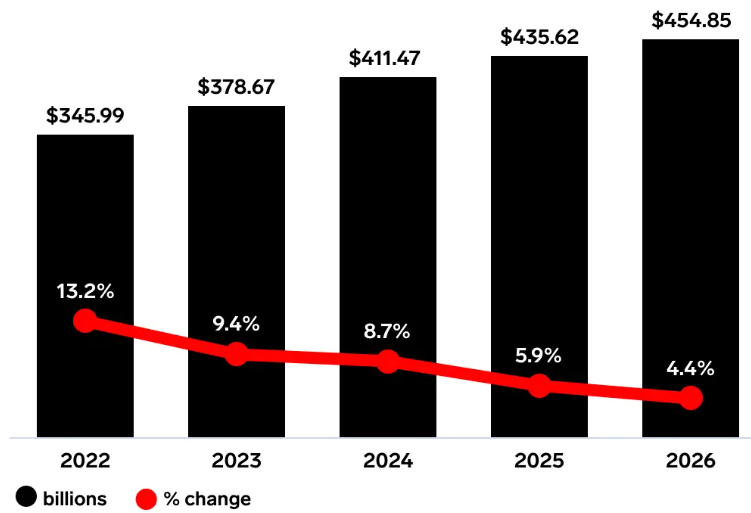
- Targeted Advertising Statistics also show that in 2025, total media advertisement spending in the U.S. will amount to USD 435.62 billion, with a growth rate of 5.9%.
- In contrast, spending will reach up to USD 454.85 billion (4.4%) by 2026, respectively.
Statistics on Social Media Ad Revenue Growth
TikTok leads the growth with an impressive 45%, indicating its rising influence in the digital marketing landscape.
| Company | Ad Revenue (USD billion) | YoY Growth Rate |
| Meta (Facebook) | 114 | 12% |
| Google (YouTube) | 38 | 10% |
| TikTok | 20 | 45% |
| X | 6 | 5% |
| Snapchat | 5 | 15% |
Benefits of Targeted Advertising
- 71% of the clients would love to achieve more personalization, which will earn additional 15% of digital marketing revenues.
- Conversely, 44% of clients buy more often from companies that do targeted marketing.
- Develop a brand awareness and positive image of your brand through effective messaging and marketing.
- Make your marketing efforts simple and keep them resourceful for better success in business.
- Improve the return on investment of your brand marketing with the help of effective data-driven strategies that will help you avoid waste of resources.
- About 47% of the consumers felt comfortable about getting advertisements according to their preferences, while 27% were still concerned about their privacy.
Challenges In Targeted Advertising
- In 2025, around 80% of consumers express concerns about data privacy, up from roughly 60% in 2024, per a consumer survey on personal data and privacy.
- Around 88% of marketers/consumers report noticing ad repetition at least occasionally in 2025, with 53% saying they’ve seen the same ad excessively.
- In 2025 50% of marketers say their segmentation strategies could be more effective.
- On the other side, 70% of consumers unsubscribed from at least three brands in the past three months due to overwhelming message volume in 2025.
- By 2025, the average cost-per-click (CPC) on Google Ads rose to USD 5.32, up from USD 4.66 in 2024.
- In 2025, 35% of businesses report facing higher competition for ad space.
- Based on Targeted Advertising Statistics, platform algorithm changes continued to significantly affect reach in 2025.
- In 2025, 40% of marketers need help to coordinate across multiple channels.
Key Demand-Influencing Factors In 2025
- Around 80% of consumers remain more likely to buy from brands offering personalized ads/experiences in 2025.
- Meanwhile, AI adoption for ad targeting and audience segmentation has grown further, with roughly 55% of marketers using AI for audience segmentation in 2025, up from the 75% figure cited more broadly for AI-driven ad targeting improvement in 2024.
- Mobile ad spends reached approximately USD 254.4 billion globally in 2025 (per IMARC), or USD 259 billion per another estimate, up from roughly USD 213 billion in 2024.
- In 2025, 63% of marketers report challenges balancing ad targeting with privacy laws.
- E-commerce accounted for 16.9% of total U.S. retail sales in early 2026 (Q1), with global smartphone traffic driving nearly 80% of all retail website visits worldwide in 2025
- Targeted Advertising Statistics further state that 70% of consumers change their brand preferences within six months.
- Globally, 5G device shipments reached 6.11 billion units in 2025, with the total 5G devices market expected to grow to 7.42 billion units in 2026.
- Social media ad revenue reached approximately USD 242 billion globally in 2025, growing 11% year-over-year.
Final Thoughts
Targeted advertising is an effective criterion for the modern marketing industry. Targeted advertising aids organizations in reaching particular customers in need. This is because targeted advertising helps organizations increase engagement and ROI; however, companies have obstacles in the form of data privacy policies and ad fatigue.
This article on Targeted Advertising Statistics elaborates that businesses that are now using targeted advertising strategies will surely stay competitive and advanced in the fast-changing digital world. By using new technologies like 5G, augmented reality, and AI tools, companies can improve their ads while maintaining customer trust and following privacy laws.
FAQ
Targeted advertising is a marketing method that shows ads to specific people based on their traits, interests, or online actions. Instead of showing the same ad to everyone like on TV, companies use personal data to pick who sees their products.
If a user has turned on Personalized Ads on their device, Apple’s advertising platform may use their information to serve ads that are more relevant to them. Turning off Personalized Ads will prevent Apple from using this information for ad targeting.
Yes, marketing studies estimate that we are exposed to 4,000 to 10,000 ads each day. However, this massive number counts passive brand logos, product labels on grocery shelves, and tiny digital elements that your brain tunes out, rather than 4,000 traditional commercial breaks.

Sources