






Preface
Shopify Statistics: Shopify is one of the most popular e-commerce platforms, helping millions of businesses build and grow online stores. From small startups to well-known global brands, merchants use Shopify to sell products across websites, social media, marketplaces, and physical stores. Its easy-to-use tools, secure payment options, and powerful features make online selling simple, even for beginners. Over the years, Shopify has become a major player in the fast-growing e-commerce industry by continuously adding new technologies, including AI-powered tools.
In this article, you’ll discover the latest Shopify statistics, including merchant growth, market share, revenue, customer trends, and other key insights that highlight the platform’s global success.
Best Picks
- Shopify generated USD 11.56 billion in FY2025 revenue, up 30% YoY, surpassing USD 10 billion for the first time.
- The platform processed USD 378.4 billion in Gross Merchandise Volume during FY2025.
- Shopify powers 5.1% of all websites and holds a 7.2% global CMS market share, ranking second after WordPress.
- The platform serves 5.5 million+ merchants globally across 175 countries.
- Shopify powers approximately 6.94 million live websites worldwide, according to industry estimates.
- 29% of U.S. ecommerce stores use Shopify, making it the country’s leading ecommerce platform.
- The Shopify App Store features 16,000+ apps, with 25+ million app installations and USD 1 billion+ paid to developers.
- Shopify is estimated to reach 875 million+ shoppers worldwide in 2026.
- 71% of Shopify traffic comes from mobile devices, highlighting mobile-first shopping behavior.
- Shopify employs approximately 7,722 people globally while continuing to invest in AI, security, and merchant growth.
What is Shopify?
Shopify is a collective commerce platform that allows anyone to grow, manage, and even start a new business. We can use Shopify to accept payments in physical and digital locations, manage sales, advertise to consumers, and build a store online.
The reputation of Shopify as a commerce leader stems from listening to the experiences of billions of business owners by giving a hand to solopreneurs and the brand’s enterprises. Shopify holds all the products and features that power current businesses and will give shape to the predicted commerce world.
How Does Shopify Work?
Shopify collects commerce-related activities in one platform, with one admin to examine the whole sales process, from getting an order to post-sales analysis. With Shopify, business owners can sell on various platforms, including their websites, in the industry, on social media, and in person from brick-and-mortar locations.
The consumer’s data and inventory can sync across channels for easy management. Shopify is a fixed, hosted, and cloud-based platform, which means we can safely see our data from any device with an internet connection. This gives us the flexibility to run our business from anywhere.
Key Shopify Features
- Storefront themes and customization: Shopify offers 70+ professionally designed, mobile-friendly themes that businesses can easily customize to match their brand. Merchants can also connect or purchase a custom domain directly through Shopify.
- Shipping and security: Every Shopify store includes a free SSL certificate to protect customer data and transactions. The platform provides automatic shipping rates from major carriers, calculates location-based taxes, supports 50+ languages, and allows merchants to offer free shipping promotions.
- Abandoned cart recovery: Shopify automatically tracks abandoned carts and sends reminder emails, helping businesses recover lost sales and improve conversion rates.
- Payment gateway: Shopify supports 70+ payment gateways and includes Shopify Payments, powered by Stripe. Merchants using Shopify Payments avoid extra transaction fees and benefit from competitive payment processing rates.
- Store management: The platform helps merchants manage customers, export customer data, support guest checkout, automate refunds, and run dropshipping businesses through third-party app integrations without holding inventory.
- Marketing and SEO: Shopify includes built-in SEO tools, discount codes, gift cards, product reviews, and social commerce integrations with platforms such as Facebook Shops, Instagram Shops, and Pinterest to increase visibility and sales.
- Product and inventory management: Merchants can add unlimited products, create multiple product variants, track inventory, and import or export product catalogs using CSV files.
- Analytics: Shopify provides an analytics dashboard with sales reports, visitor insights, order tracking, financial reports, and product performance data to support better business decisions.
- 24/7 customer support: Shopify offers 24/7 assistance through email, phone, and live chat. Merchants also have access to community forums, tutorials, documentation, webinars, Shopify Compass, and Shopify University for ongoing learning and support.
Shopify Financial Outlook Of 2025 Full-Year Performance
- Shopify delivered a strong FY2025, with adjusted revenue reaching USD 11.56 billion, the first time the company crossed the USD 10 billion mark. Revenue increased 30% YoY.
- Adjusted gross profit grew to USD 5.56 billion, while adjusted EBITDA reached USD 1.50 billion.
- Adjusted net income totaled USD 1.53 billion, reflecting continued profitability.
- Free cash flow increased to USD 2.01 billion, representing a 17% free cash flow margin.
- This also marked Shopify’s 10th consecutive quarter of double-digit free cash flow margins.
- Gross Merchandise Volume reached USD 378.4 billion, up about 29%-30% YoY from USD 292.3 billion in 2024.
Q1 2026 Results
- According to a report published by Digital Commerce 360, Shopify reported USD 3.17 billion in revenue, up 34.3% YoY.
- Gross profit increased 32% YoY to USD 1.55 billion, while operating profit totaled USD 382 million.
- GMV climbed to USD 100.7 billion, growing about 34.8%-35% YoY, making it the second consecutive quarter with more than USD 100 billion in quarterly GMV.
- Merchant Solutions revenue rose 39% YoY and contributed nearly 75% of total revenue, while Subscription Solutions revenue increased 21% YoY.
- Shopify reported a GAAP net loss of USD 581 million and a diluted EPS of -USD 0.45, mainly due to stock-based compensation and other non-cash expenses.
- Free cash flow margin remained strong at 15%.
Q2 2026 Valuation
- Management expects high-20% revenue growth, mid-20% gross profit growth, and a mid-teens free cash flow margin in Q2 2026.
- Scanx. trade report forecasts approximately USD 3.44 billion in revenue and USD 0.28-0.37 EPS. Shopify will report Q2 2026 results on August 5, 2026.
- Shopify’s FY2025 valuation includes a 171.2x P/E, 18.2x P/S, 136.3x EV/EBITDA, and a market capitalization of USD 167.6 billion.
- Analysts maintain a Buy consensus with an average 12-month price target of USD 134.85, ranging from USD 24 to USD 587.
- The company also expanded its share repurchase program by USD 3 billion, increasing the total authorization to USD 5 billion.
Shopify Market Share Statistics
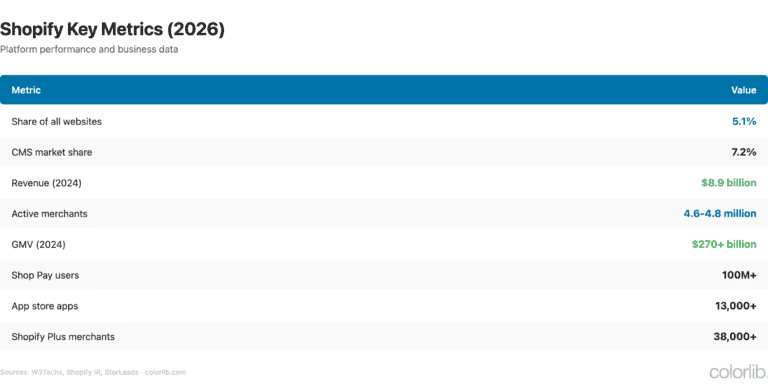
(Source: colorlib.com)
- As of March 2026, Shopify powers 5.1% of all websites worldwide.
- Shopify holds a 7.2% share of the global CMS market, making it the second-largest CMS platform after WordPress.
- In the United States, Shopify accounts for 29% of the ecommerce platform market.
- Since 2015, Shopify’s website share has grown from 0.3% to 5.1%, representing an impressive 929% increase.
- Shopify’s CMS market share increased by 15% year over year.
- Among the world’s top 1 million websites, 7.8% use Shopify, demonstrating its popularity with high-traffic sites.
- Founded in 2006 in Ottawa, Canada, Shopify has grown into one of the world’s leading ecommerce platforms.
Shopify Merchant Count Overview
- Shopify has become one of the largest global e-commerce platforms, supporting millions of businesses worldwide.
- The company no longer reports exact merchant numbers after 2021, but industry estimates suggest Shopify powers more than 6.9 million sellers globally.
- Recent market estimates indicate that Shopify may have more than 5.5 million merchants by 2026, based on platform usage trends and third-party tracking data.
- Shopify reported 2.06 million merchants in December 2021, which remains the last official merchant count before the company shifted to describing its user base as “millions of merchants.”
Live Shopify Store Count
- Technology tracking platforms show different estimates for the number of active Shopify-powered websites because they measure live stores differently.
- According to Backlinko data, Shopify powers approximately 6,937,924 live websites worldwide in early to mid-2026.
- Storeleads estimates that Shopify has around 2,865,709 active stores during Q2-Q3 2026.
- Storeleads data also shows that Shopify stores increased by 11% year over year in Q2 2026.
Top Countries by Live Shopify Stores
| Country | Live Shopify Stores |
| United States | 3,758,271 |
| United Kingdom | 244,544 |
| Germany | 191,332 |
| Australia | 170,911 |
| India | 137,541 |
| Canada | 136,034 |
| France | 123686 |
| Colombia | 104553 |
| Netherlands | 93703 |
| Brazil | 73628 |
Global Merchant Distribution
- Shopify merchants operate across 175 countries out of the world’s 193 countries, showing the platform’s strong international reach.
- The United States remains Shopify’s largest merchant market, with approximately 875,000 merchants.
- U.S. merchants represent around 50% of Shopify’s total merchant base, making the country the platform’s most important market.
Shopify Stores by Product Category
| Product Category | Number of Shopify Stores |
| Car and Truck Parts | 6,231 |
| Electronics | 6,888 |
| Sporting Goods | 7,737 |
| Art | 11,645 |
| Food and Beverages | 16,291 |
| Fashion Accessories | 22,874 |
| Jewellery and Watches | 27617 |
| Health and Beauty | 192874 |
| Home and Garden | 230435 |
| Clothing | 531409 |
| Others | 65956 |
Shopify App Store Statistics, 2026
- The Shopify App Store offers 16,000+ public apps, giving merchants tools to improve marketing, payments, customer service, inventory, and store operations, according to chargeflow.io.
- Shopify’s app ecosystem is supported by tens of thousands of developers worldwide, with thousands of new apps added every year.
- More than 80% of Shopify merchants use third-party apps to customize their stores and support business growth.
- Shopify merchants have completed 25+ million app installations, showing strong adoption across the platform.
- On average, each Shopify store uses about 6 apps to manage different business functions.
- Shopify has paid more than USD 1 billion to app developers.
- Shopify also offers a 0% revenue share on the first USD 1 million in annual revenue earned by developers, down from the previous 20% commission.
- Overall, Shopify’s growing app marketplace continues to support innovation, merchant success, and long-term ecosystem expansion.
Shopify Shopper Reach and Customer Base
- According to yaguara.co, Shopify is estimated to serve more than 875 million unique customers in 2026.
- Based on these trends, Shopify shoppers in 2026 may represent around 40% of the global online shopper population.
Merchant Activity and Platform Engagement
- Shopify records approximately 2.1 million daily active users, mainly merchants and store administrators.
- Around 40% of monthly active merchants log in to Shopify every day, indicating strong platform engagement.
- Shopify supports approximately 1.75 million active merchants worldwide.
Shopping Behavior and Store Performance
- According to a report shared by community.popupsmart.com, the average Shopify order value ranges from USD 85 to USD 108.56.
- Shopify stores report an average product return rate of 27%.
- A typical Shopify store in the United States generates about USD 72 in revenue per customer.
- Average store revenue is estimated at USD 5,583 per month, or roughly USD 67,000 annually, although earnings vary by business size and industry.
Marketing and Conversion Trends
- Mailmodo report also mentioned that Email marketing delivers the highest Shopify conversion rate at 4.29%, followed by product search (3.04%), direct search (2.93%), and social media (1.81%).
- Retail and ecommerce businesses earn an average return of USD 45 for every USD 1 spent on email marketing.
- Around 50% of consumers have made a purchase directly from an email campaign.
Platform Usage and Customer Experience
- Shopify powers 24% of ecommerce websites worldwide.
- Mobile devices generate 71% of Shopify traffic.
- About 57.65% of Shopify stores are based in the United States.
- Shopify supports 20 languages to serve global customers.
- Around 70% of Shopify Inbox conversations involve customers ready to buy, while product cards increase live-chat conversion rates from 21% to 23.5%.
- More than 59% of consumers value great customer service over price, 83% trust brands with excellent customer experience, and 70% are willing to switch brands after poor customer service.
Global Shopify Employee Statistics
(Source: reveliolabs.com)
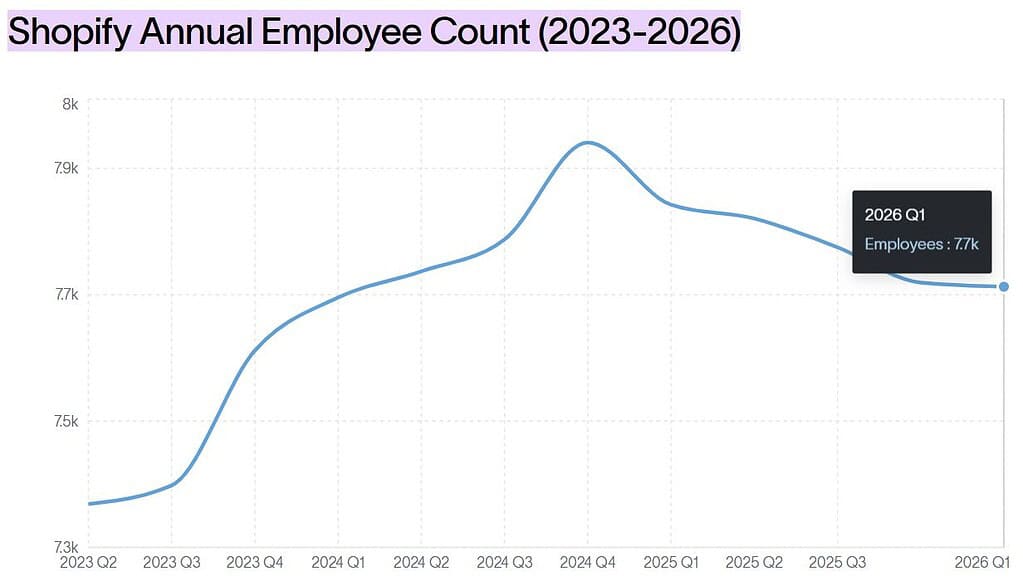
- Shopify employed approximately 7,722 people worldwide as of March 2026, according to independent workforce estimates.
- The company’s workforce increased by about 1.1% from 7,640 employees in 2023 to 7,722 employees in 2026.
- However, Shopify’s total headcount declined by around 3.2% year over year in 2026 compared with 2025.
- Shopify’s official reports also describe its workforce as 7,600+ employees, which is consistent with external estimates.
Geography and Compensation
- According to RevelioLabs, Canada remained Shopify’s largest employee base with 2,304 employees, representing 30.2% of the global workforce, despite a 2.8% year-over-year decline.
- The average global employee salary reached approximately USD 95,136 in 2026, up 1.7% from the previous year.
- Median employee tenure increased to 3.2 years, improving by 0.3 years year over year.
- North America recorded median compensation at 1.4× the global average, while Southern Asia had the lowest median salary at around USD 8,000.
Hiring Activity and Merchant Workforce
- Shopify listed around 198 active job openings in 2026, reflecting a 9.5% increase from 2025 and indicating selective hiring.
- The Shopify ecosystem included approximately 2.87 million live stores in Q2 2026.
- Among these merchants, 95.4% had unknown employee counts, 2.4% employed 1-9 people, 0.8% employed 10-24 people, and only 840 stores had 5,000+ employees, showing that most Shopify businesses are small or independently operated.
(Reference: burstcommerce.com)
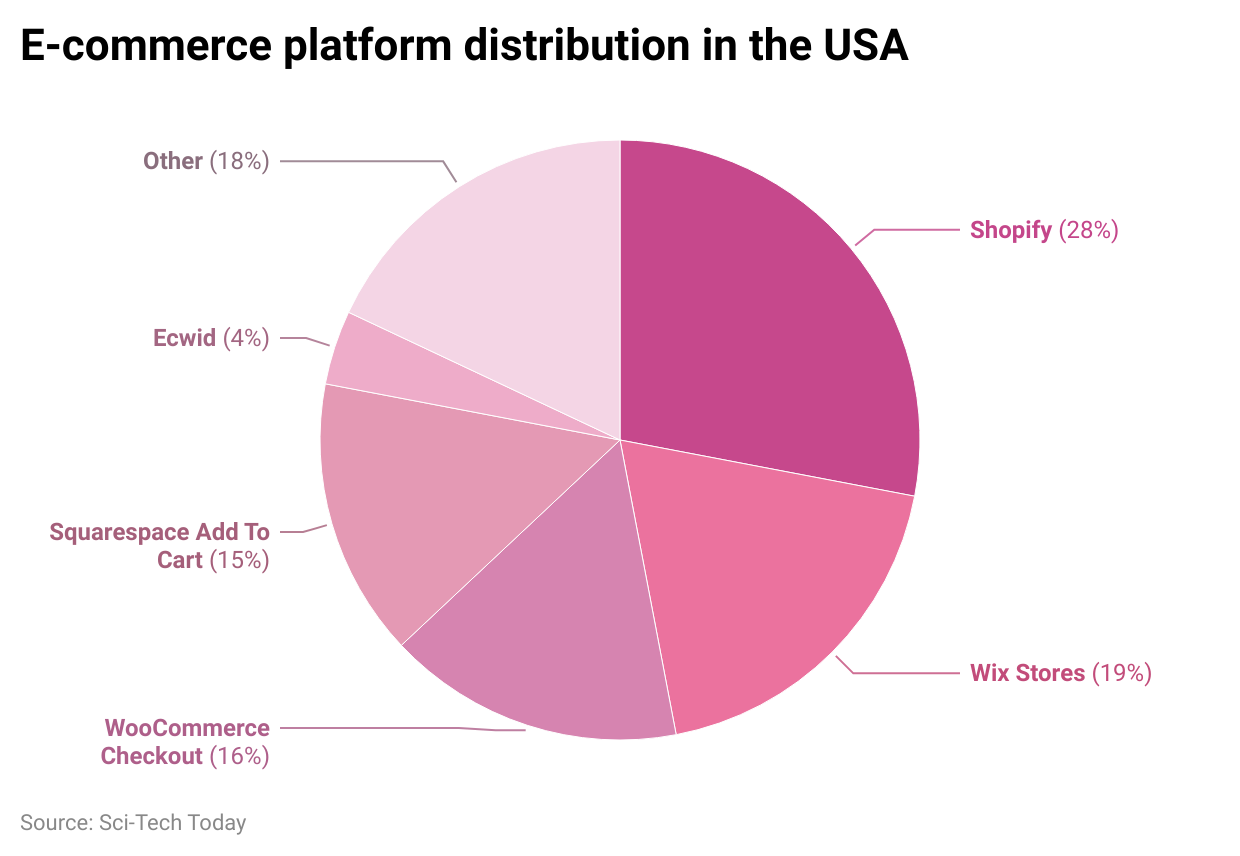
- The above pie chart shows that the E-commerce platform is distributed in the United States: 28% Shopify, 19% Wix Stores, 16% WooCommerce Checkout, 15% Squarespace Add to Cart, 4% Ecwid, and 18% Others.
- Shopify statistics state that Tobi Lütke and Scott Lake were right to pivot from snowboard sales to e-commerce software.
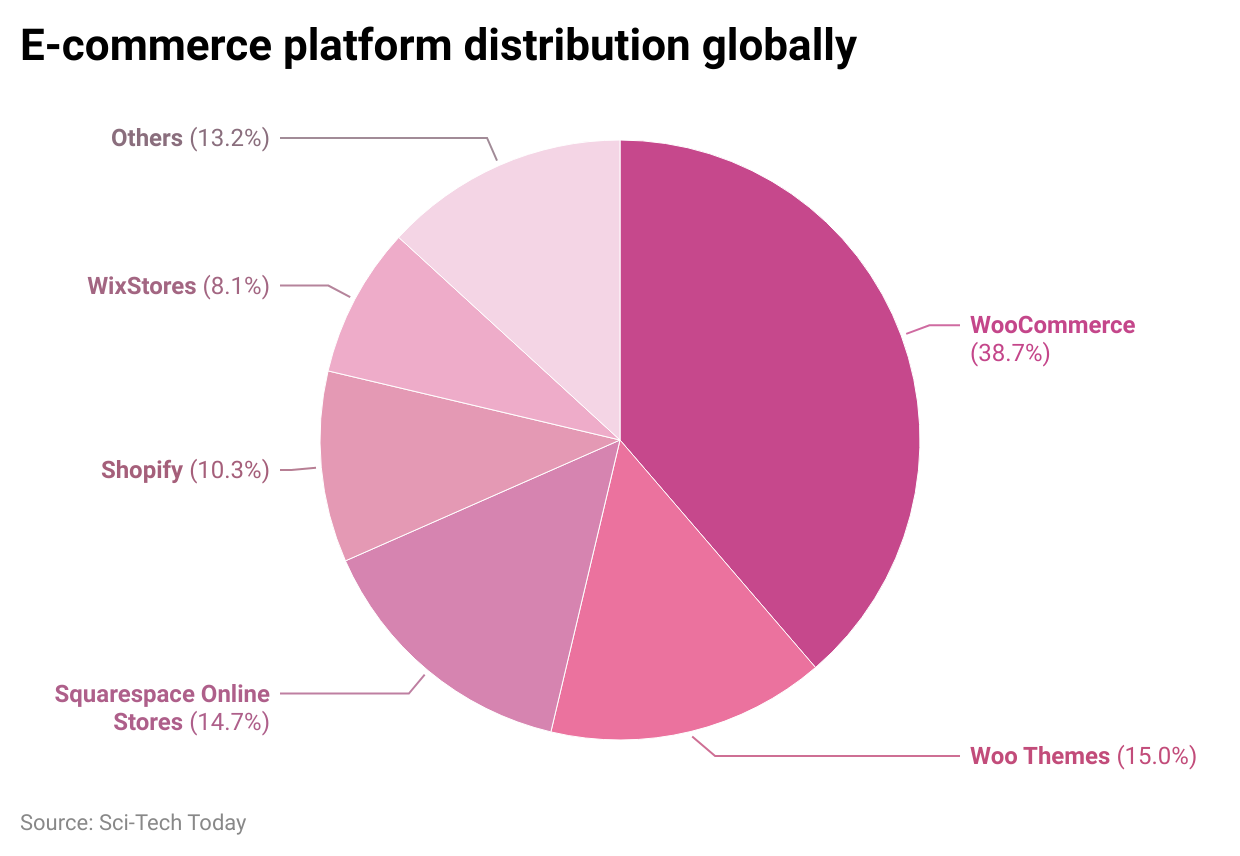
- Around 10.32% of the worldwide e-commerce stores use Shopify, which makes it a very popular e-commerce platform in the fourth rank globally.
(Reference: burstcommerce.com)
- The pie chart above shows the distribution of e-commerce platforms worldwide: 38.7% WooCommerce, 15% WooThemes, 14.7% Squarespace Online Stores, 10.3% Shopify, 10.3% WixStores, and 13.2% Others.
- The three nations with the most Shopify stores are the United States, with 2.8 million, the United Kingdom, with 203,835, and Australia, with 149,342. Shopify is comfortably the biggest e-commerce platform in every country.
- Shopify is even at the top in the Brazilian and German markets. On the other hand, Shopify permits merchants to make online stores in 20 languages.
- Shopify accounts for almost 25% of the top worldwide e-commerce brands.
- The maximum number of merchants on Shopify are for small operations, such as homemade candles and a single-person market selling drop-shipped T-shirts.
- Out of the top 1 million websites worldwide, almost 1 out of 4 use Shopify, whereas nearly 1 in 7 favor WooCommerce Checkout, and 1 in 12 are related to Magento.
- Around 6% of the huge online retailers are Shopify Plus, and the platform’s enterprise-grade features.
Best Shopify Apps For Store Design
| App name | Templates | Automation workflows | Pricing min (USD/month) | Pricing max (USD/month) | Rating (/5) |
| PageFly Landing Page Builder | 100 | – | 0 | 199 | 4.9 |
| GemPages Landing Page Builder | – | – | 0 | 199 | 4.9 |
| Avada Email Marketing & SMS | – | – | 16 | – | 4.9 |
| Automizely Marketing | – | – | 0 | 179 | 4.9 |
| Omnisend | – | 20 | 0 | 59 | 4.8 |
| Retainful | – | – | 0 | 49 | – |
For Conversion
| App name | Price min (USD/month) | Price max (USD/month) | Rating (/5) |
| Ali Reviews | 0 | 49.9 | 4.9 |
| DataFeedWatch | 59 | 199 | 4.8 |
| Loox | 9.99 | 299.99 | 4.9 |
| Nabu for Google Shopping Feed | 0 | 249.99 | 4.9 |
| iCart Cart Drawer Cart Upsell | 0 | 0 | 0 |
Best Shopify SEO Apps
| App name | Min price (USD/month) | Max price (USD/month) | Rating (/5) |
| Avada SEO Suite | 0 | 34.95 | 4.9 |
| Booster SEO & Image Optimizer | 0 | 69 | 4.8 |
| Plug In SEO | 0 | 79.99 | 4.7 |
For Dropshipping
| App | Min price (USD/month) | Max price (USD/month) | Rating (/5) |
| DSers | 0 | 49.9 | 5.0 |
| Spocket | 0 | 99.99 | 4.7 |
| Printful | 0 | 49 | 4.6 |
For Store Management
| App | Min price (USD/month) | Max price (USD/month) | Rating (/5) |
| AfterShip | 0 | 239 | 4.7 |
| Prisync | 49 | 399 | 4.8 |
| BeProfit | 0 | 150 | 4.7 |
| Reveal | 0 | 299 | 5.0 |
Best Shopify Loyalty Apps
| App | Min price (USD/month) | Max price (USD/month) | Rating (/5) |
| Joy Loyalty | 0 | 499 | 5.0 |
| Yotpo Loyalty & Referrals | 0 | 199 | 4.7 |
| Smile.io | 0 | 599 | 4.8 |
Shopify Security, Trust, and Platform Scale Overview
- Shopify’s 2026 security strategy focuses on PCI DSS 4.0 compliance, SSL/TLS encryption, AI-powered fraud detection, and privacy-first analytics to strengthen merchant and shopper trust.
- Shopify provides default HTTPS security through SSL/TLS encryption across all stores and checkout pages, helping protect against threats such as data interception and unauthorized access.
- The platform includes DDoS protection and PCI DSS-compliant payment infrastructure, reducing the security workload for merchants using Shopify’s native checkout.
- In 2026, Shopify introduced security improvements aligned with PCI DSS 4.0, including automated compliance workflows, continuous monitoring, stronger authentication, and easier audit preparation.
- Shopify’s AI-driven fraud detection systems analyze signals such as unusual order activity, payment mismatches, and card-testing attempts to reduce fraud and chargebacks.
- Shopify merchants operate in a challenging environment where global ecommerce fraud losses are estimated at USD 48 billion annually. Around 81% of data breaches involve weak or stolen credentials, highlighting the importance of 2FA, access controls, and monitoring.
- Shopify recommends enabling 2FA for all accounts, reviewing permissions quarterly, monitoring login activity, and using trusted apps to reduce security risks.
- With secure payments, HTTPS protection, and PCI-compliant checkout systems, Shopify continues to position security as a key factor behind customer trust and long-term ecommerce growth.
Final Thoughts
Shopify has become one of the most trusted e-commerce platforms for businesses of all sizes. Its steady growth, strong financial performance, and regular product updates show its focus on helping merchants succeed. With AI-powered tools, secure payment options, and global reach, Shopify continues to attract new businesses and support existing ones.
As online shopping grows worldwide, Shopify is expected to remain a leading platform in the e-commerce industry for years to come.
FAQ
Shopify offers plans for different budgets, with pricing based on features, apps, and payment options.
Yes, Shopify supports thousands of third-party apps for marketing, payments, shipping, and more.
Shopify includes built-in SEO tools like customizable meta tags, clean URLs, XML sitemaps, and image alt text to improve search rankings.

Sources