





Brief Overview
Comet Observation Statistics: When we talk about comet observation, we are basically talking about the science and the practice of studying comets, the icy visitors that move around our solar system. Comets are made of dust, rock, and frozen gases, and when they come close to the Sun, they heat up and form those long, glowing tails that fascinate sky watchers.
Scientists, astronomers, and even amateur sky watchers contribute to comet observation. Every discovery, every measurement of a comet’s brightness, tail length, or orbit adds another piece to the puzzle. With thousands of comets discovered so far, and many more waiting to be found, the numbers behind comet observation are as interesting as the comets themselves. We can track how many comets are found each year, how big or small they are, what they are made of, and even how often we can expect to see a bright comet with the naked eye.
So, in this article, we are going to explore comet observation. Instead of just telling you comets are fascinating, I’ll show you the statistics, how many comets we’ve found, how they are discovered, what sizes they come in, and what missions have revealed their chemistry. By the end, you’ll see that comet observation is not just about pointing a telescope at the sky; it is about reading the history of the solar system. Let’s get into it.
Editor’s Key Takeaways
- Over 3,800 comets have been officially cataloged by the International Astronomical Union (IAU) as of 2025, and new ones are being discovered every single year.
- Around 80% of comet discoveries in recent years have come from automated surveys like Pan-STARRS and LINEAR, not manual telescope spotting.
- The average size of comet nuclei ranges between 1 to 10 km, but giants like Comet Hale-Bopp reached nearly 60 km.
- On average, at least 1 to 2 naked-eye comets appear per decade, but truly spectacular ones like Halley’s or Hale-Bopp occur once every few centuries.
- Halley’s Comet, probably the most famous, is observed roughly every 76 years, with the next appearance expected in 2061.
- Space missions have studied comets directly: ESA’s Rosetta mission in 2014 collected over 21,000 images and analyzed the composition of Comet 67P.
- Comets lose an average of 1 to 10 meters of surface material each time they pass near the Sun, reshaping their surface over time.
- About 30% of observed comets are “short-period comets” that return in less than 200 years, while the rest are long-period comets that may not return for thousands of years.
- The longest observed comet tail stretched over 360 million km, nearly twice the distance from Earth to the Sun.
- Historical records show comet sightings going back to 240 BC in Chinese astronomy logs, proving comet observation has been practiced for over 2,200 years.
| Category | Key Statistic |
| Total comets discovered (2025) |
3,800+ confirmed by IAU |
|
Annual discoveries | Around 20 to 30 comets per year |
| Discovery source |
80% automated surveys, 20% amateur/professional telescopes |
|
Size range of nuclei | Typically, 1 to 10 km, record size 60 km (Hale-Bopp) |
| Naked-eye comets |
1 to 2 per decade visible without telescope |
|
Short-period vs long-period | 30% short-period, 70% long-period |
| Famous comet (Halley’s) |
Period of 76 years, next in 2061 |
|
Space missions | Rosetta (2014), Stardust (2004), Deep Impact (2005) , thousands of data points |
| Comet tail length record |
360 million km (Comet Hyakutake, 1996) |
|
First recorded observation |
240 BC in Chinese astronomy logs |
Global Comet Population and Discovery Trends
(Source: space.com)
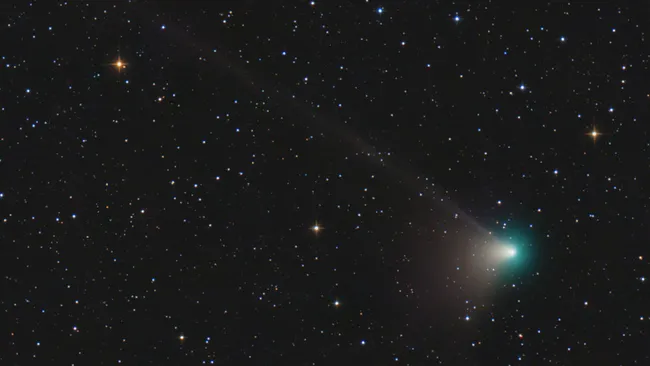
- As of recent compilation pages maintained by the MPC and SBN, thousands of comets are cataloged, and the discovery rate has accelerated sharply since the 1990s, thanks to automated surveys. The graph of discoveries per year shows an upward trend that is steeped with SOHO and modern sky surveys.
- SOHO alone has discovered multiple thousands of comets since 1996, and by 2024 had passed roughly 5,000 comet detections (mostly sungrazers). That single mission accounts for a very large fraction of new comet designations in recent decades.
- The Minor Planet Center and related SBN sites list the number of discoveries each year. In recent years, several dozen to a few hundred comets discovered annually through ground and space-based surveys, depending on the year of course.
| Metric | Recent / Typical value |
| Cataloged comets (order of magnitude) | Thousands (catalog growing year to year). |
| SOHO discoveries (total, 1996 to 2024) | 5,000 comets. |
| New comets per year (ground + space, recent years) | Tens to a few hundred (varies). |
Who Found These Comets?
(Source: wikipedia.org)
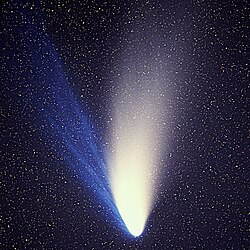
- Observations from SOHO (solar coronagraphs) have found the vast majority of small sungrazers – more than 5,000 already. Technique used: continuous solar imaging hides the Sun and makes sungrazers visible at the edges of the Sun. Volunteers (both amateur and professional) sift through the images provided by SOHO.
- Pan-STARRS surveys (PS1 and PS2) are now the leading ground-based comet discoverers in the 2010s and 2020s, having found well over a hundred comets and, in many years, comprising over 50% of new comet discoveries. The reason is deep, wide-field imaging and automated moving-object pipelines.
- Comet detections by LINEAR, Catalina, ATLAS, and NEOWISE number dozens to hundreds per instrument. For example, NEOWISE imaged more than 160 comets in its prime mission/extended mission and, within the NEOWISE program, several dozen new comets were discovered (on the order of 25 new comets were discovered within the 10-year lifespan of the NEOWISE project).
- Discoverers from amateurs are still significant. There are still some comets being discovered by backyard enthusiasts, as well as crowd-sourced projects, including SOHO image monitors.
| Discoverer / Survey | Approx. contribution/note |
| SOHO (space coronagraph) | 5,000 comets (mostly sungrazers). |
| Pan-STARRS | 100+ comets discovered; 50% of new comets have been discovered in recent years. |
| NEOWISE (WISE) | Observed 163 comets; discovered 25. Good at IR detections. |
| LINEAR, Catalina, ATLAS | Each: dozens to 100s over time; ATLAS found the interstellar comet 3I/ATLAS in 2025. |
| Amateurs & citizen science | A significant fraction of SOHO discoveries and a regular source of rare finds. |
Orbital Classes and How Many of Each Kind?
(Source: researchgate.net)
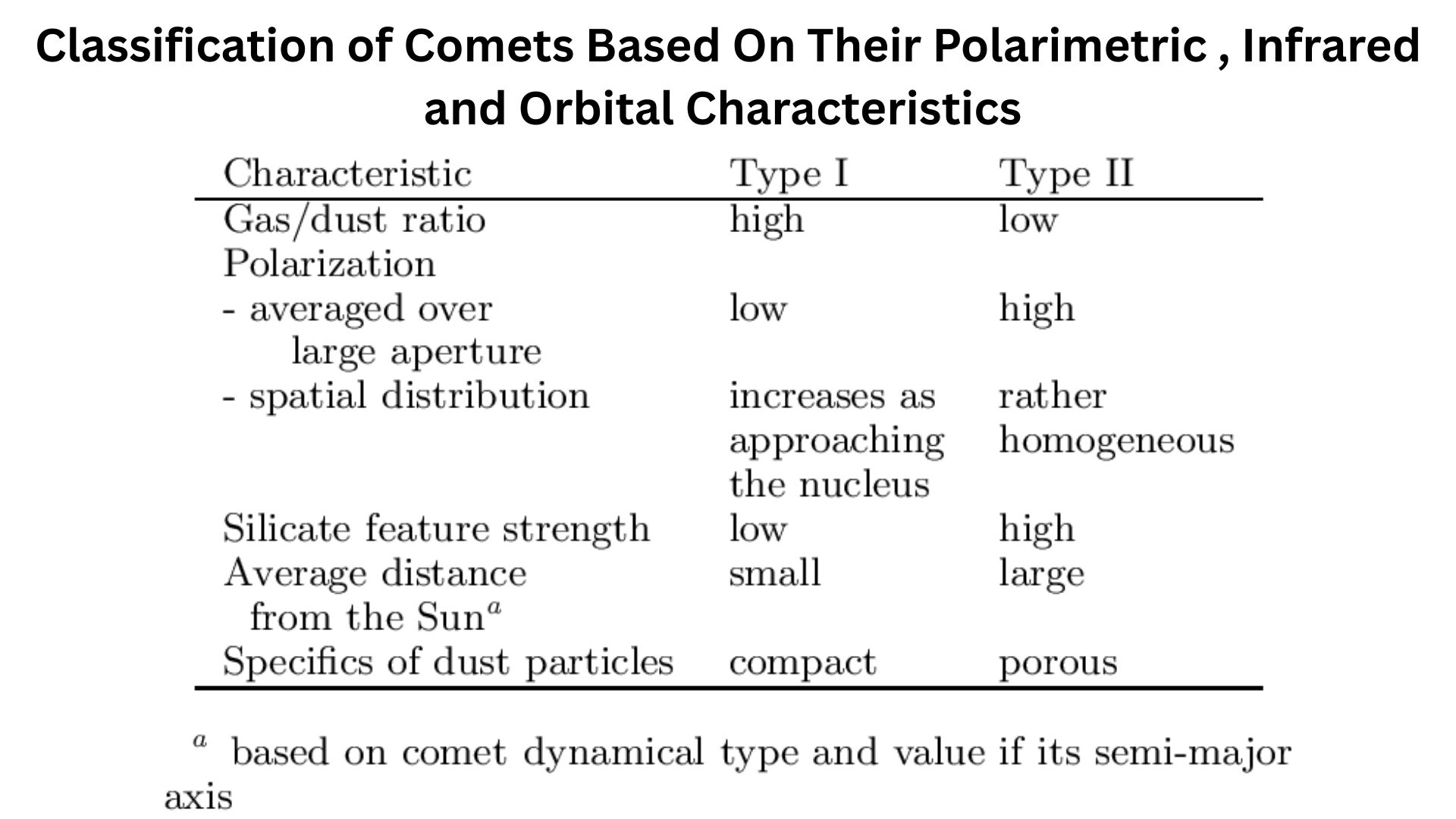
- Periodic comets are the ones we can expect to return. There are a few hundred numbered periodic comets (those observed at multiple apparitions and assigned P-numbers). As of recent lists, there are roughly 500 numbered comets, most being Jupiter-family comets.
- Short period, repeatedly visiting comets constitute Jupiter Family Comets. The number of known Jupiter Family Comets is in the order of hundreds. Dynamical modelling suggests that there could be several thousand more JFCs to be discovered, due to observational bias of small, faint objects.
- Long-period comets (LPCs) and near-parabolic comets are discovered less often per object, but new LPC detections rose noticeably with deep surveys – we now detect many more faint, distant LPCs than a few decades ago. Analysis papers demonstrate a rising discovery rate for LPCs in the last 20 years.
| Class | Known / cataloged (approx) |
| Numbered periodic comets | 500 (1P to 507P type listings). |
| Jupiter-family comets (known) | Hundreds listed; many more predicted by models. |
| Long-period / near-parabolic comets | Thousands observed overall; the discovery rate increased recently. |
Nucleus Sizes and Size Distributions
(Source: sciencedirect.com)
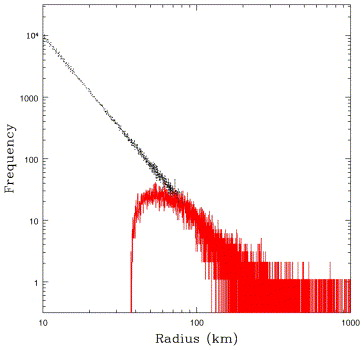
- Typical active comet nuclei (especially JFCs) are small: most measured JFC nuclei have effective radii of roughly 0.5 to 5 km. Surveys using Spitzer and other mid-IR telescopes find a cumulative size distribution with a power-law slope near -1.9 for radii, meaning small objects outnumber large ones strongly. This implies observational incompleteness at sub-km sizes.
- A few comets are exceptionally large. The recently discovered giant incoming object C/2014 UN271 (Bernardinelli-Bernstein) has been estimated with a nucleus radius of tens of kilometers, with some estimates pointing to an effective diameter of order 100 km or more, making it far bigger than a typical comet nucleus and placing it in a different regime. This object surprised observers because it was active at very large distances
- Typical nucleus density estimates from spacecraft encounters and modeling are in the few-hundred kilograms per cubic meter range – comets are very porous. Bulk densities derived from several mission’s cluster around 300 to 700 kg m power -3 depending on the method and object.
| Property | Typical values/notes |
| Typical JFC nucleus radius | 0.5 to 5 km; many around 1 to 3 km. |
| Largest recent nucleus (Bernardinelli-Bernstein) | Radius estimates in the tens of km; diameter, possibly 100 km-class by some analyses. |
| Typical bulk density | 300 to 700 kg m power -3 (very porous). |
Composition and Volatile
(Source: astrobiology.com)
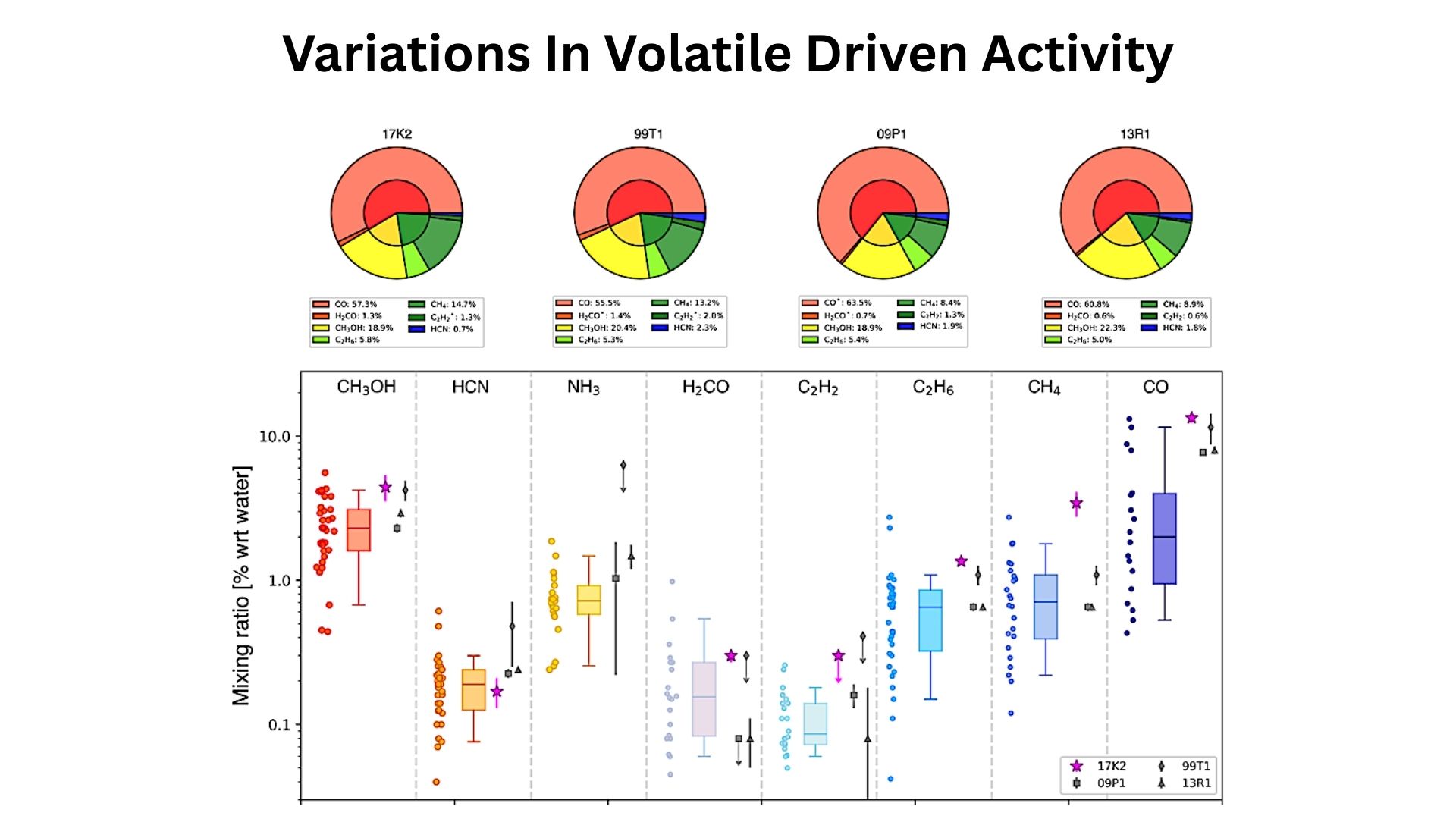
- The three main volatiles in the comet coma include H2O, CO2, and CO. From large sample spectral surveys and spacecraft observations, it was established that CO and CO2 together make up 18% ± 4% of the water production in many comets inside 2.5 AU of the Sun; however, values vary from comet to comet. That is, water is the leading volatile, but other carbon-based volatiles constitute an important percentage.
- In-situ measurements of Rosetta on Comet 67P/Churyumov Gerasimenko revealed unexpected composition and isotopic ratios. The deuterium to hydrogen ratio in water from 67P was determined to be (5.3 ± 0.7) × 10 power -4; that is, three times the value in terrestrial oceans. Such a single-comet measurement indicated that different comets have varied chemical compositions.
- Large surveys and spacecraft show at least 30 molecular species detected in comets by radio, IR, and in-situ mass spectrometry; remote spectroscopy continues to expand the inventory. The relative abundances vary by comet, heliocentric distance, and measurement technique.
| Quantity | Representative number |
| (QCO + QCO2) / QH2O (median within 2.5 AU) | 18% ± 4% for many comets. |
| D/H in comet 67P | (5.3 ± 0.7) × 10 power -4 (Rosetta measurement). |
| Species detected across comets | 30+ molecular species observed in comae (various surveys). |
Brightness, Visibility and “Naked-Eye” Comets
(Source: spaceweatherarchive.com)
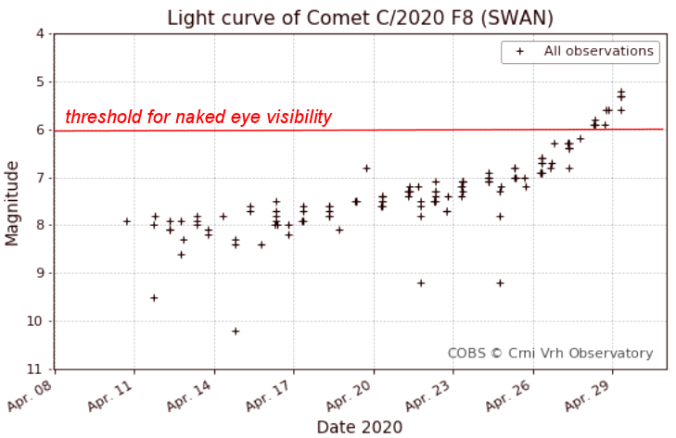
- Most comets are faint at discovery. Large modern surveys routinely detect comets at magnitude 18 to 24 on discovery images; only a small fraction brighten to naked-eye visibility. The median total magnitude parameter for many comets (M1 in studies) sits near 10 mags, which is telescope territory.
- A recent study of secular brightness curves found M1 values clustered roughly 4 to 22, with a median near 10.
- Historically, “great” or naked-eye comets are rare. Roughly one comet per year may become visible to the unaided eye somewhere on Earth, but truly spectacular or long-lasting naked-eye comets are less frequent, a few per decade at most.
| Metric | Typical/historical |
| Discovery magnitudes (modern surveys) | Often mag 18 to 24 at discovery. |
| Median total magnitude (survey sample) | 10 (range 4 to 22). |
| Naked-eye comet frequency | 1 / year visible somewhere; great comets are rarer. |
Tail Lengths and Records
(Source: researchgate.net)
- The longest measured comet tail on record was that of Comet Hyakutake (C/1996 B2), whose ion/plasma tail extended at least 570 million km (about 3.8 to 3.3 AU) as measured when the spacecraft crossed it. That is the documented longest tail detection to date.
- The Great Comet of 1843 previously held a record with a tail measured at around 2 AU in length by some observers; these historical observations are subject to interpretative uncertainty, but the Hyakutake measurement is spacecraft-confirmed.
| Comet | Tail length (measured/reported) |
| Hyakutake (C/1996 B2) | 570 million km (spacecraft crossing |
| Great Comet of 1843 (C/1843 D1) | Tail reported up to 2 AU by some measures. |
Space Missions and in-Situ
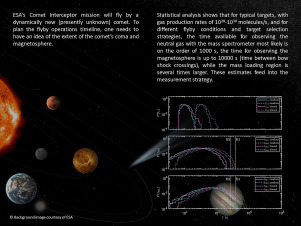
(Source: sciencedirect.com)
- Multiple spacecraft have flown past or studied comets. Major mission examples with outcomes and numbers:
- Giotto (ESA) – Halley 1986: first close images and in-situ dust/gas data.
- Vega 1 and 2, Suisei, Sakigake – Halley family flybys in 1985 to 86 generated composition and dust data.
- Stardust (NASA) – flew past 81P/Wild 2 and returned 10,000 dust particles to Earth in 2006 for lab study.
- Deep Impact (NASA) – deliberately impacted 9P/Tempel 1 with a 366 kg impactor in 2005 and measured ejecta properties. That experiment quantified near-surface strength and composition.
- Rosetta (ESA) – orbited and escorted 67P/Churyumov to Gerasimenko, producing continuous datasets and in-situ chemistry for years; total volatile mass loss estimates over one apparition are on the order of 6 × 10 power 9 kg for that comet. Rosetta revolutionized our small-scale statistical understanding.
| Mission | Key numeric outcomes |
| Stardust | Returned 10,000 cometary particles to Earth (Wild 2). |
| Deep Impact | Impact mass 366 kg; crater/ejecta studied; composition changes measured. |
| Rosetta | Orbital escort of 67P; total volatile mass loss estimated at 6 × 10 power 9 kg over apparition. |
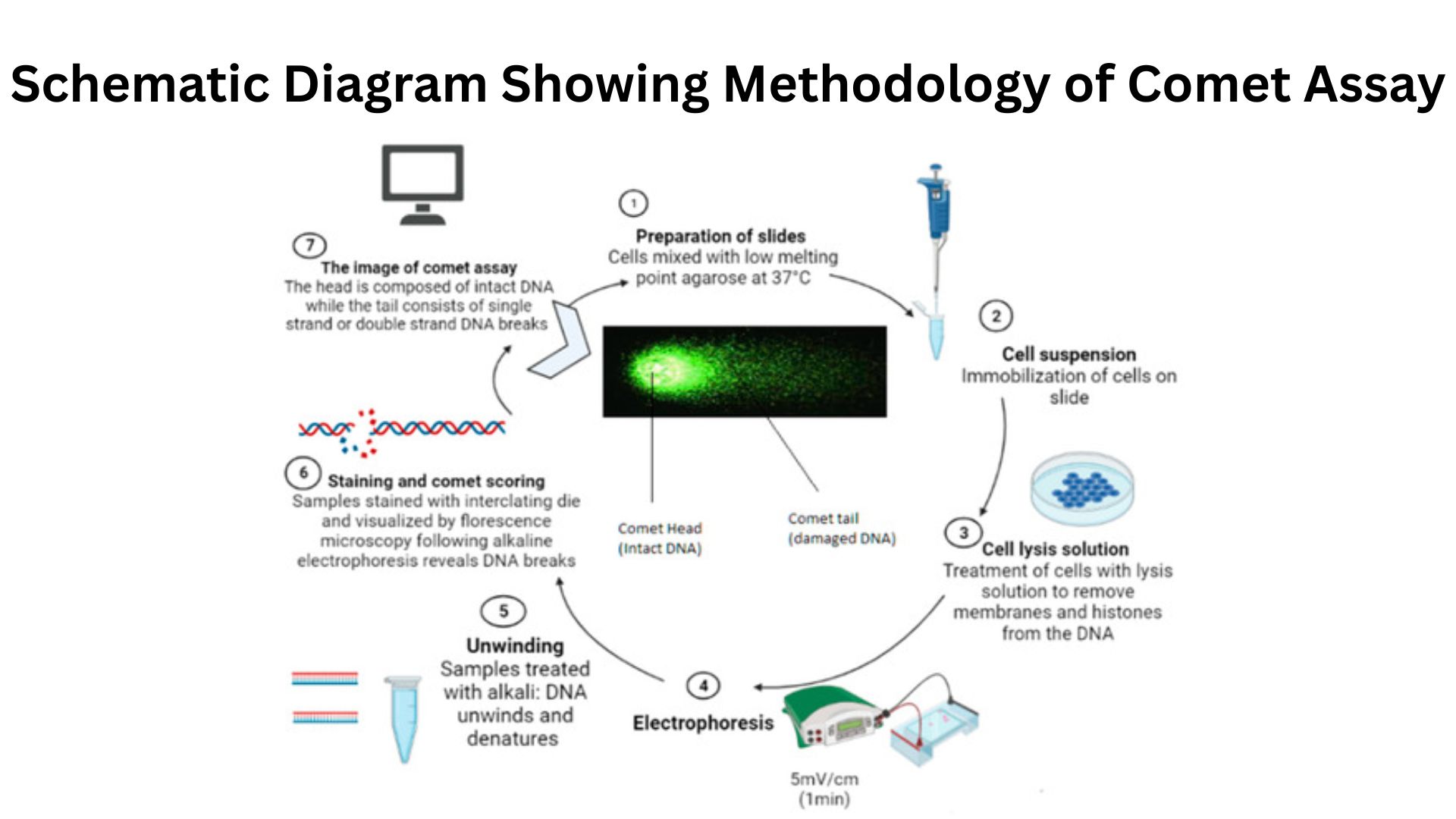
Observation Methods, Detection Limits, and Practical Survey
(Source: mdpi.com)
- Ground optical surveys typically detect moving faint sources down to mag 20 to 24, depending on aperture, exposure, and sky brightness.
- Pan-STARRS routinely finds comets at mag 20+. Infrared space surveys like NEOWISE detect comets by thermal emission and are effective at spotting activity beyond optical detectability.
- The Vera C. Rubin Observatory (LSST) is expected to be a game-changer: simulations and early analyses predict Rubin will expand known small-body populations by a factor of 4 to 9 and could detect thousands to millions of small solar-system objects, including orders-of-magnitude more comets and possibly dozens of interstellar objects during its lifetime. Rubin’s planned single-visit depth near magnitude 24.5 will allow earlier discovery of comets at larger distances.
- NEOWISE/WISE observed 163 comets during its prime mission and detected thermal signatures that allowed nucleus and dust analyses across hundreds of comets.
- The combination of optical and IR statistics dramatically improves size and activity estimates.
| Platform/survey | Detection strength (typical) |
| Ground CCD surveys (Pan-STARRS, Catalina, ATLAS) | Discovery mag 18 to 24, depending on survey and cadence. |
| NEOWISE (infrared) | Observed 163 comets; good for thermal/CO+CO2 diagnostics. |
| Vera C. Rubin Observatory (LSST) | Single-visit depth 24.5 mag; predicted 4 to 9x expansion of small-body catalogs. |
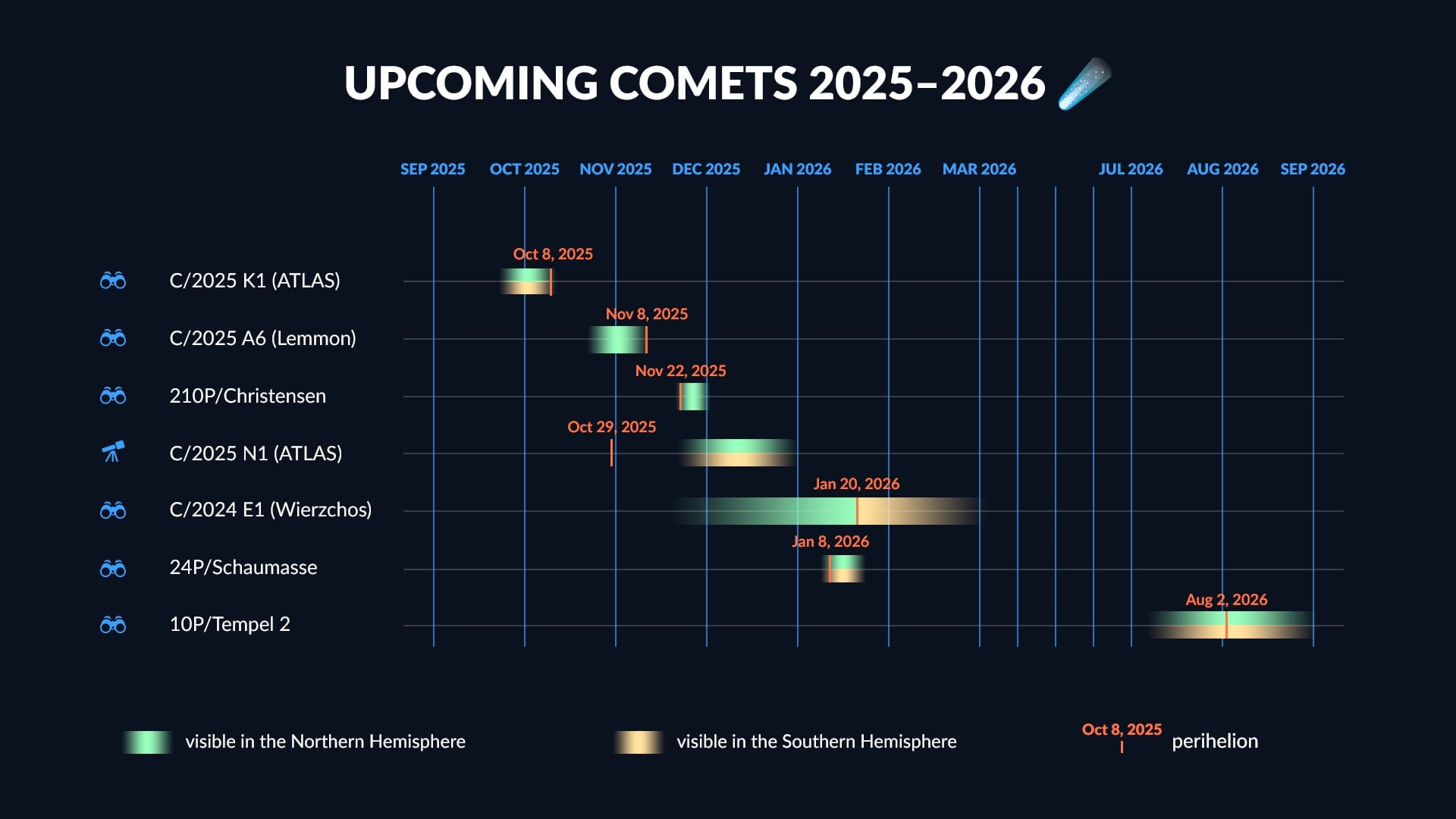
Trends, Future, and What to Expect in the Next Decade
(Source: starwalk.space)
- An abrupt increase in the observed number of comets and other icy bodies should be expected during the Rubin period. Predictions suggest that an order of magnitude increase in the discovered number of objects will occur, with comet detection before their activation becoming possible.
- Rubin should be able to discover dozens of interstellar objects over a period of ten years.
- The net scientific return: better size distributions down to smaller nuclei, better composition statistics from coordinated IR and ground follow-up, and many more targets for spacecraft or rendezvous proposals.
- The observational sample will move from hundreds of well-studied comets to thousands with basic data and hundreds with good physical characterization.
| Prediction | Range/note |
| Increase in known small-body counts with Rubin | 4 to 9× expansion expected in small-body populations. |
| Interstellar object detections (Rubin estimates) | 5 to 50 possible during survey lifetime (models vary). |
| Better early detection distances | Many comets will be found at larger heliocentric distances and earlier cautions before perihelion. |
Recent Developments Of Comet Observation
- In March 2025, NASA’s Comet Interceptor mission, developed in collaboration with the European Space Agency (ESA), successfully completed its final design review, with the launch scheduled for 2029.
- In January 2025, astronomers using the Vera C. Rubin Observatory reported the detection of over 1,000 new small comets in a single survey run, thanks to its advanced 3.2-gigapixel camera.
- In October 2024, Comet C/2023 A3 (Tsuchinshan–ATLAS) became one of the most widely observed comets in recent history, reaching peak brightness with a magnitude of around -4.9, making it visible to the naked eye across both hemispheres.
Final Thoughts
When we look at comet observation, it’s not just about spotting a bright object in the night sky; it’s about reading the numbers and patterns that comets leave behind. From thousands of discoveries to space missions that gave us close-up data, comets tell the story of how our solar system began and how it is still changing. Every orbit, every tail length, and every discovery add to the bigger picture.
If this article sparked your interest in comet observation, keep an eye on the sky and follow the data. You never know, the next bright comet might be the one you’ll get to observe and add to the history of these cosmic travelers. If you have any questions about this article, let me know in the comments section. Thanks.
FAQ
To observe a comet, drive to a dark-sky location to avoid light pollution, use astronomy apps like Stellarium to find the comet’s location, and scan the sky with binoculars. Comets appear as faint, fuzzy patches. For more detail, switch to a low-power telescope or try astrophotography.
A comet is visible in the night sky for anywhere from a few weeks to a couple of months. This duration depends on how close it passes to the Sun and Earth, and whether you are using the naked eye or a telescope.
The last prominent comet visible to the naked eye was C/2023 A3 (Tsuchinshan-ATLAS). It made its closest approach to Earth in October 2024, gracing the evening skies globally (including across India) before fading as it headed back into the outer solar system.