









Introduction
Co-working Statistics: Work is changing, and so are our workplaces. Today, many people prefer flexible spaces instead of traditional offices. Co-working spaces bring freelancers, entrepreneurs, remote workers, and small businesses together in one shared workplace. These spaces offer everything needed to work comfortably, along with a chance to meet new people, share ideas, and build valuable connections.
They are affordable, creative, and designed to increase productivity. As more people choose flexible work styles, co-working spaces are becoming a popular choice around the world. Beyond serving as functional workspaces, they operate as collaborative ecosystems where professionals scale their businesses.
Editor’s Focus Points
- The global coworking spaces market is expected to grow from USD 28.94 billion in 2026 to USD 72.43 billion by 2033, at a 14.0% CAGR.
- North America is expected to lead the market with a 41.2% share in 2026.
- Besides, the global coworking spaces market is dominated by Enclosed Offices at 45.6%.
- The number of global coworking users reached 5.5-6 million in 2025.
- Employees spend about 15% more time collaborating in coworking environments.
- Asia-Pacific leads with approximately 15,000-16,000 coworking spaces globally.
- The United States has 9,136 coworking spaces, totaling 161.3 million sq. ft. and covering 2.2% of the total office inventory.
- Los Angeles ended Q1 2026 with 351 coworking spaces, remaining the largest U.S. market, and added 13 locations.
- In Q1 2026, Manhattan leads coworking space by size with 12.76 million square feet, about 40% more than Chicago at 9.13 million square feet.
- Regus leads the U.S. coworking market with 1,210 locations, capturing a 13.7% market share.
- The national median coworking membership price stayed steady at USD 220 per month in Q1 2026, unchanged from Q4 2025.
General Co-working Statistics
- In 2026, the global total will be approximately 40,000+ Coworking spaces.
- Around 1.7 million people use coworking spaces in the U.S.
- The average coworking space measures 7,308 sq. ft. globally and 9,799 sq. ft. in the U.S.
- North American spaces average 9,799 sq. ft. and serve about 105 members, or 93 sq. ft. per person.
- U.S. spaces host an average of 105 members, compared with 83 globally. Asia averages 114 members per space, while South America averages 54.
- Before the pandemic, 3.4% of the U.S. workforce worked remotely. In 2026, the average monthly hot desk price is around USD 300.
(Source: spacebring.com)
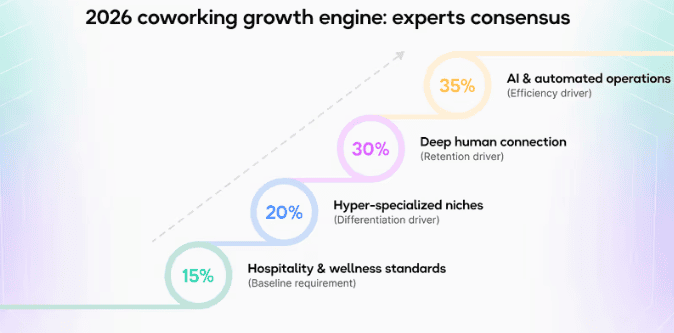
- AI and automated operations are expected to be the biggest driver of efficiency, contributing 35% to coworking growth in 2026.
- Human connection drives 30% retention, niche workspaces add 20% differentiation, while hospitality and wellness provide a 15% growth foundation.
Key Coworking Trends 2026
- According to avanta.co.in, suburban coworking spaces are growing fast, with occupancy rising 25% year over year.
- Around 45% of memberships are now paid for by employers.
- Nearly 65% of users prefer locations within a 15-minute commute.
- Corporate employees make up about 36% of coworking users.
- Only 3% of large companies use flexible spaces for 10% or more of their portfolios.
- AI tools like smart booking and occupancy tracking are becoming standard in workspaces.
- Location convenience is now more important than interior design when choosing coworking spaces.
Global Coworking Spaces Market Size
- The global coworking spaces market is expected to grow from USD 28.94 billion in 2026 to USD 72.43 billion by 2033, at a 14.0% CAGR.
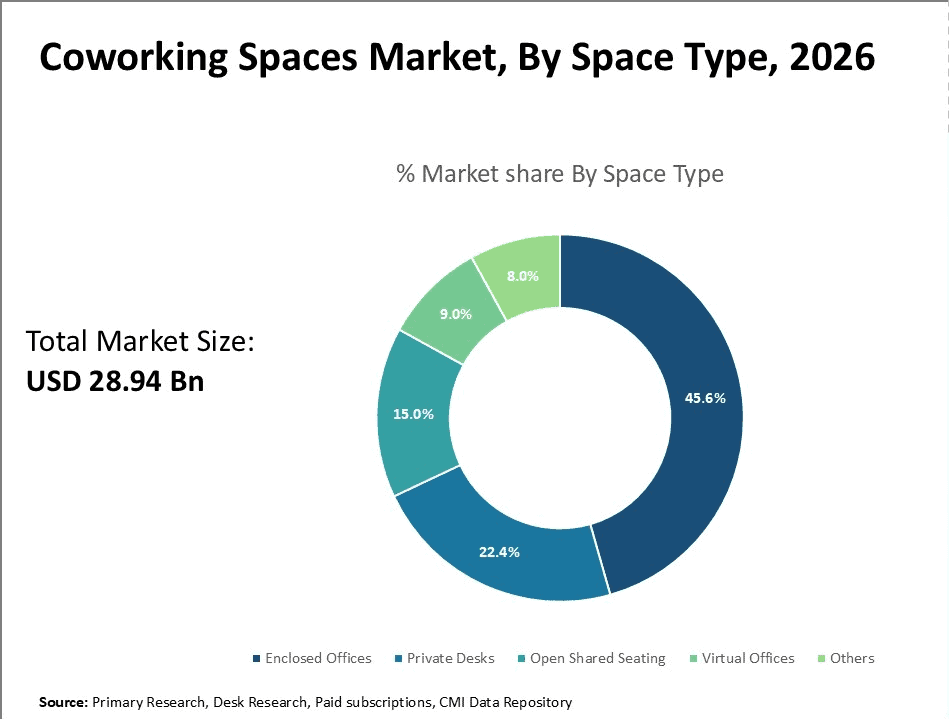
- The enclosed offices segment is projected to hold the largest market share, at 45.6%, in 2026.
- North America is expected to lead the market with a 41.2% share in 2026.
- Asia Pacific is forecast to be the fastest-growing region, accounting for 23.2% of the market in 2026.
By Space Types
(Source: coherentmarketinsights.com)
- In 2026, the global coworking spaces market is dominated by Enclosed Offices at 45.6%, followed by Private Desks at 22.4% and Open Shared Seating at 15%.
- Virtual Offices account for 9% of the market, while the other segment holds 8%.
Global Coworking Market Usage and User Experience Insights
- SpeakwiseApp’s report further stated that the number of global coworking users reached 5.5 to 6 million in 2025.
- The average member age is 36 years, with Millennials making up 61% of users.
- Nearly 50% of users are women, reflecting balanced gender participation.
- About 74% of members feel more productive than working from home or a traditional office.
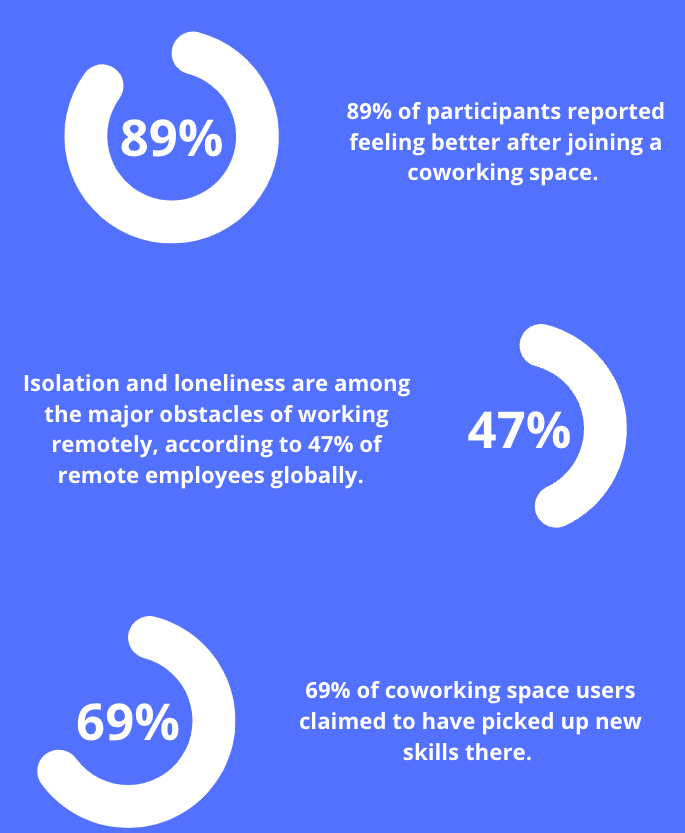
- Around 89% report higher happiness after joining coworking spaces.
- 86% feel less isolated compared to remote work setups.
- About 84% of remote workers say coworking increases their engagement.
- 67% experience better work-life balance.
- Employees spend about 15% more time collaborating in coworking environments.
- Nearly 95% of members report business growth after using coworking spaces.
- According to a report published by Zippia, the average age of coworking members is 36 years.
- Women account for over 50% of global members, although active membership in many spaces remains close to 40%.
- In the U.S., nearly 90% of members identify as White or Caucasian.
- Around 20% of members work in IT, followed by professionals in PR, marketing, consulting, and design.
- Globally, 42% of members are freelancers, while 58% are company employees using flexible workspaces.
- Freelancers in coworking spaces increase income by 25%
- About 80% of members have a college degree.
- The U.S. accounts for nearly 20% of global coworking spaces, followed by India at about 10%.
Global Coworking Spaces by Region, 2026
- Asia-Pacific leads with approximately 15,000-16,000 coworking spaces globally.
- North America follows with around 10,000-11,000 spaces.
- Europe has nearly 9,000-10,000 coworking locations, followed by Latin America (3,000-3,500 spaces) and the Middle East & Africa (around 1,500-2,000 spaces).
By Country
| Country | Estimated Spaces (2026) | Key Highlight |
| United States | 9,136 | Coworking covers 161.3 million sq. ft. and makes up 2.2% of the country’s total office inventory |
| United Kingdom | 4,048 | London alone holds 1,191 spaces, making the UK the single largest coworking market across Europe |
| India | 3,500-4,000 | Flexible workspace stock has crossed 110–114 million sq. ft. across 2,600+ centres, with the market valued at USD 4.53 billion |
| Germany | 970-1,000+ | Berlin alone hosts 182+ coworking centers, and Germany contributes 25.33% of total European coworking revenue |
| Spain | 940 | Spain is the fastest-growing coworking market in Europe, expanding at a CAGR of 8.77%, with Barcelona emerging as the regional hub |
| Canada | 617-620 | Demand is concentrated in Toronto and Vancouver, driven by tech sector growth and hybrid work adoption |
| Mexico | 584 | Mexico City alone recorded a staggering 163% year-over-year surge in coworking demand in 2024 |
| Japan | 450-460 | Hybrid enterprise work policies are pushing steady coworking adoption across Tokyo and other major metros |
| France | 460 | Demand is supported by government-backed initiatives, including the French Tech Visa and the globally recognized Station F innovation campus |
| Australia | 350 | Sydney remains the primary demand center, while the broader APAC region, including nearby Kuala Lumpur, posted 78% year-over-year growth |
United States Coworking Spaces Market Trends
- According to Coworking Cafe, in Q1 2026, the U.S. coworking market reached 9,136 locations, up from 8,854 in Q4 2025, reflecting 3.2% growth and the addition of 282 new spaces.
- Total coworking space increased from 159.4 million to 163.9 million sq. ft., a 2.9% rise, adding nearly 4.5 million sq. ft. in one quarter.
- Average site size declined slightly from 18,000 to 17,945 sq. ft., indicating growing demand for smaller and more flexible workspace formats.
- Coworking spaces account for only 2.28% of the total U.S. office inventory, up from 2.22%.
- The South leads with 36% of the top 50 markets across 18 metros, followed by the West (28%, 14 markets), the Northeast (23%, 8 markets), and the Midwest (20%, 10 markets).
Number of Coworking Spaces
- Los Angeles ended Q1 2026 with 351 coworking spaces, remaining the largest U.S. market, and added 13 locations.
| City / Region | Q1 2026 | Q4 2025 |
| Los Angeles | 351 | 338 |
| Dallas – Fort Worth | 337 | 323 |
| Chicago | 336 | 328 |
| Washington, D.C. | 311 | 310 |
| Manhattan | 308 | 299 |
| Atlanta | 298 | 282 |
| Boston | 267 | 265 |
| Denver | 265 | 260 |
| Houston | 254 | 256 |
| New Jersey | 222 | 214 |
| Philadelphia | 204 | 182 |
| Phoenix | 177 | 172 |
| Seattle | 174 | 167 |
| Miami | 161 | 155 |
| Bay Area | 157 | 146 |
| San Francisco | 154 | 151 |
| San Diego | 152 | 148 |
| Detroit | 141 | 137 |
| Tampa – St. Petersburg – Clearwater | 135 | 120 |
| Minneapolis – St. Paul | 124 | 119 |
| Orange County | 123 | 121 |
| Nashville | 117 | 118 |
| Charlotte | 115 | 113 |
| Raleigh – Durham | 113 | 106 |
| Austin | 108 | 103 |
Total Coworking Square Footage
- In Q1 2026, Manhattan leads coworking space by size with 12.76 million square feet, about 40% more than Chicago at 9.13 million square feet.
| City / Region | Q1 2026 | Q4 2025 |
| (in million) | ||
| Manhattan | 12.76 | 12.44 |
| Chicago | 9.13 | 8.96 |
| Los Angeles | 7.74 | 7.49 |
| Washington, D.C. | 7.44 | 7.35 |
| Dallas – Fort Worth | 6.86 | 6.69 |
| Boston | 6.12 | 6.09 |
| Atlanta | 5.74 | 5.47 |
| Houston | 5.05 | 5.03 |
| Denver | 4.22 | 4.15 |
| San Francisco | 3.93 | 3.83 |
| New Jersey | 3.74 | 3.41 |
| Philadelphia | 3.66 | 3.31 |
| Seattle | 3.41 | 3.24 |
| Phoenix | 3.37 | 3.29 |
| Miami | 3.33 | 3.19 |
| Bay Area | 3.33 | 3.18 |
| Orange County | 2.95 | 2.86 |
| San Diego | 2.87 | 2.8 |
| Raleigh – Durham | 2.33 | 2.21 |
| Nashville | 2.13 | 2.15 |
| Minneapolis – St. Paul | 2.05 | 2 |
| St. Louis | 2.03 | 1.93 |
| Indianapolis | 2.02 | 1.9 |
| Detroit | 2.02 | 1.93 |
| Tampa – St. Petersburg – Clearwater | 2 | 1.84 |
Top Co-working Operators Statistics, 2026
(Source: yardikube.com)
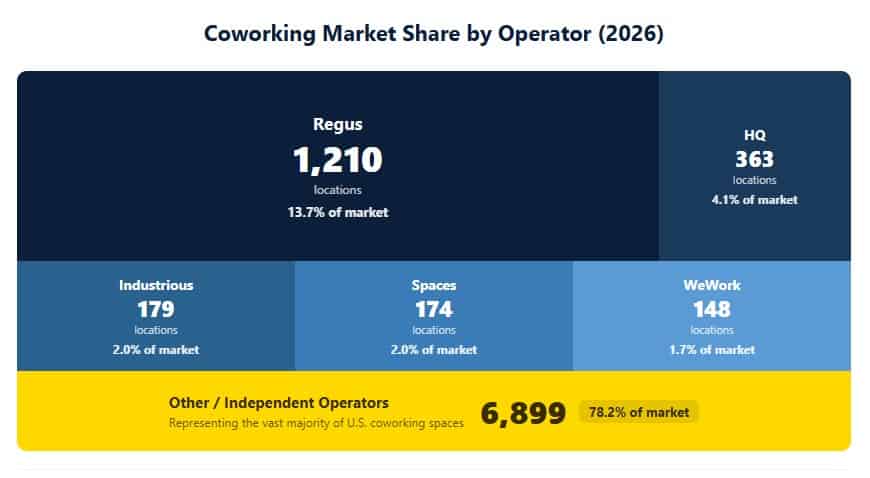
- Regus leads the U.S. coworking market with 1,210 locations, capturing a 13.7% market share.
- HQ holds the second spot with 363 locations and a 4.1% market share, followed by Industrious with 179 locations (2.0%), Spaces with 174 locations (2.0%), and WeWork with 148 locations (1.7%).
- Despite the presence of these well-known brands, Other and Independent Operators dominate the landscape, with 6,899 locations and a commanding 78.2% share of the total U.S. coworking market.
Coworking Pricing Trends
- According to coworkingcafe, the national median coworking membership price stayed steady at USD 220 per month in Q1 2026, unchanged from Q4 2025.
- Meeting rooms further remained at USD 45 per hour, while day passes increased from USD 30 to USD 33, and virtual offices rose from USD 159 to USD 169 per month.
- Pricing shifts varied across markets.
- Manhattan remained the most expensive at USD 339 per month, with strong demand keeping rates stable. Brooklyn eased to USD 320, down USD 19.
- San Francisco, Los Angeles, Seattle, Boston, the Bay Area, Miami, New Jersey, and Nashville remained stable at around USD 235 per month.
- Dallas-Fort Worth fell from USD 214 to USD 208, Chicago held at USD 199, Houston rose to USD 229, and Indianapolis increased to USD 200. Tampa-St. Petersburg saw a sharp rise from USD 200 to USD 220 (+10%).
- Lower-cost markets stayed competitive, with St. Louis and Columbus at USD 150, Salt Lake City at USD 169, and Raleigh-Durham dropping from USD 225 to USD 206.
Pricing Analysis of the Coworking Spaces Market
| Membership Type | Global/National Average | Premium Markets | Budget Markets |
| Hot Desk | Global average: USD 195-206; U.S. median: USD 149 | USD 400-600 in NYC; USD 350-550 in San Francisco | Around USD 99 in Wichita and Greensboro |
| Dedicated Desk | U.S. average: USD 300-387 | USD 700-1,200 in NYC; USD 600-1,100 in San Francisco | USD 250-500; USD 189 in Grand Rapids |
| Private Office | Starts at USD 600; global range USD 350-800 | USD 2,000+ in NYC; USD 1,500+ in San Francisco; USD 1,000-1,500 in Chicago | USD 500-900 |
| Virtual Office | U.S. median: USD 120 | USD 240 in Naples and USD 215 in Trenton | USD 50-65 in Rochester and College Station |
Benefits and Impacts of Co-working
- Co-working spaces offer several in-office perks, including social events, coffee, and snacks, which are accepted by 94% of users.
- 57% of people said co-working spaces enable convenient location, along with cutting down on commute time.
- 55% of users benefit from networking opportunities that promote better business interaction.
- Increased flexibility with office spaces and a sense of community are the other two advantages claimed by 53% and 51% of co-working space users.
- Focus Enhancement: 68% of coworkers believe the co-working environment improves their ability to concentrate.
- Skill Development: 69% of coworkers report acquiring new skills through interactions and collaborations within the space.
Challenges and Opportunities
The future of co-working spaces seems bright, but several challenges remain:
- Competition: The market is becoming increasingly saturated, requiring co-working spaces to differentiate themselves through unique offerings and strong community building.
- Financial Sustainability: Maintaining profitability in a competitive market will necessitate strategic pricing models, efficient space management, and value-added services.
- Technological Integration: Implementing advanced technologies requires ongoing investment and ensuring user-friendliness for members.
The Reason Behind Co-working Popularity
(Source: flexas.com)
Conclusion
Understanding these statistics provides valuable insights into the current state and future potential of the co-working space industry. The main principle of the co-working industry is to help enable affordability, flexibility, and Productivity. The report is focused on the United States’ insights and includes other major players in the co-working industry worldwide.
As the demand for flexible work arrangements continues to rise, co-working spaces are poised to play an increasingly significant role in the evolving work landscape.

Sources