








Beginning
AI in Marketing Statistics: AI is changing the way brands reach and connect with people. From creating content to studying customer behavior, AI is helping marketers work faster and make better decisions. AI-powered tools can analyze data, suggest products, personalize messages, manage ads, and answer customer questions via chatbots. This makes it easier for businesses to understand what customers want and deliver the right message at the right time. AI can also reduce repetitive work, save time, and improve marketing results.
However, it comes with challenges, including data privacy, accuracy, and the need for human judgment. As AI continues to grow, businesses must learn to use it wisely while keeping customers at the center.
Preferred Choice
- By the end of 2026, the global AI in marketing market is expected to reach a valuation of USD 62.21 billion, up from USD 47.32 billion in 2025.
- 67% of small and medium-sized businesses now use AI for marketing activities.
- Around 75% of marketers have adopted AI.
- 29% of B2B marketers currently use AI, while 32% plan to adopt it in the future.
- About 66% of consumers are comfortable with AI managing resale activities.
- Among shoppers, AI is most widely experienced in product reviews and images (46%).
- 65% of CMOs believe AI advances will significantly change their roles in the near term.
- 93% of marketers use AI to create content faster.
- 30% of media agencies and brands have already integrated AI into their campaign lifecycles.
- AI adoption is high in social media marketing, with 89.7% of marketers using AI at least once a week.
- Text content creation ranks as the top generative AI use among marketers, at 55.38%.
- ChatGPT leads usage at 72%, followed by Canva AI at 58%.
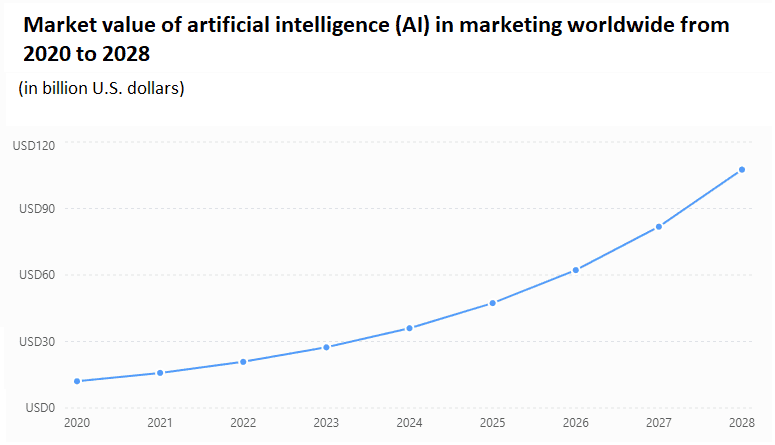
Global Market Value of AI in Marketing
(Source: statista.com)
- According to Statista, the global AI in marketing market was valued at approximately USD 12.05 billion in 2020. It is projected to reach USD 107.54 billion by 2028, representing a CAGR of about 31.4%.
- By the end of 2026, the market valuation is expected to reach around USD 62.21 billion, up from USD 47.32 billion in 2025.
AI Adoption in Marketing and Business
- According to a report published by Adobe, 67% of small and medium-sized businesses now use AI for marketing activities.
- 60% of marketers use AI tools every day, showing growing reliance on AI.
- 83% of companies consider AI a top business priority.
- 78% of businesses use AI in at least one business function.
- 88% of digital marketers use AI in their daily work.
- 50% of marketers have added AI to their regular workflows.
- 20% of U.S. workers now use AI in their jobs.
- 37% of companies that do not use AI say they do not understand how it works.
- 92% of businesses plan to invest in generative AI tools within the next three years.
In B2C Marketing
- According to Salesforce, 75% of marketers have adopted AI.
- Meanwhile, 78% need more personalized content, and 75% use AI to scale personalization.
- 83% say consumers expect two-way brand conversations, but 69% struggle to respond quickly.
- 81% trust AI to handle customer responses and support engagement.
- AI and agents influenced 20% of global holiday orders, worth USD 262 billion in sales.
- 86% of marketers say AI is raising customer expectations.
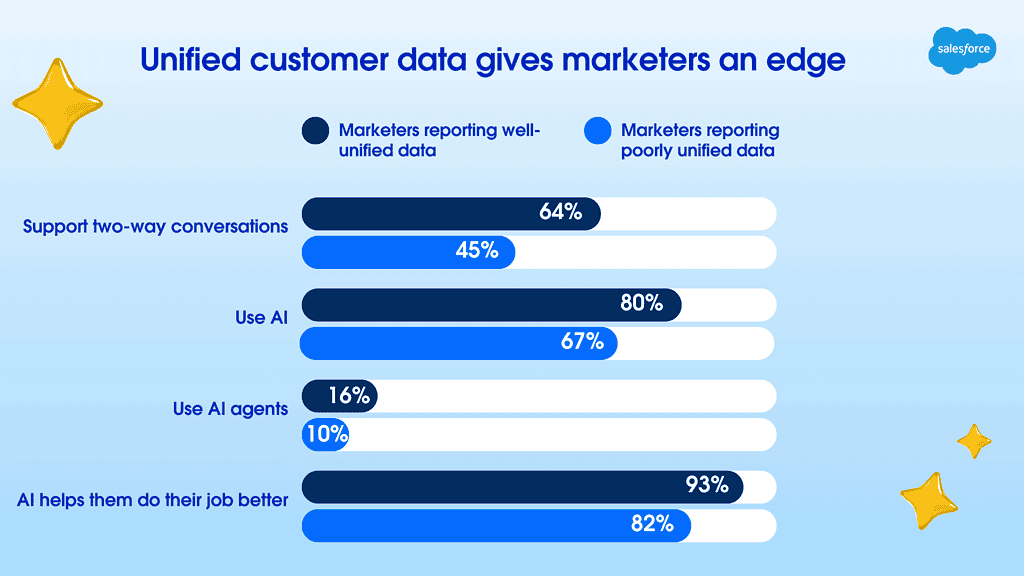
Unified Customer Data Improves AI Marketing Results
(Source: salesforce.com)
- 64% of marketers with well-unified customer data support two-way customer conversations, compared with 45% of those with poorly unified data.
- 80% of marketers with unified data use AI, versus 67% with poorly connected data.
- AI agents are used by 16% of data-mature marketers, compared with 10% of others.
- 93% say AI improves their work, versus 82% among marketers with poorly unified data.
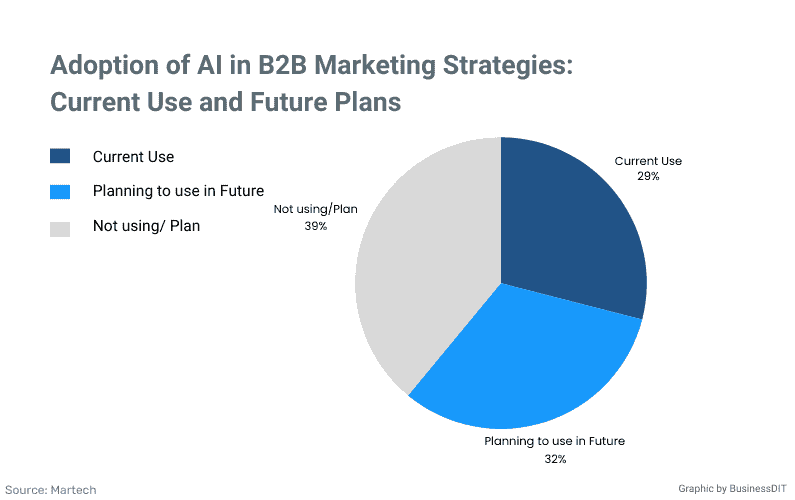
In B2B Marketing
- 64% of B2B marketers consider AI valuable for their marketing strategy.
(Source: businessdasher.com)
- 29% of B2B marketers currently use AI, while 32% plan to adopt it in the future.
- 39% neither use nor plan to use AI, indicating substantial untapped adoption potential.
- 63% of B2B marketers say AI has contributed to higher revenue.
- 26% of U.S. B2B marketers using chatbots reported a 10%-20% increase in lead generation.
- Meanwhile, 99% believe AI chatbots improve lead conversion.
- By 2025, 75% of B2B sales organizations were expected to combine AI with traditional sales tools.
- Around 27% planned major AI investments for content recommendations.
- AI personalization interests 71% of B2B marketers, while 63% use AI to identify trends.
- Additionally, 59% seek prospects, and 53% expect improved marketing effectiveness and revenue.
In C2C Marketing
- The Digital Commerce 360 report also found that about 66% of consumers are comfortable with AI managing resale activities.
- 33% could be encouraged to resell through easier AI-based listings, while 32% want a simpler listing setup.
- Faster payouts could motivate 36% of consumers to resell more.
- According to group.dhl.com, 29% of shoppers let AI make purchase decisions.
- This rises to 33% among Gen Z and 36% among Millennials.
- 59% expect virtual-assistant commerce.
- Meanwhile, 73% expect greater use of generative AI.
- However, 48% remain concerned about privacy and trust.
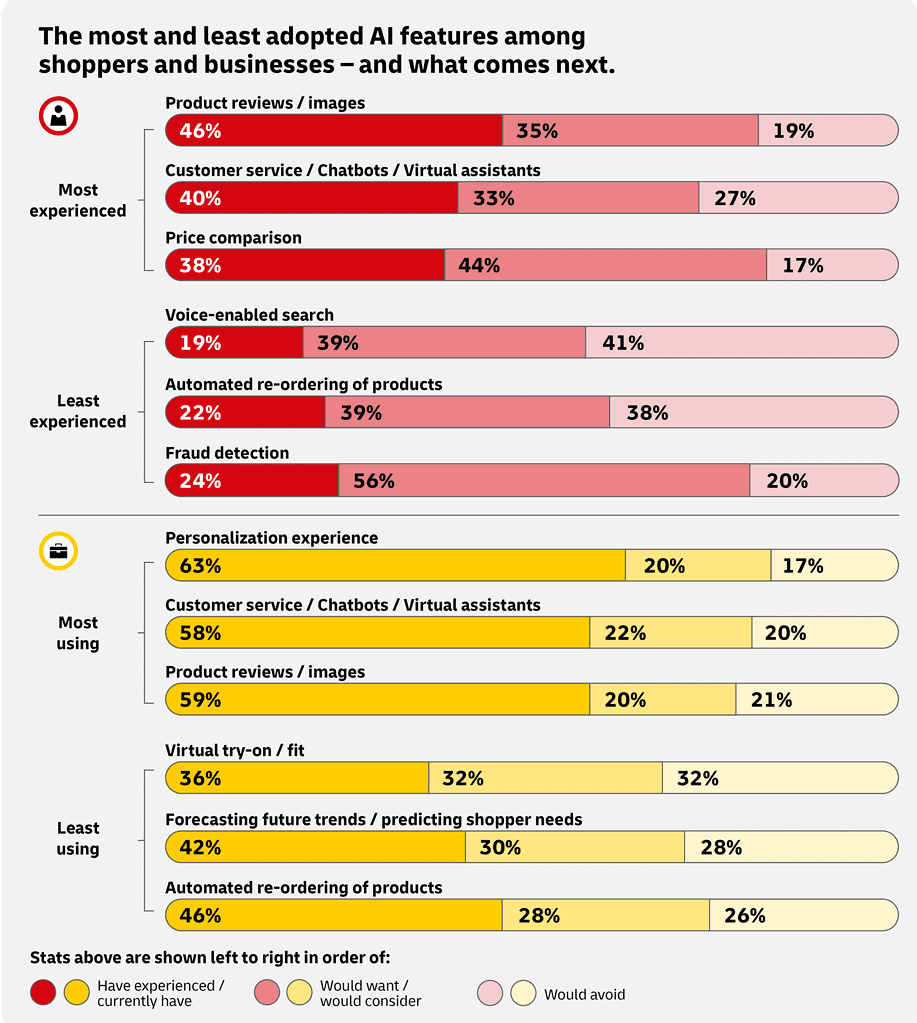
AI Feature Adoption Among Shoppers and Businesses
(Source: group.dhl.com)
- Among shoppers, AI is most widely experienced in product reviews and images (46%). It is followed by customer service, chatbots, and virtual assistants (40%), and price comparison (38%).
- Voice-enabled search has 19% adoption, followed by automated reordering at 22% and fraud detection at 24%.
- Interest in AI adoption remains strong, with 44% citing price comparison, 39% voice search, and 56% fraud detection.
- Personalization leads AI adoption at 63%, followed by product reviews and images at 59%, and customer service at 58%.
- Automated re-ordering is used by 46% of businesses, while 42% use AI to forecast trends and predict shopper needs.
- Only 36% of businesses use virtual try-on tools, while 32% may adopt them.
AI Is Reshaping Marketing Leadership and Business Strategy
- Shopify notes that 65% of CMOs believe AI advances will significantly change their roles in the near term.
- AI is expected to significantly reshape company identities, according to 82% of business leaders.
- Fewer than 5% of marketing leaders using GenAI as a standalone tool report major business gains.
- 70% of enterprise marketers are implementing or planning to implement GenAI within six months.
- By 2027, 50% of companies are expected to deploy AI agents.
- 89% of martech leaders piloting or integrating agentic AI expect significant benefits after technical gaps are resolved.
- Only 31% of employees believe their leaders understand the AI technologies they promote.
- 60% of government and enterprise leaders identify risk, compliance, and legacy-system integration as major AI challenges.
AI Use in Content, SEO, and Search
- 93% of marketers use AI to create content faster.
- Ahrefs further reported that companies publish 42% more content each month with AI support.
- 74% of new webpages contain some AI-generated content.
- 91% of pages cited in AI Overviews contain some AI-generated content.
- 44% of respondents use ChatGPT for content creation, making it the most widely used AI model for this purpose.
- According to HubSpot, 55% of marketers identify content creation as the most common AI use case.
- 68% of businesses report higher ROI from AI-driven content marketing.
- Another 65% have seen improved SEO performance from AI marketing tools.
- Websites ranking first in traditional search are 25% more likely to appear in AI Overviews.
In Marketing Campaigns, Advertising, and Email
- Based on the IAB report, around 30% of media agencies and brands have already integrated AI into their campaign lifecycles.
- According to zebracat.ai, AI-powered PPC bid management can cut wasted ad spending by about 37% while improving advertising ROI by nearly 50%.
- In some industries, AI-driven email campaigns can increase open rates by up to 41%.
- Around 75% of US marketers report that AI helps their organizations reduce costs.
In Social Media Marketing
(Source: sociality.io)
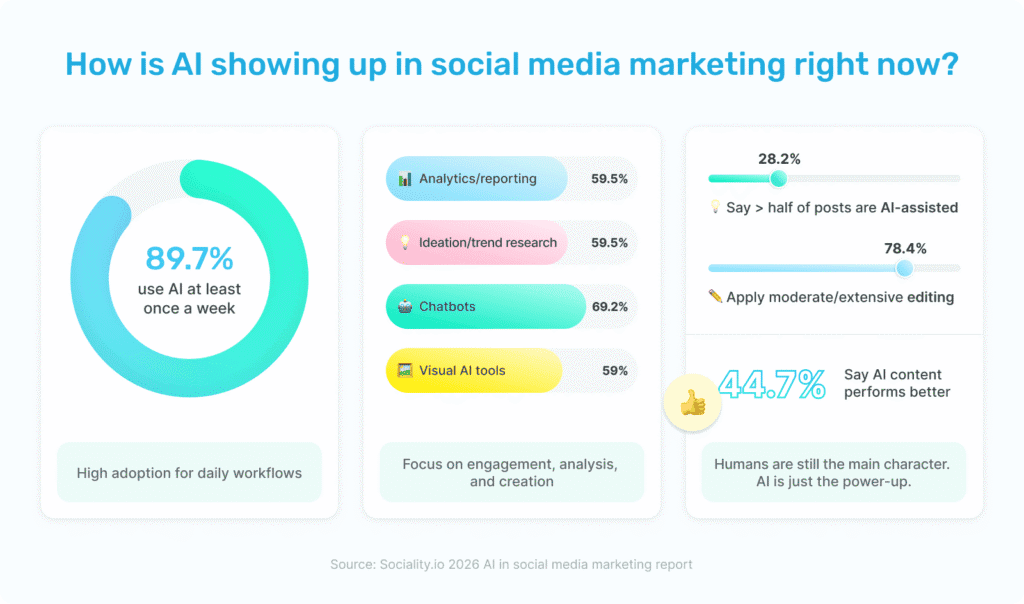
- AI adoption is high in social media marketing, with 89.7% of marketers using AI at least once a week.
- Analytics, reporting, content ideas, and trend research each rank as top AI applications, used by 59.5% of marketers.
- Chatbots are used by 69.2% of marketers, while visual AI tools are used by 59%.
- More than half of posts receive AI support, according to 28.2% of marketers.
- Marketers still review AI content, with 78.4% making moderate or extensive edits before publishing.
- Overall, 44.7% of marketers report that AI-assisted social media content performs better than content created without AI.
Generative AI Use in Marketing
(Source: hubspotusercontent-na1.net)
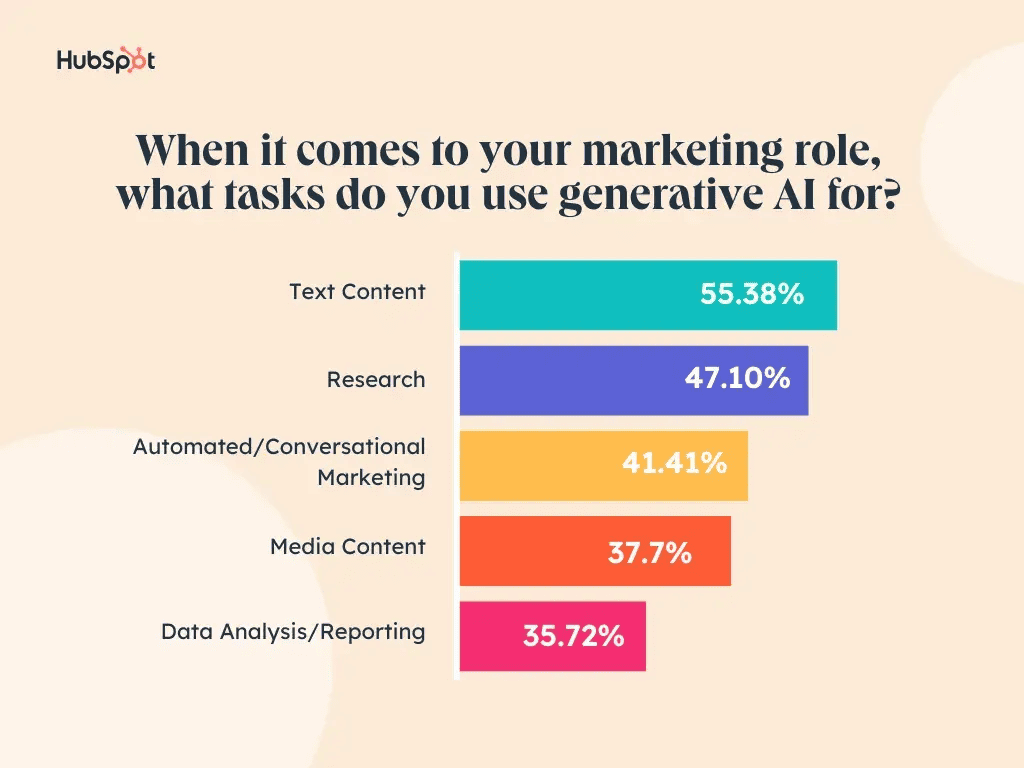
- Text content creation ranks as the top generative AI use among marketers, at 55.38%.
- Research is the second-largest application, used by 47.10%.
- Automated and conversational marketing accounts for 41.41% of usage.
- Generative AI supports media-content creation for 37.7% of marketers.
- Data analysis and reporting are used by 35.72% of respondents.
Industries Expecting AI and Big Data as a Core Skill, 2025-2030
| Industry | Share of Employers |
| Information and technology services | 66% |
| Telecommunication | 66% |
| Financial services and capital markets | 61% |
| Insurance and pensions management | 58% |
| Education and training | 56% |
| Automotive and aerospace | 54% |
| Medical and healthcare services | 51% |
| Government and public sector | 50% |
| Electronics | 44% |
| Supply chain and transportation | 44% |
| Real estate | 43% |
| Production of consumer goods | 42% |
| Retail and wholesale of consumer goods | 41% |
| Infrastructure | 39% |
| Professional services | 37% |
Marketing Measurement Investment Priorities
(Reference: sqmagazine.co.uk)
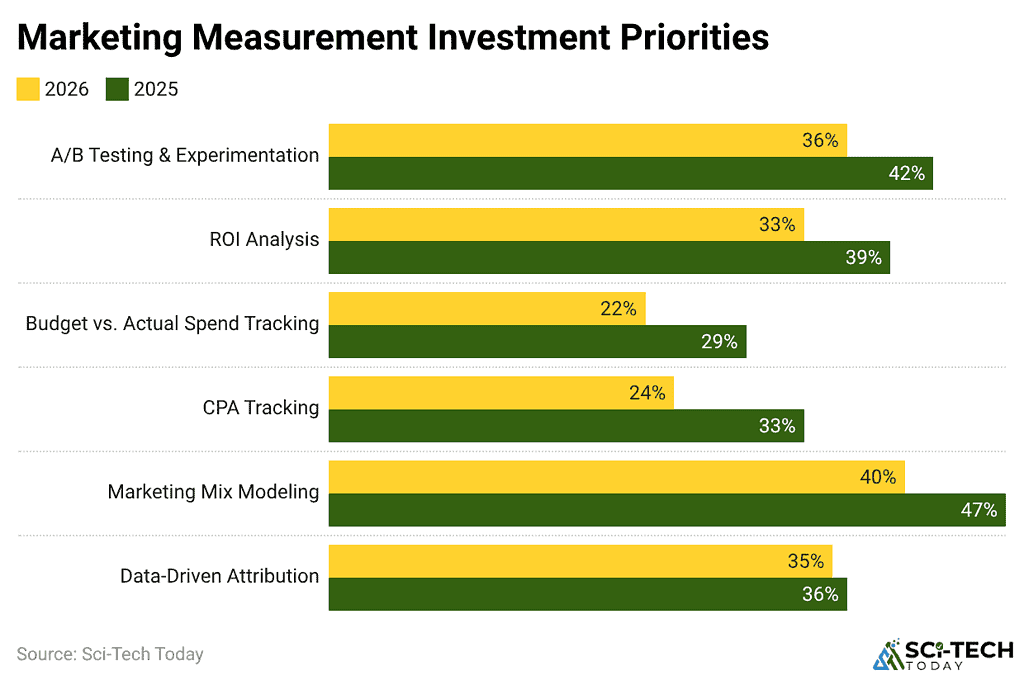
- A/B testing and experimentation remained a key priority, although investment fell from 42% in 2025 to 36% in 2026.
- ROI declined from 39% to 33%, indicating a reduced investment focus.
- Budget vs. actual spend tracking dropped from 29% to 22%.
- The highest priority in both years.
- Data-driven attribution saw the smallest decline, moving from 36% to 35%.
AI Marketing Tools Usage
(Reference: searchlab.nl)
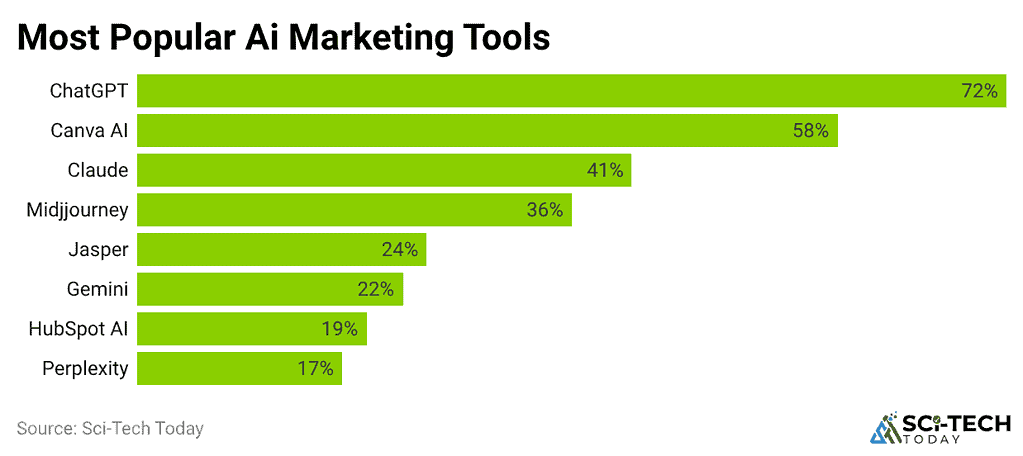
- ChatGPT leads usage at 72%, followed by Canva AI at 58%.
- Claude is used by 41%, while Midjourney is used by 36%.
- Jasper (24%), Gemini (22%), HubSpot AI (19%), and Perplexity (17%) show lower adoption.
AI and Automation Impact Across Seller Operations
(Source: marketplacepulse.com)
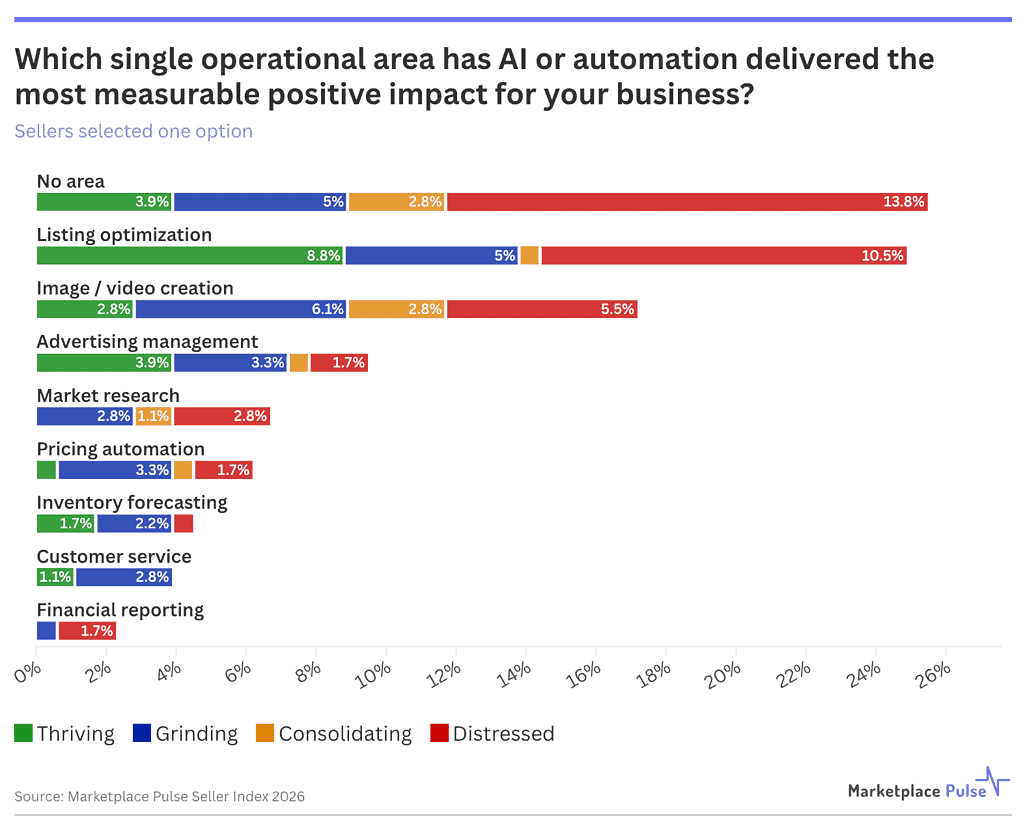
- Sellers in distressed businesses reported the highest impact from AI or automation in listing optimization (10.5%) and in areas with no clear impact (13.8%).
- Thriving sellers mainly benefited from listing optimization (8.8%), followed by advertising management (3.9%) and image/video creation (2.8%).
- Grinding businesses saw notable gains from image/video creation (6.1%), listing optimization (5%), and market research (2.8%).
- Consolidating sellers recorded the strongest impact in image/video creation (2.8%), while market research accounted for 1.1%.
- Pricing automation generated a 3.3% impact among grinding sellers, while inventory forecasting contributed 2.2%.
- Customer service showed limited AI impact, reaching 2.8% among grinding sellers.
AI Is Reshaping Customer Experience
- Adobe’s 2026 research surveyed 3,000 CX executives and practitioners and 4,000 customers.
(Source: business.adobe.com)
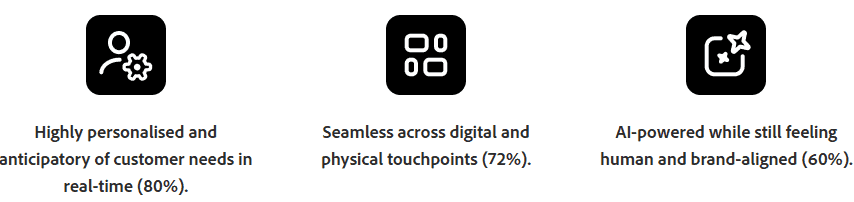
- Organizations expect future CX to be highly personalized and predictive in real time (80%).
- 72% expect experiences to become seamless across digital and physical channels.
- 60% want AI-powered experiences that still feel human and aligned with their brand.
- Customers have limited attention, with 50% saying emails, ads, and social posts have only 2-5 seconds to attract interest.
Recent AI Marketing Developments
- According to SQ Magazine, OpenAI’s GPT-5 Turbo reportedly powers real-time campaign content for about 38% of enterprise marketing teams.
- Meta’s Llama 4 supports AI targeting in over 55% of large-brand paid social campaigns.
- Google Gemini AI has reached around 180 million monthly active users.
- Adobe Firefly can reduce creative production time by 20%40%.
- Shopify’s Sidekick is estimated to serve more than 60% of high-volume DTC merchants.
- TikTok’s AI video tools can cut production time by 50%-70%.
- Salesforce Einstein contributes to 20%-40% gains in operational efficiency.
- Amazon’s AI tools support hundreds of thousands of sellers among 2 million+ active merchants.
- The virtual influencer market has reached about USD 4.6 billion.
Final Thoughts
AI is becoming an important part of modern marketing. It helps brands understand their customers, personalize campaigns, save time, and make better decisions. Still, good marketing needs a human touch. Creativity, ideas, and customer understanding cannot come from AI alone.
The best results come when marketers use AI to support their work rather than depend on it completely. As the technology improves, smart use of AI can help businesses grow and stay ahead.
FAQ
AI marketing analyzes customer data, predicts behavior, personalizes campaigns, automates tasks, and helps marketers make faster, data-driven decisions.
Yes, AI can help create engaging, relevant, and personalized content faster.
AI is unlikely to replace human marketers, but it will automate tasks and help them make smarter, faster decisions.

Sources