








Overview
Vegan Statistics: More people are choosing a vegan lifestyle than ever before. A vegan diet includes only plant-based foods and avoids all animal products, such as meat, dairy, eggs, and honey. People become vegan for many reasons, including better health, protecting animals, and caring for the environment. When planned properly, a vegan diet can provide most of the nutrients your body needs and may lower the risk of some health problems. However, it also requires smart food choices to avoid nutrient deficiencies.
This guide explains everything you need to know about Veganism, including its benefits, possible risks, foods to eat, foods to avoid, and simple tips for following a healthy vegan lifestyle.
Editor Approved
- Around 88 million people worldwide were vegan in 2023, representing about 1.1% of the 8.3 billion global population.
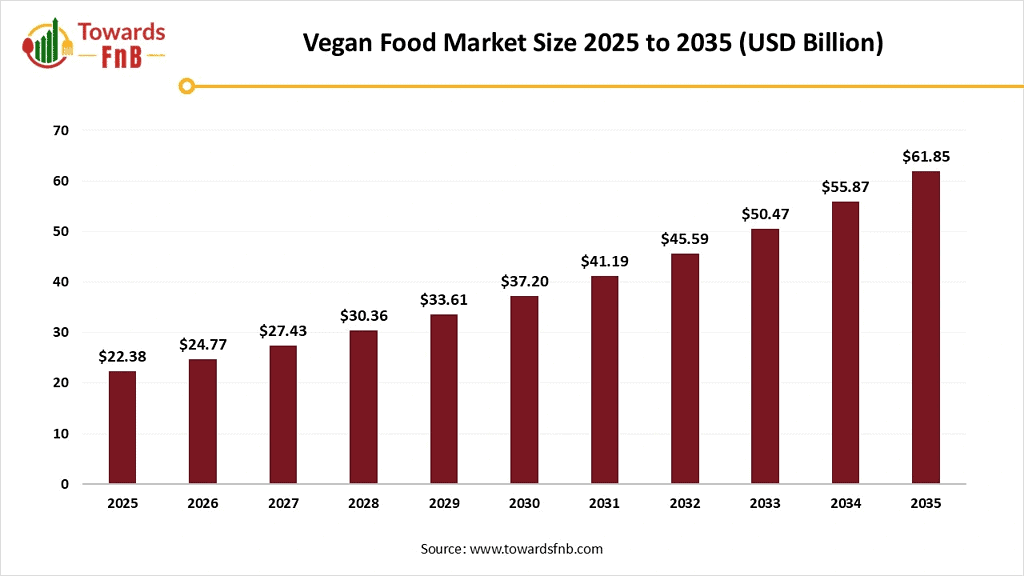
- The global vegan food market was valued at USD 22.38 billion in 2025 and is projected to reach USD 61.85 billion by 2035, growing at a 10.7% CAGR.
- The alternative protein market reached USD 26.66 billion in 2025 and is forecast to grow to USD 88.8 billion by 2034, at a 14.3% CAGR.
- Animal welfare is the leading reason people choose veganism, cited by 68.1% of respondents.
- India and Mexico have the world’s highest vegan population share, with 9% of their populations following a vegan diet.
- Plant-based milk is the most widely adopted alternative product, used by 81% of surveyed consumers in 2025.
- Switching to a vegan diet can reduce food-related greenhouse gas emissions by 46%, land use by 33%, and water use by 7%.
- An Oxford University study estimates that a global vegan diet by 2050 could save 8 million lives, reduce 2/3 of greenhouse gas emissions, and avoid USD 1.5 trillion in climate-related damages.
- Women account for 67% of the global vegan population, while 79.6% of 1,143 surveyed vegans in Saudi Arabia were women.
- The vegan food market is expected to grow from USD 42.24 billion in 2025 to USD 132.21 billion by 2034, with Asia Pacific holding the largest regional share at 43.10%.
Global Vegan Population Statistics
- A World Animal Foundation report stated that in 2023, the world had about 88 million vegans, equal to around 1.1% of the 8.3 billion global population in 2026.
- Around 25.8 million people tried a vegan diet during January 2025.
- Only 1%-2% of the global population follows a vegan lifestyle.
- An Oxford University (2016) study estimated that a global vegan diet by 2050 could save 8 million lives, reduce 2/3 of greenhouse gas emissions, and avoid USD 1.5 trillion in climate-related damages.
- Vegan diets create only about 30% of the environmental impact of high-meat diets.
- Plant-based diets could reduce agricultural labor needs by 22%-28% by 2030 and lower labor costs by 0.2%-0.6% of GDP annually.
- A vegan diet can reduce daily carbon emissions by 46% and lower early death risk by 18%-21%.
- Women make up 67% of vegans, while 79.6% of 1,143 surveyed vegans in Saudi Arabia were women.
- In India, 10% of people are vegan, compared with 13% in 2022, while about 25% are vegetarian.
Global Vegan Food Market Highlights
(Source:towardsfnb.com)
- The global vegan food market was valued at USD 22.38 billion in 2025.
- The market is expected to grow from USD 24.77 billion in 2026 to USD 61.85 billion by 2035, at a 10.7% CAGR during 2025-2034.
- North America held the largest regional share of the global vegan food market, accounting for 35% in 2025.
- The North American market is expected to grow from USD 9.41 billion in 2026 to USD 23.5 billion by 2035, at a 10.7% CAGR.
- The U.S. market is projected to increase from USD 7.06 billion in 2026 to USD 17.63 billion by 2035, also growing at a 10.7% CAGR.
- Meanwhile, offline distribution channels dominated the market with an 85% share in 2025.
Global Vegan and Plant-Based Market Statistics
- The alternative protein market was valued at USD 26.66 billion in 2025 and is projected to grow from USD 30.48 billion in 2026 to USD 88.8 billion by 2034, at a 14.3% CAGR.
- The plant-based protein market is expected to reach USD 22 billion in 2026 and USD 49.9 billion by 2036.
- The plant-based food market reached USD 64.14 billion in 2025 and USD 68.4 billion in 2026.
- The vegan food market is forecast to grow from USD 42.24 billion in 2025 to USD 132.21 billion by 2034, with Asia Pacific holding 43.10% of the market.
- The plant-based milk market stood at USD 22.66 billion in 2025 and is expected to reach USD 43.46 billion by 2034.
- Vegan cosmetics were valued at USD 20.48 billion in 2025, while Europe held 33.63% of the market.
- The plant-based leather market is projected to grow from USD 216.24 million in 2025 to USD 355.23 million by 2032, at a 7.34% CAGR.
Plant-based Food Sales by Category
(Source: market.biz)
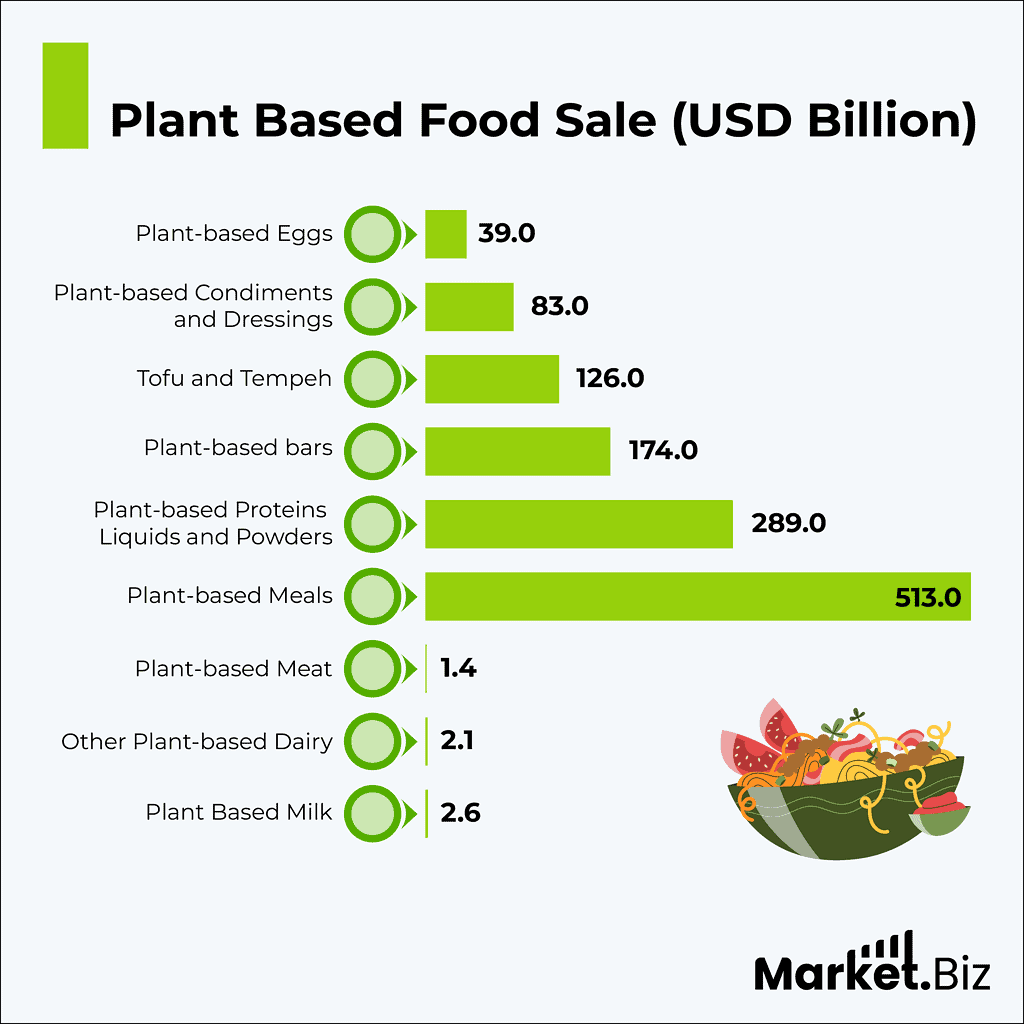
- Plant-based meals lead the market with sales of USD 513 billion.
- Plant-based proteins, liquids, and powders generate USD 289 billion, while plant-based bars account for USD 174 billion.
- Tofu and tempeh record sales of USD 126 billion, followed by plant-based condiments and dressings at USD 83 billion and plant-based eggs at USD 39 billion.
- Other categories remain smaller, with plant-based milk at USD 2.6 billion, other plant-based dairy at USD 2.1 billion, and plant-based meat at USD 1.4 billion.
Vegan Statistics By Health Benefits And Deficiencies
- A person following a vegan diet is likely to suffer from insufficient levels of vitamins B2, B3, B12, and D, along with selenium, calcium, and zinc
- Vegan Statistics show that a vegan diet aids in reducing the risk of prostate cancer.
- If the entire planet’s population shifts to a vegan diet, then within the next 25 years, the environment, personal health, and pollution will be greatly improved, and more than 8 million animal lives will be saved.
- Based on a report by the University of Oxford, global Veganism can reduce greenhouse gas emissions created by farming by 66%.
- Furthermore, if greenhouse gas emissions are reduced, then governments can save $1.5 trillion in climate change mitigation projects.
- Vegan Statistics further show that a vegan lifestyle worldwide is likely to reduce overall agricultural land use by 76%.
- Diabetic patients who follow a vegan diet are likely to control their blood sugar level by 28%.
New Diets People Plan to Start
(Source: miro.medium.com)
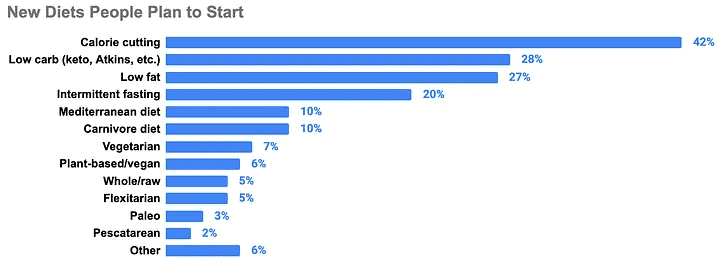
- A 2026 survey of 2,201 US adults shows 42% plan to start a calorie-cutting diet, making it the most preferred approach.
- Low-carb diets such as keto or Atkins attract 28%, while low-fat diets are chosen by 27% of respondents.
- Intermittent fasting appeals to 20%, and the Mediterranean diet is selected by 10%.
- Smaller but notable shares plan a carnivore diet at 10%, vegetarian at 7%, and plant-based or vegan at 6%.
- Whole or raw diets and flexitarian patterns each attract 5%, paleo 3%, pescatarian 2%, and 6% of respondents choose other diets.
Key Reasons for Adopting a Vegan Lifestyle
- 68.1% of people chose veganism mainly because of animal welfare, making it the leading reason.
- 17.4% adopted a vegan diet to improve their health and reduce the risk of chronic diseases.
- 9.7% switched to veganism due to environmental concerns, especially the impact of meat production.
- Before becoming vegan, 52.1% were vegetarians, while 43.3% changed directly from meat-based diets.
- Feature-length documentaries were the most influential source, encouraging many people to adopt a vegan lifestyle.
Countries with the Highest Share of Vegans
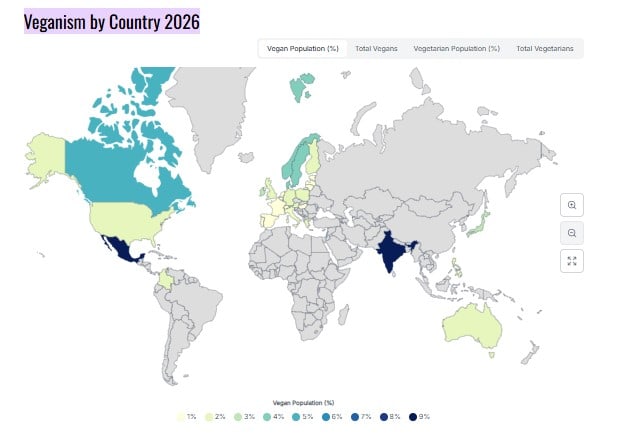
(Source: worldpopulationreview.com)
- India and Mexico have the highest share of vegans, with 9% of their populations following a vegan diet.
- Canada and Israel each report a vegan population of 5%.
- Sweden and Norway complete the list, with 4% of people identifying as vegans.
| Country | Vegan Population Share | Toal Vegans | Veganism Year |
| India | 9% | 121.5M | 2021 |
| Mexico | 9% | 11.3M | 2016 |
| Canada | 5% | 1.8M | 2020 |
| Israel | 5% | 421K | 2015 |
| Sweden | 4% | 415K | 2020 |
| Denmark | 4% | 230K | 2020 |
| Norway | 4% | 215K | 2020 |
| Japan | 3% | 3.5M | 2018 |
| Ireland | 3% | 146.5K | 2018 |
| United States | 2% | 5M | 2023 |
| Philippines | 2% | 2M | 2014 |
| Germany | 2% | 1.7M | 2021 |
| United Kingdom | 2% | 1.4M | 2025 |
| Colombia | 2% | 1M | 2016 |
| Poland | 2% | 536K | 2017 |
| Australia | 2% | 518K | 2018 |
| Greece | 2% | 200K | 2022 |
| Austria | 2% | 180K | 2022 |
| Finland | 2% | 120K | 2021 |
| Italy | 1.6% | 964.8K | 2024 |
| France | 1% | 726K | 2018 |
| Spain | 1% | 380K | 2021 |
| Netherlands | 1% | 150K | 2024 |
| Belgium | 1% | 110K | 2018 |
| Portugal | 1% | 60K | 2017 |
| Hungary | 1% | 90K | 2022 |
| Switzerland | 1% | 85K | 2020 |
| Lithuania | 1% | 27K | 2020 |
| Latvia | 1% | 19K | 2020 |
| Estonia | 1% | 11K | 2020 |
Consumer Adoption of Plant-based Alternatives in 2025
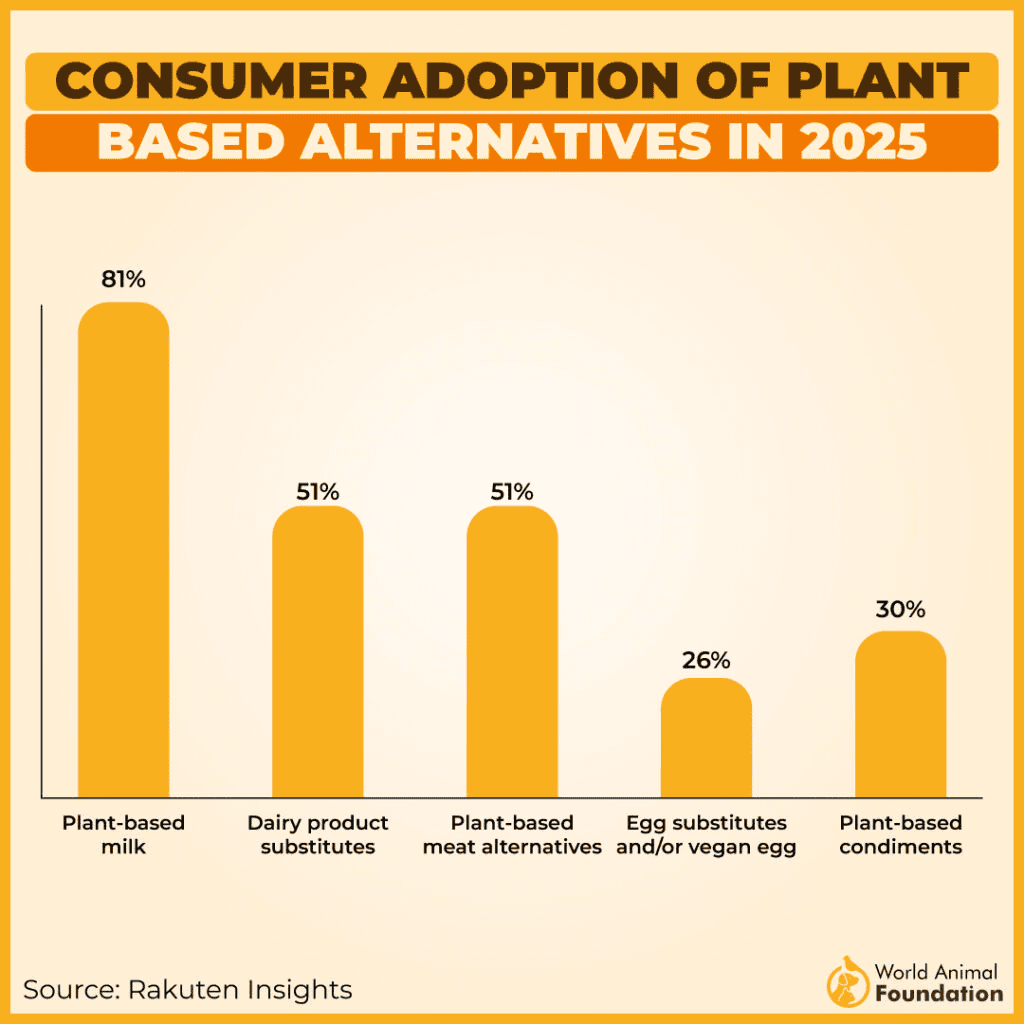
(Source: worldanimalfoundation.org)
- In 2025, plant-based milk shows the highest adoption, used by 81% of surveyed consumers.
- Dairy product substitutes and plant-based meat alternatives are each chosen by 51%.
- Egg substitutes or vegan egg products are adopted by 26% of consumers.
- Plant-based condiments reach 30% adoption.
Share of People Consuming Plant-based Alternatives
- In key Asian markets, Vietnam records the highest share, with 92% of people consuming plant-based alternatives.
- China and Indonesia each show 81% usage.
- The Philippines follows at 70%, while Thailand reaches 71%, and India and Malaysia both report 67%.
- In more mature markets, Singapore and Taiwan each stand at 61%, South Korea at 55%, Hong Kong at 64%, while Japan.
Top 10 Vegan Celebrities Inspiring People in 2026
- Maggie Q uses her platform to encourage vegan diets and animal protection.
- Natalie Portman became vegan in 2011 after being vegetarian since age 9 and actively supports animal rights.
- Travis Barker adopted veganism after surviving a plane crash and co-owns the vegan restaurant Crossroads Kitchen.
- Ariana Grande follows a vegan lifestyle, and all r.e.m. beauty products are vegan and cruelty-free.
- Sadie Sink chose veganism before Stranger Things to support animal welfare.
- RZA is a longtime vegan and promotes compassionate living.
- Alicia Silverstone encourages cruelty-free and vegan living through her advocacy.
- Billie Eilish was named PETA Person of the Year 2021 and supports vegan initiatives.
- Joaquin Phoenix has been vegan since age 3 and avoids animal-derived materials.
- Anitta promotes plant-based meat as a vegan celebrity ambassador.
List of Celebrities Who Have Turned Vegan
| Celebrities | Since when? |
| Moby | 1987 |
| Joaquin Phoenix | Since 3 years old |
| Billie Eilish | Since Childhood |
| Woody Harrelson | More than 30 years |
| Rainn Wilson | Around 2017 |
| Evanna Lynch | 2014 |
| Stevie Wonder | 2016 |
| Elliot Page | 2011 |
| Lewis Hamilton | 2017 |
| Rooney Mara | 2011 |
| Ricky Gervais | Unknown |
| Pamela Anderson | More than 30 years |
| Alan Cumming | 12 years |
| Sia Furler | 2014 |
| Peter Dinklage | 2014 |
| RZA | 1997 |
| Mayim Bialik | At the age of 19 years |
| Fearne Cotton | At the age of 11 years |
| Colin Kaepernick | Revealed in 2016 |
| Sadie Sink | Unknown |
| Leona Lewis | 2012 |
| Lucy Watson | Unknown |
| Joan Jett | During 80s |
| Thandiwe Newton | Unknown |
| Tobey Maguire | 2009 |
| Bryan Adams | 1989 |
| Mýa | From a young age |
| Madelaine Petsch | Since birth |
| Alicia Silverstone | 1998 |
| Natalie Portman | 2008 |
| Daisy Ridley | Unknown |
| Emily Deschanel | At the age of 17 years |
| Kate Mara | Unknown |
| Ruby Rose | Unknown |
| Danielle Brooks | 2017 |
| James Cromwell | While filming Babe |
| Nathalie Emmanuel | Unknown |
| Kevin Smith | Unknown |
| Bimini Bon Boulash | Unknown |
| Rob Zombie | Unknown |
| Romesh Ranganathan | 2013 |
| Will.i.am | 2018 |
| Travis Barker | 2008 |
| Brian May | Unknown |
| Maggie Q | Unknown |
| Theo Rossi | At the age of 22 |
| Christ Packham | Unknown |
| Casey Affleck | 1995 |
| Jenna Dewan | 2013 |
| Jessica Chastain | More than 15 years |
| Daryl Hannah | At the age of 11 |
| Morrissey | 2010 |
| Jared Leto | Unknown |
| Oli Skyes | 2013 |
| Bella Ramsey | Unknown |
| Halle Bailey | Unknown |
| Jessie Cave | 2016 |
| Jon Stewart | 2015 |
| Sam Ryder | Unknown |
| Peter Egan | 2016 |
| Elaine Hendrix | 2006 |
| Aidan Gallagher | From a young age |
| Lizzo | 2020 |
| Jermaine Dupri | Unknown |
| Lee Mack | 2016 |
| Jennifer Coolidge | Unknown |
| Cillian Murphy | Unknown |
| Donna D’Errico | Unknown |
| Jon Richardson | Unknown |
(Source: statista.com)
Key Reasons People Choose Plant-based Diets
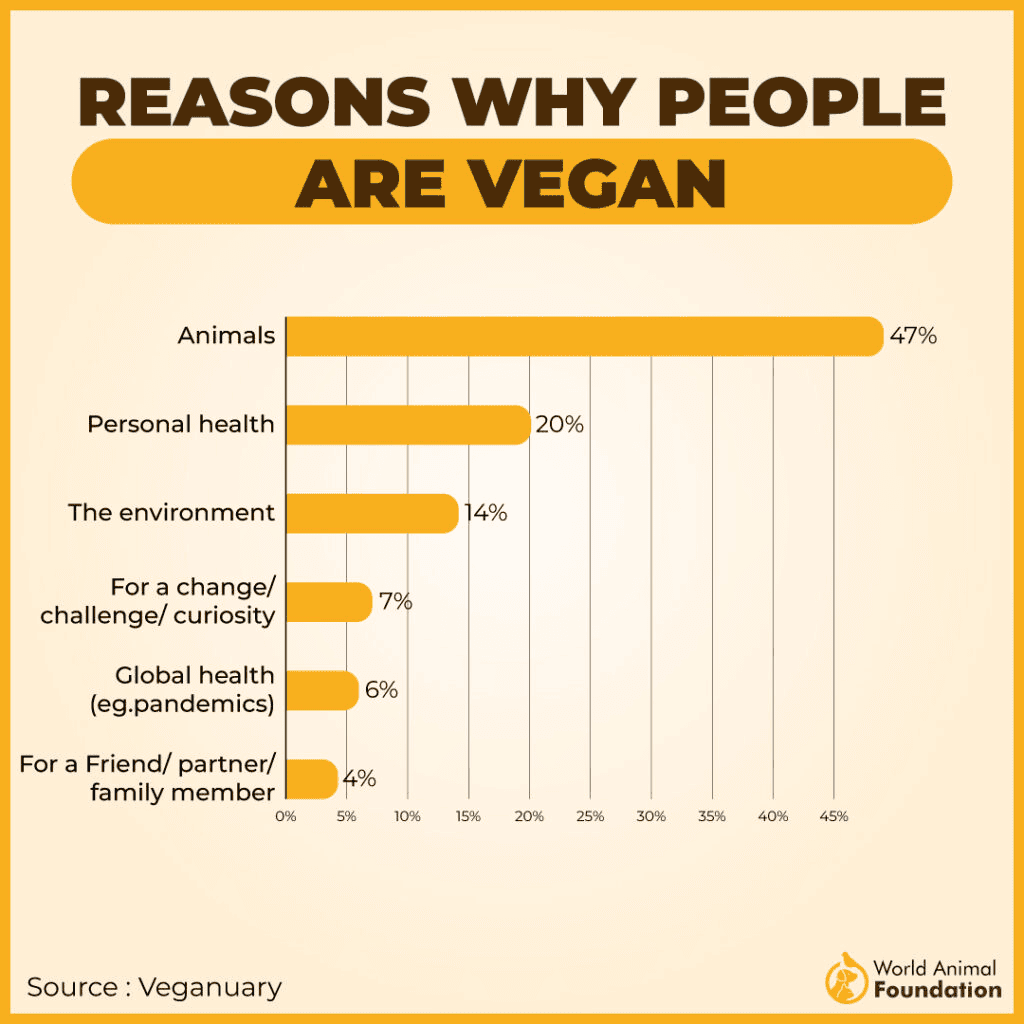
(Source: worldanimalfoundation.org)
- Survey results show that 47% of respondents choose a plant-based diet mainly to protect animals.
- Personal health is the second most common reason, motivating 20% of people to change their eating habits.
- Environmental concerns drive 14% of respondents, linking plant-based choices with lower ecological impact.
- Around 7% adopt these diets for change, challenge, or curiosity, while concerns about global health, such as pandemics, influence 6%.
- Only 4% decide to follow a plant-based diet primarily to support a friend, partner, or family member.
Veganism’s Impact on the Environment and Lifestyle
- Veganism is becoming more common in 2026, helping reduce pressure on land, water, and the climate.
- According to climateaction.org, Animal farming uses about 75% of global agricultural land and contributes to deforestation and biodiversity loss.
- Switching to a vegan diet can lower food-related greenhouse gas emissions by 46%, reduce land use by 33%, and cut water use by 7%, as per frontiersin.org.
- Replacing animal products with plant-based foods could reduce food-related emissions by up to 68% over 15 years and agriculture-related emissions by about 49%.
- Nearly 30% of land biodiversity loss is linked to animal farming.
- Plant-based meat creates about 89% lower environmental impact than conventional meat.
- Nutrithrive report further stated that many consumers now follow a 90%-95% plant-based diet, while searches for plant-based topics and reducetarian diets have increased by about 400% year over year.
- A 1-month vegan diet can save around 33,000 liters of water and spare about 30 animal lives.
Dispelling Myths And Embracing The Truth About Veganism
There are many misconceptions surrounding veganism. Here are some common myths debunked and the truths revealed:
- Myth: Vegans don’t get enough protein.
- Truth: With proper planning, vegans can easily get enough protein from a variety of plant-based sources, such as legumes, nuts, seeds, and whole grains. These options are often packed with protein and other essential nutrients.
- Myth: Vegan diets are bland.
- Truth: Vegan cuisine is vibrant and flavorful, with endless possibilities for creating delicious and exciting dishes. From innovative plant-based meat alternatives to colorful and creative vegetable dishes, vegan meals can be just as satisfying and flavorful as any traditional meal.
- Myth: Being vegan is too expensive.
- Truth: While some specialty vegan products can be pricey, a well-planned vegan diet can be quite affordable. Focusing on whole grains, beans, and seasonal fruits and vegetables can keep grocery costs reasonable. Additionally, many staple vegan ingredients are naturally budget-friendly.
- Myth: Being vegan is all or nothing.
- Truth: Every step towards reducing animal products helps. Consider “Meatless Mondays” or gradually incorporating more plant-based meals into your diet. Even small changes can make a positive difference in your health and the environment.
Closing Remarks
A vegan diet is based on plant foods and avoids all animal products. Many people choose it to improve their health, protect animals, or help the environment. When planned properly, it can provide all the nutrients your body needs.
Eating a mix of fruits, vegetables, whole grains, beans, nuts, and seeds helps maintain a balanced diet. With good planning, a vegan lifestyle can be healthy, simple, and easy to follow for many people.
FAQ
Vegans eat fruits, vegetables, grains, legumes, nuts, seeds, and plant-based alternatives to dairy and meat, such as soy milk, oat milk, tofu, tempeh, and plant-based burgers.
Many vegans need vitamin B12 and sometimes vitamin D, iron, or omega-3 supplements.
Yes, a balanced vegan diet may support weight loss when combined with healthy eating and regular exercise.

Sources